Kubernetes · kubegap
Will Argo CD auto-prune delete your namespace? How to prevent it with Prune=false and Delete=false
Yes, if the Application has automated prune: true and tracks the Namespace. When the Namespace manifest drops out of what Git renders, the next automated sync deletes the Namespace and everything in it. Annotate the Namespace with argocd.argoproj.io/sync-options: Prune=false,Delete=false. In our test on Argo CD v3.2.0 the unannotated Namespace was Pruned 2 min 48 s after the push; the annotated one was PruneSkipped and also survived the deletion of its Application.
What we saw: `Pruned` / `pruned` versus `PruneSkipped` / `ignored (no prune)`
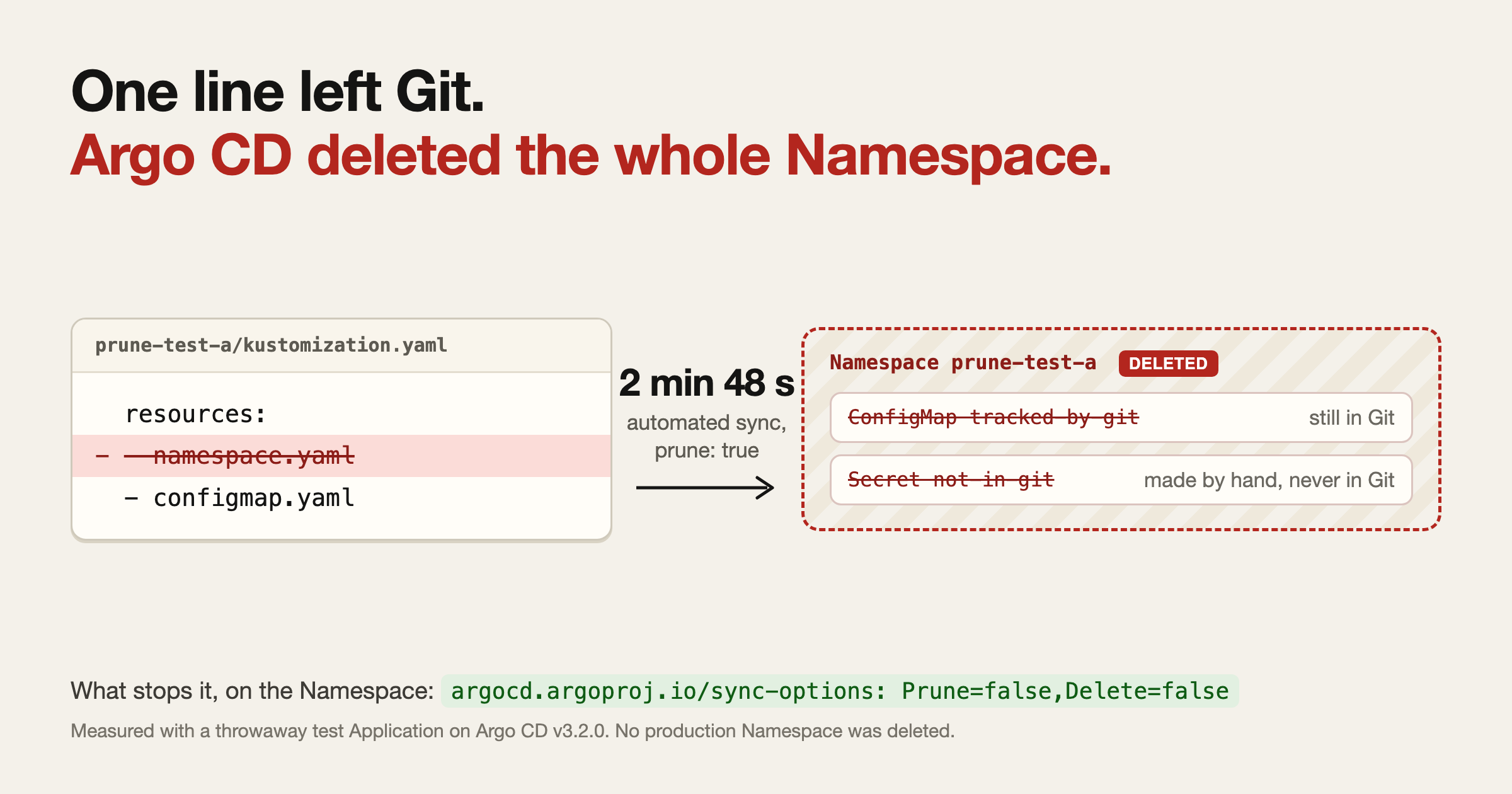
If you searched "argocd deleted namespace", "argocd prune deleted my namespace" or "argocd prevent namespace deletion", run kubectl logs -n argocd sts/argocd-application-controller | grep "Adding resource result". A Namespace that Argo CD has just deleted shows Pruned / pruned; one that it skipped shows PruneSkipped / ignored (no prune). The cause of the first: an Application with automated prune: true tracks its own Namespace (or a CRD), and that object's manifest dropped out of what Git renders, so the next automated sync deleted it with everything inside. The difference between the two results is one annotation on the object, argocd.argoproj.io/sync-options: Prune=false,Delete=false: Prune=false stops the prune, and Delete=false covers the other path, where an ApplicationSet deletes the Application and resources-finalizer.argocd.argoproj.io deletes the resources it tracks. On our cluster an audit found 8 production Namespaces and 23 CRDs exposed this way. Nothing was deleted in production: we reproduced both deletion paths with throwaway test Applications, then fixed the manifests. Below are the raw output of that test, the Argo CD source lines that decide which annotation blocks which path, why the auto-sync will wipe out all resources protection (allowEmpty) does not cover one removed manifest, read-only checks with the value that means you have the same problem, and what we changed and did not change, including an argocd_app_info{sync_status="OutOfSync"} alert. The cluster is a 2-node k3s cluster (k3s v1.33.5+k3s1) running Argo CD v3.2.0, with the manifests repository on GitHub; all times are UTC, 2026-11-14.
The finding
The finding came from a full run of kubegap v0.3.0, an open-source audit of Kubernetes cluster operations, taken at 16:25:29. Its problem 3, translated from Korean: "Argo CD apps with prune enabled manage a Namespace and CRDs." The reason it gave: if one manifest drops out of Git or a path changes, Argo CD can delete a production namespace with the PVCs and Secrets in it, or delete the Istio and Gateway API CRDs and with them every object of those kinds. The report counted 9 of 11 production Applications with automated prune: true that track a Namespace or CRD: 8 track one Namespace each, and istio tracks 23 CRDs. All 9 have selfHeal and the finalizer resources-finalizer.argocd.argoproj.io. The report had not opened the repository; it inferred that the Git directories contain a Namespace manifest.
At 19:11 we ran the check ourselves (names masked, CRD lines shortened):
$ kubectl get applications.argoproj.io -A -o json | jq -r '.items[] | select(.spec.syncPolicy.automated.prune==true) | .metadata.name as $n | .status.resources[]? | select(.kind=="Namespace" or .kind=="CustomResourceDefinition") | $n+" "+.kind+"/"+.name'
prod-a Namespace/prod-a
prod-j Namespace/prod-j
prod-k Namespace/prod-k
prod-c Namespace/prod-c
prod-g Namespace/prod-g
istio CustomResourceDefinition/authorizationpolicies.security.istio.io
istio CustomResourceDefinition/backendtlspolicies.gateway.networking.k8s.io
istio CustomResourceDefinition/destinationrules.networking.istio.io
istio CustomResourceDefinition/envoyfilters.networking.istio.io
... 19 more CustomResourceDefinition lines for istio
prod-i Namespace/prod-i
prod-l Namespace/prod-l
prod-h Namespace/prod-h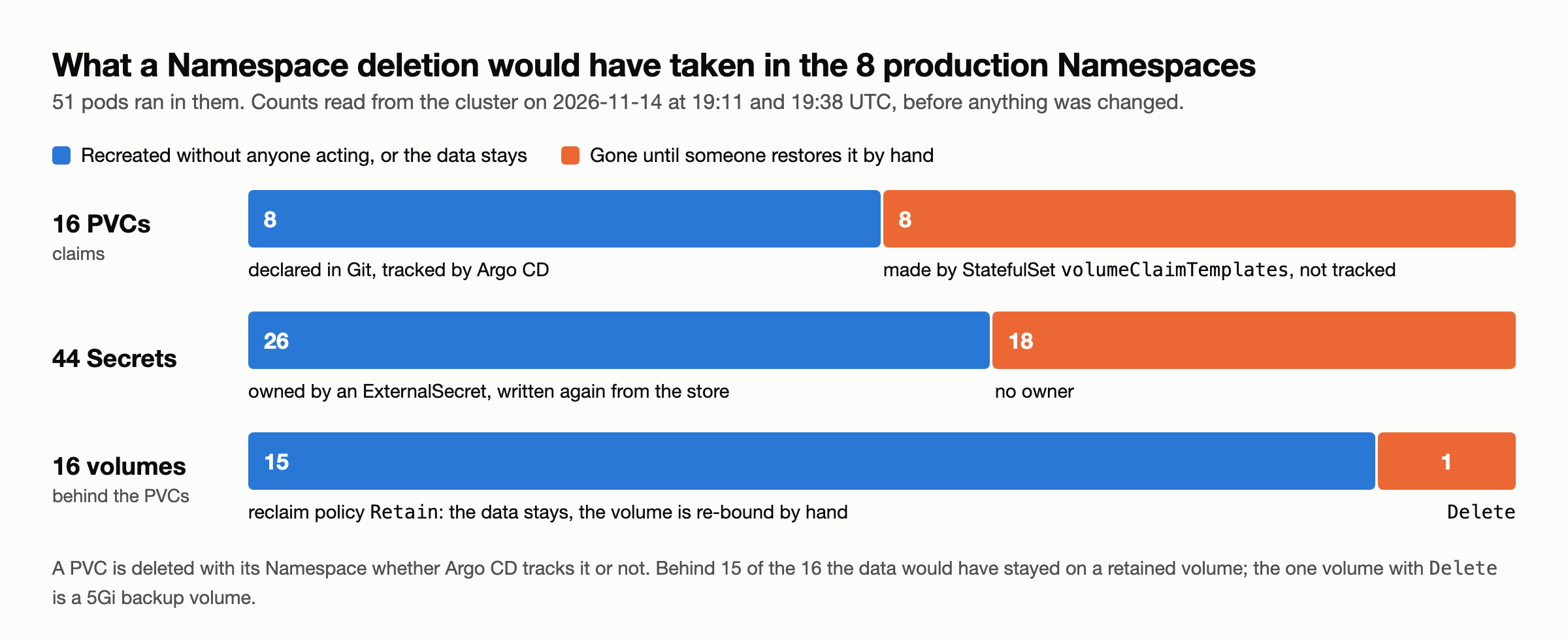
The rest of what we read at 19:11:
- The cluster has 22 Applications. 21 have automated prune: true. 15 are generated by one ApplicationSet, prod-apps, and 7 are tracked by an Application named root.
- None of the 8 Namespaces had an argocd.argoproj.io/sync-options annotation. Each had the tracking annotation argocd.argoproj.io/tracking-id: <app>:/Namespace:/<name>.
- The inference of the report was right: the manifests repository has a Namespace manifest in each of the 8 directories, 7 as a namespace.yaml listed in kustomization.yaml and one inside a larger manifest file.
- prod-apps uses a git directory generator on prod/*. Its template has prune: true, selfHeal: true, CreateNamespace=true, no finalizers, and the ApplicationSet has no spec.syncPolicy. The generated Applications carry resources-finalizer.argocd.argoproj.io all the same, and they have no destination.namespace; the namespace comes from namespace: in each kustomization.
- The 8 namespaces held 51 pods, 16 PVCs and 44 Secrets. Counted later, at 19:38: 8 of the 16 PVCs are not tracked by Argo CD (they come from StatefulSet volumeClaimTemplates), 26 of the 44 Secrets are owned by an ExternalSecret and 18 have no owner. Of the 16 PersistentVolumes bound in those namespaces, 15 have reclaim policy Retain and 1 has Delete (a 5Gi backup volume).
- The 23 CRDs come from two sources: the Istio base chart 1.30.8, whose CRDs carried helm.sh/resource-policy: keep and no sync-options, and Gateway API v1.5.1 from a kustomize remote, whose CRDs carried neither. In the listing taken at 19:11:07, 15 CRDs show keep and 8 show no annotation. Custom objects existed under 7 of the 23 kinds: gatewayclasses 2, gateways.gateway.networking.k8s.io 1, httproutes 3, destinationrules 1, peerauthentications 1, telemetries 1, virtualservices 1.
- Prometheus had no argocd_app_info series, no rule mentioning argocd_, and there was no ServiceMonitor for Argo CD.
The test
We did not remove anything from a production directory to find out. We added three throwaway directories under prod/, each a kustomization with a Namespace and one ConfigMap: prune-test-a and prune-test-c without any annotation, prune-test-b with argocd.argoproj.io/sync-options: Prune=false,Delete=false on the Namespace. The commit was pushed at 19:13:54. The ApplicationSet created the three Applications at 19:14:36, and all three were Synced and Healthy by 19:14:47, each tracking ConfigMap/tracked-by-git and its Namespace, each with the finalizer. At 19:14:45 we created a Secret named not-in-git by hand in each of the three namespaces, as a stand-in for objects that exist only in the cluster.
Step 1: the Namespace manifest leaves Git. At 19:15:03 we pushed a commit that removes namespace.yaml, and its line in kustomization.yaml, from prune-test-a and prune-test-b. The application controller log (commit replaced by <commit>):
prune-test-a
19:17:51  Initiated automated sync to [<commit>]
19:17:51  Adding resource result, status: 'Pruned', phase: 'Succeeded', message: 'pruned'
19:18:00  Adding resource result, status: 'SyncFailed', phase: 'Failed', message: 'namespaces "prune-test-a" not found'

prune-test-b
19:18:10  Initiated automated sync to [<commit>]
19:18:10  Adding resource result, status: 'PruneSkipped', phase: 'Succeeded', message: 'ignored (no prune)'
19:18:11  Sync operation to <commit> succeeded
At 19:18:40:
$ kubectl get configmap,secret -n prune-test-a
No resources found in prune-test-a namespace.
$ kubectl get configmap,secret -n prune-test-b
configmap/istio-ca-crl         1     4m3s
configmap/istio-ca-root-cert   1     4m3s
configmap/kube-root-ca.crt     1     4m3s
configmap/tracked-by-git       1     4m3s
secret/not-in-git   Opaque   1     3m56s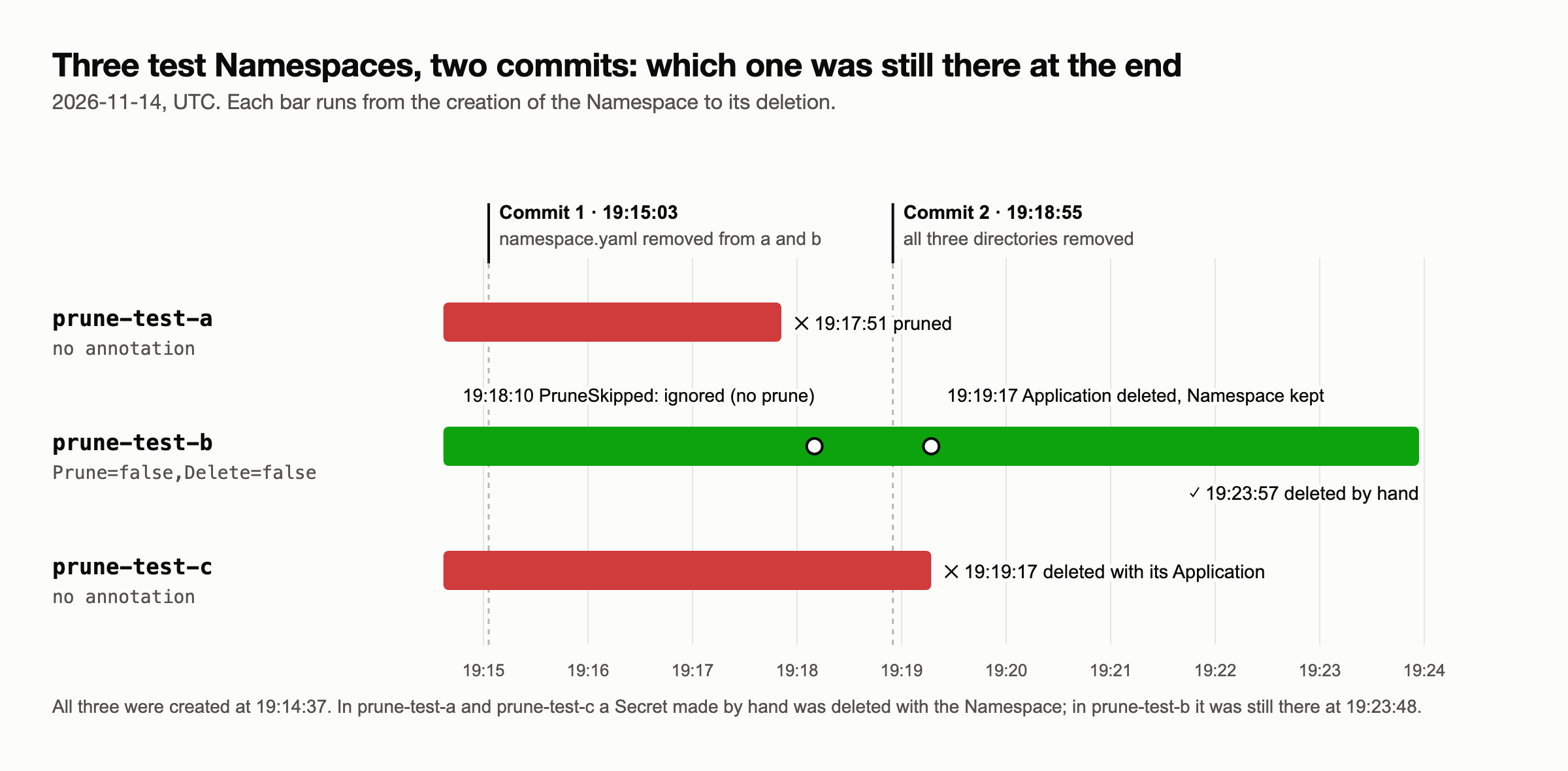
Namespace prune-test-a got its deletionTimestamp at 19:17:51, 2 min 48 s after the push, and was gone at the 19:18:05 sample. No webhook is configured (inferred from the controller log line "comparison expired"); the controller picked the commit up on its own refresh interval. The Secret we had made by hand went with the namespace.
The Application prune-test-a did not recover. It still had a ConfigMap to apply into a namespace that no longer existed (status at 19:18:40, trimmed):
"sync": "OutOfSync",
"health": "Missing",
"message": "one or more objects failed to apply, reason: namespaces \"prune-test-a\" not found. Retrying attempt #3 at 7:18PM."
It retried 5 times until 19:23:10. The namespace was not recreated although the Application has CreateNamespace=true. My reading is that this is because the generated Applications have no destination.namespace (inference; we did not test it separately).
prune-test-b at 19:18:40: operation Succeeded, application OutOfSync / Healthy, and in status.resources the Namespace is OutOfSync with requiresPruning: true. The Namespace was Active with the same uid and the same creationTimestamp (19:14:37), and both tracked-by-git and not-in-git were present.
Step 2: the directories are removed. At 19:18:55 we pushed a commit that removes all three directories. The result is in the next section, with the code that explains it: prune-test-c was deleted with its Application, and prune-test-b stayed.
Why
A tracked Namespace is an ordinary resource to prune
An Application tracks a Namespace when a Namespace manifest is part of what its source renders. Ours had one in every directory, so each Application listed its own Namespace in status.resources.
The Argo CD documentation for automated sync says: "By default (and as a safety mechanism), automated sync will not delete resources when Argo CD detects the resource is no longer defined in Git." With prune: true in the automated policy, it does. The only built-in protection left is this one: "automated sync with prune have a protection from any automation/human errors when there are no target resources." In the source that check, which reports auto-sync will wipe out all resources, fires only when every resource of the Application needs pruning and allowEmpty is false. If one manifest drops out and the rest still render, it does not fire. That is the case of prune-test-a: the ConfigMap stayed in Git, the Namespace manifest left, and the Namespace was pruned.
What is deleted together with a Namespace or a CRD is decided by Kubernetes, not by Argo CD. The Kubernetes documentation on deleting a namespace: "This deletes _everything_ under the namespace!" On deleting a CRD: "the server will uninstall the RESTful API endpoint and delete all custom objects stored in it." Everything under the namespace includes objects Argo CD never tracked, which is what happened to the hand-made Secret in prune-test-a.
Prune is stopped by one annotation only
This is pruneObject in gitops-engine at the commit that Argo CD v3.2.0 pins (pkg/sync/sync_context.go):
func (sc *syncContext) pruneObject(liveObj *unstructured.Unstructured, prune, dryRun bool) (common.ResultCode, string) {
	if !prune {
		return common.ResultCodePruneSkipped, "ignored (requires pruning)"
	} else if resourceutil.HasAnnotationOption(liveObj, common.AnnotationSyncOptions, common.SyncOptionDisablePrune) {
		return common.ResultCodePruneSkipped, "ignored (no prune)"
	}
	if dryRun {
		return common.ResultCodePruned, "pruned (dry run)"
	}
	...
	return common.ResultCodePruned, "pruned"
}
It returns without deleting in two cases: the sync ran without prune (ignored (requires pruning)), or the live object has Prune=false in argocd.argoproj.io/sync-options (ignored (no prune), result code PruneSkipped). helm.sh/resource-policy is not checked there, and neither is the kind of the object.
Deleting the Application is a second path, with different exemptions
The Argo CD documentation on the finalizer: "When deleting an Application with this finalizer, the Argo CD application controller will perform a cascading delete of the Application's resources." For ApplicationSets, the documentation says generated Applications get the finalizer "if .syncPolicy.preserveResourcesOnDeletion is set to false", and that preserveResourcesOnDeletion: true "prevents the finalizer from being added to the Application". The source (applicationset/utils/utils.go lines 272–280) adds the finalizer when the template has none and syncPolicy is absent or preserveResourcesOnDeletion is false. Our ApplicationSet had no syncPolicy, which is why every generated Application carried the finalizer without our having written it anywhere.
With a git directory generator, the Application is deleted when the generator no longer produces an Application of that name: the directory was removed, renamed or moved out of the pattern. What the cascade then deletes is decided by shouldBeDeleted (controller/appcontroller.go lines 1165–1170 in v3.2.0):
// shouldBeDeleted returns whether a given resource obj should be deleted on cascade delete of application app
func (ctrl *ApplicationController) shouldBeDeleted(app *appv1.Application, obj *unstructured.Unstructured) bool {
	return !kube.IsCRD(obj) && !isSelfReferencedApp(app, kube.GetObjectRef(obj)) &&
		!resourceutil.HasAnnotationOption(obj, synccommon.AnnotationSyncOptions, synccommon.SyncOptionDisableDeletion) &&
		!resourceutil.HasAnnotationOption(obj, helm.ResourcePolicyAnnotation, helm.ResourcePolicyKeep)
}
It returns false for a CRD, for the Application's self-reference, for an object with Delete=false, and for an object with helm.sh/resource-policy: keep. Prune=false is not in this function.
Step 2 of the test, at 19:19:17 (ApplicationSet controller first, then the application controller):
19:19:17  prune-test-c  Deleted application
19:19:17  prune-test-a  Deleted application
19:19:17  prune-test-b  Deleted application
19:19:17  prune-test-c  Deleting application's resources with Foreground propagation policy
19:19:17  prune-test-c  2 objects remaining for deletion
19:19:17  prune-test-b  Deleting application's resources with Foreground propagation policy
19:19:17  prune-test-b  1 objects remaining for deletion
At 19:23:48 (the prune-test-a lines left out; that namespace had been deleted in step 1):
$ kubectl get applications -n argocd | grep prune-test
(none)
$ kubectl get ns | grep prune-test
prune-test-b          Active   9m11s
$ kubectl get configmap,secret -n prune-test-c
No resources found in prune-test-c namespace.
$ kubectl get configmap,secret -n prune-test-b
configmap/istio-ca-crl         1     9m11s
configmap/istio-ca-root-cert   1     9m11s
configmap/kube-root-ca.crt     1     9m11s
secret/not-in-git   Opaque   1     9m4s
Namespace prune-test-c got its deletionTimestamp at 19:19:17 and was gone at the 19:19:27 sample, with its hand-made Secret. For prune-test-b the controller counted 1 object for deletion, not 2: the Namespace kept the same uid, and the Secret not-in-git was still in it. The ConfigMap tracked-by-git, which was tracked and had no annotation, was deleted by the cascade. Delete=false on the Namespace protects the Namespace and whatever Argo CD does not track inside it; it does not protect the other tracked resources of the Application. The ApplicationSet controller logged Deleted application for prune-test-a at 19:19:17 as well, but the Application stayed until 19:23:10: its finalizer ran only after the sync operation failed (5 retries), and it then deleted 0 resources.
The two paths against the four protections
| Automated prune (manifest leaves Git) | Cascade (Application deleted with the finalizer) | |
|---|---|---|
Prune=false on the object | Skipped: PruneSkipped / ignored (no prune) | Not checked: deleted |
Delete=false on the object | Not checked: pruned | Skipped |
helm.sh/resource-policy: keep on the object | Not checked: pruned | Skipped |
| The object is a CRD | No exemption: pruned unless it has Prune=false | Skipped, with or without any annotation |
The table is read from the two functions above. Our test confirmed the Namespace cases with both options set together (skipped on both paths) and with neither (deleted on both paths). The conclusions that follow are inferences from the source: a CRD can be deleted by Argo CD through prune and not through the cascade; keep does not stop prune; a Namespace needs Prune=false against prune and Delete=false against the cascade.
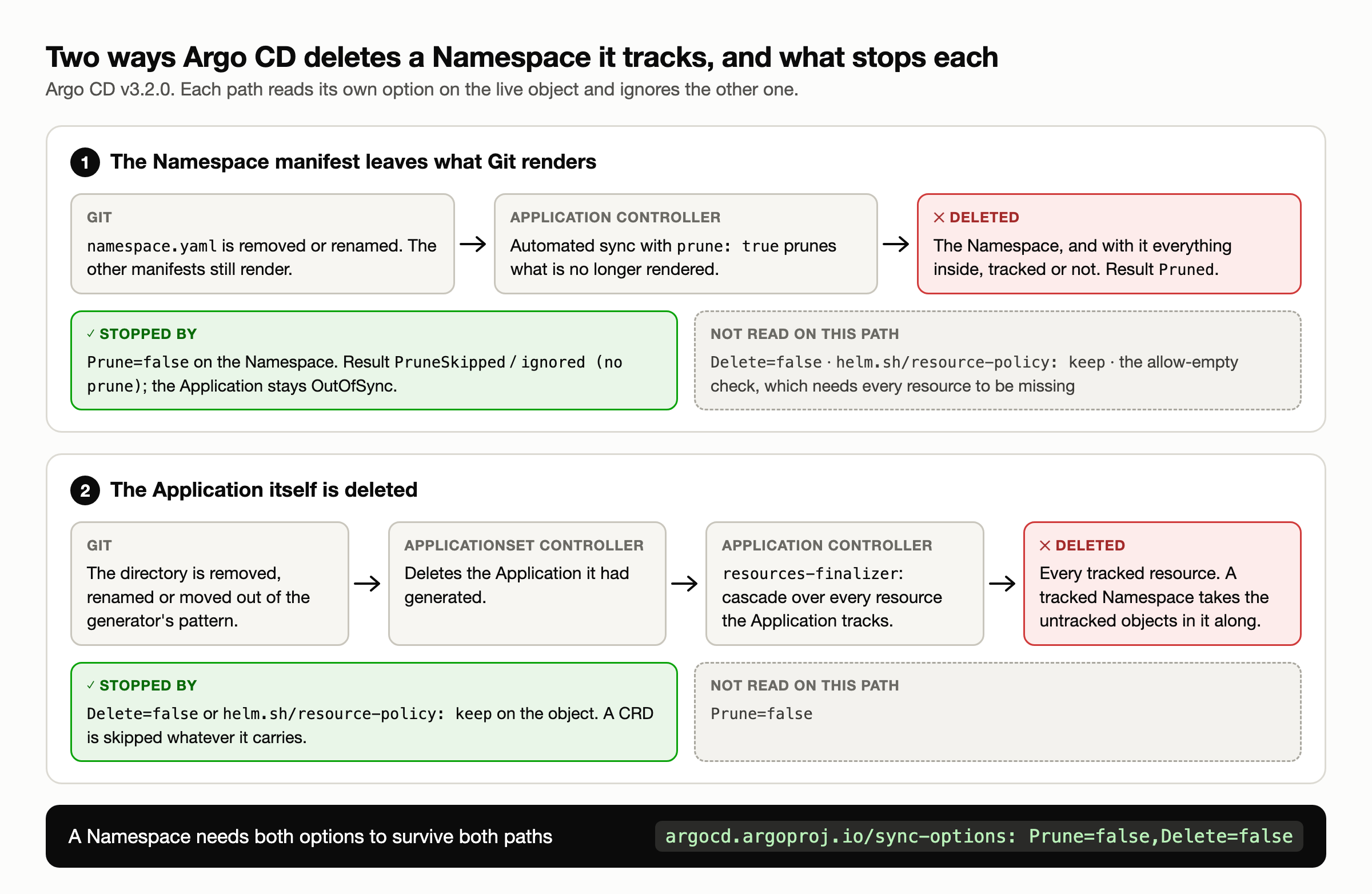
One thing I had wrong before reading the source: I took the helm.sh/resource-policy: keep on the Istio CRDs for what protects them when the Application is deleted. CRDs are skipped by the cascade with or without any annotation, so keep adds nothing for a CRD on that path, and it does nothing on the prune path.
What to check in your cluster now
Checks 1 to 4 are read-only and need kubectl and jq. Check 5 changes Git and the cluster.
1. Applications with automated prune that track a Namespace or a CRD, and whether that object is protected
kubectl get applications.argoproj.io -A -o json | jq -r '
  .items[] | select(.spec.syncPolicy.automated.prune==true) | .metadata.name as $app |
  .status.resources[]? | select(.kind=="Namespace" or .kind=="CustomResourceDefinition") |
  "\($app) \(.kind) \(.name)"' |
while read app kind name; do
  opt=$(kubectl get "$kind" "$name" -o json | jq -r '.metadata.annotations["argocd.argoproj.io/sync-options"] // "-"')
  echo "$app $kind/$name sync-options=$opt"
done
Same problem if: a line ends in sync-options=-, or the value has no Prune=false. (Prune=confirm makes the sync wait for a confirmation; we did not test it.) That Application will delete that Namespace or CRD on the next automated sync after its manifest drops out of the rendered output. Before the fix we had 31 such lines: 8 Namespaces in 8 Applications and 23 CRDs in one. A Namespace line whose value has Prune=false but not Delete=false is still open to check 2 (CRDs are not: the cascade skips them).
No output at all means no Application with automated prune tracks a Namespace or CRD.
If you do not want to repeat this by hand after every change, kubegap does it. kubegap is an open-source audit that reads the cluster your kubectl points at and writes a report of what will hurt in operation, with the evidence for each item. Its run at 16:25:29 is where this problem was found: it listed the 9 Applications. With the change we made to it afterwards ("kubegap after the fix" below) it opens each Namespace and CRD an Application tracks and lists, by name, the ones automated prune would delete and the Namespaces that would be deleted with their Application. It reads the annotations the way the installed Argo CD version does, and an object that is already protected is not listed. That covers check 1 and the Namespace part of check 2.
2. Applications whose tracked resources are deleted when the Application is deleted
kubectl get applications.argoproj.io -A -o json | jq -r '
  .items[] | [.metadata.name,
    ((.metadata.finalizers // []) | join(",")),
    ((.metadata.ownerReferences // []) | map(.kind+"/"+.name) | join(","))] | @tsv'
kubectl get applicationsets.argoproj.io -A -o json | jq -r '
  .items[] | [.metadata.name, (.spec.syncPolicy | tostring)] | @tsv'
Same problem if: an Application has resources-finalizer.argocd.argoproj.io and is owned by an ApplicationSet whose syncPolicy is null (or has neither preserveResourcesOnDeletion: true nor an applicationsSync policy of create-only or create-update). When the generator stops producing that Application (for a git directory generator: the directory is renamed, moved or removed), the ApplicationSet controller deletes the Application and, because of the finalizer, the application controller deletes every resource the Application tracks. A Namespace it tracks goes too unless it carries Delete=false (or helm.sh/resource-policy: keep). CRDs are skipped by this path. Ours printed prod-apps null at 19:39, after the fix; the ApplicationSet was not changed.
3. What is deleted with a Namespace and cannot be recreated from Git
NS=<namespace>; APP=<application>
kubectl get pvc -n "$NS" -o json | jq -r '.items[].metadata.name' | sort > /tmp/pvc-all
kubectl get application "$APP" -n argocd -o json |
  jq -r '.status.resources[] | select(.kind=="PersistentVolumeClaim") | .name' | sort > /tmp/pvc-tracked
comm -23 /tmp/pvc-all /tmp/pvc-tracked           # PVCs Argo CD does not track
kubectl get secret -n "$NS" -o json |
  jq -r '.items[] | select(.metadata.ownerReferences==null) | .metadata.name'   # Secrets nothing would recreate
kubectl get pv -o json | jq -r --arg ns "$NS" '
  .items[] | select(.spec.claimRef.namespace==$ns) |
  "\(.spec.claimRef.name) \(.spec.persistentVolumeReclaimPolicy)"'
Same problem if: the first list is not empty (PVCs made from a StatefulSet's volumeClaimTemplates are the usual case), or the second list has Secrets you created by hand, or a PV shows Delete. A PVC is deleted with its Namespace; with reclaim policy Delete the volume's data is deleted too, with Retain the PersistentVolume stays and has to be re-bound by hand. Ours: 16 PVCs in the eight namespaces, 8 of them not tracked; 44 Secrets, 18 without an owner; 15 volumes Retain, 1 Delete.
4. Would anyone notice an Application that stays OutOfSync?
Prune=false turns "the Namespace is deleted" into "the Application stays OutOfSync". That only helps if someone is told.
kubectl get prometheusrules -A -o json | jq -r '
  .items[] | (.metadata.namespace+"/"+.metadata.name) as $r | .spec.groups[].rules[] |
  select((.expr|tostring)|test("argocd_app_info")) | "\($r) \(.alert // .record)"'
and in Prometheus: count by (sync_status) (argocd_app_info).
Same problem if: the first command prints nothing, or the query returns no series (the application controller's metrics port, 8082, is not scraped). Both were true on our cluster before the fix.
5. Test it with a throwaway Application (changes Git and the cluster)
In the repository your Applications read, add three directories, each with a Namespace manifest and one ConfigMap; give only b the annotation:
apiVersion: v1
kind: Namespace
metadata:
  name: prune-test-b
  annotations:
    argocd.argoproj.io/sync-options: Prune=false,Delete=false
After the three Applications are Synced, create one object by hand in each namespace (kubectl create secret generic not-in-git --from-literal=note=x -n prune-test-a), then:
- Remove
namespace.yaml(and its line inkustomization.yaml) fromaandb, push, wait for the automated sync.kubectl get ns | grep prune-testandkubectl get application prune-test-b -n argocd -o json | jq '.status.operationState.syncResult.resources'; thePrunedresult ofprune-test-ais in the controller log (kubectl logs -n argocd sts/argocd-application-controller | grep "Adding resource result"), not in the Application status - Remove all three directories, push, wait for the Applications to disappear.
kubectl get ns | grep prune-testandkubectl get secret -n prune-test-b kubectl delete ns prune-test-b
Protected if: after 1, prune-test-a is gone and prune-test-b is Active with the result PruneSkipped / ignored (no prune); after 2, prune-test-c is gone and prune-test-b is still Active with the hand-made Secret in it.
What we changed, and what we have not
Changed
Three commits, pushed at 19:24:03. (The comment in the second one first gave the CRD split as 13 and 10; a follow-up commit at 20:27:55 corrected it to the 15 and 8 shown below.)
1. `Prune=false,Delete=false` on the 8 Namespace manifests. The manifests stay in Git. The report offered two ways: take the Namespace manifest out of Git and rely on CreateNamespace=true, or keep it and annotate. I kept it, because taking the manifest out is the very change that triggers the prune, and it would have to be preceded by the annotation in any case.
apiVersion: v1
kind: Namespace
metadata:
  name: prod-a
  annotations:
    argocd.argoproj.io/sync-options: Prune=false,Delete=false
2. `prune: false` in the automated policy of Application `istio`. The Istio base chart 1.30.8 has no value that adds annotations to its CRDs; its CRD-related values are base.excludedCRDs, base.enableCRDTemplates and base.enableIstioConfigCRDs. Automated prune is the only path we found in the source by which an automated sync deletes a CRD (a manual sync with force or replace was not tested), so turning prune off for the one Application that tracks them closes that path.
# argocd-apps/istio.yaml
spec:
  syncPolicy:
    automated:
      # prune is off: this Application owns 23 CRDs (15 from the istio base chart, 8 Gateway API). A CRD that drops out
      # of the render would be pruned together with every object of that kind, and the base chart has no value to put
      # Prune=false on its CRDs. After a chart upgrade, delete resources the new version no longer renders by hand.
      prune: false
      selfHeal: true
3. A scrape of the Argo CD application controller and an alert.
apiVersion: monitoring.coreos.com/v1
kind: ServiceMonitor
metadata:
  name: argocd-metrics
  namespace: monitoring
  labels:
    release: kube-prometheus-stack
spec:
  namespaceSelector:
    matchNames: [argocd]
  selector:
    matchLabels:
      app.kubernetes.io/name: argocd-metrics
  endpoints:
    - port: metrics
---
apiVersion: monitoring.coreos.com/v1
kind: PrometheusRule
metadata:
  name: argocd-rules
  namespace: monitoring
  labels:
    release: kube-prometheus-stack
spec:
  groups:
    - name: argocd.rules
      rules:
        - alert: ArgoAppOutOfSync
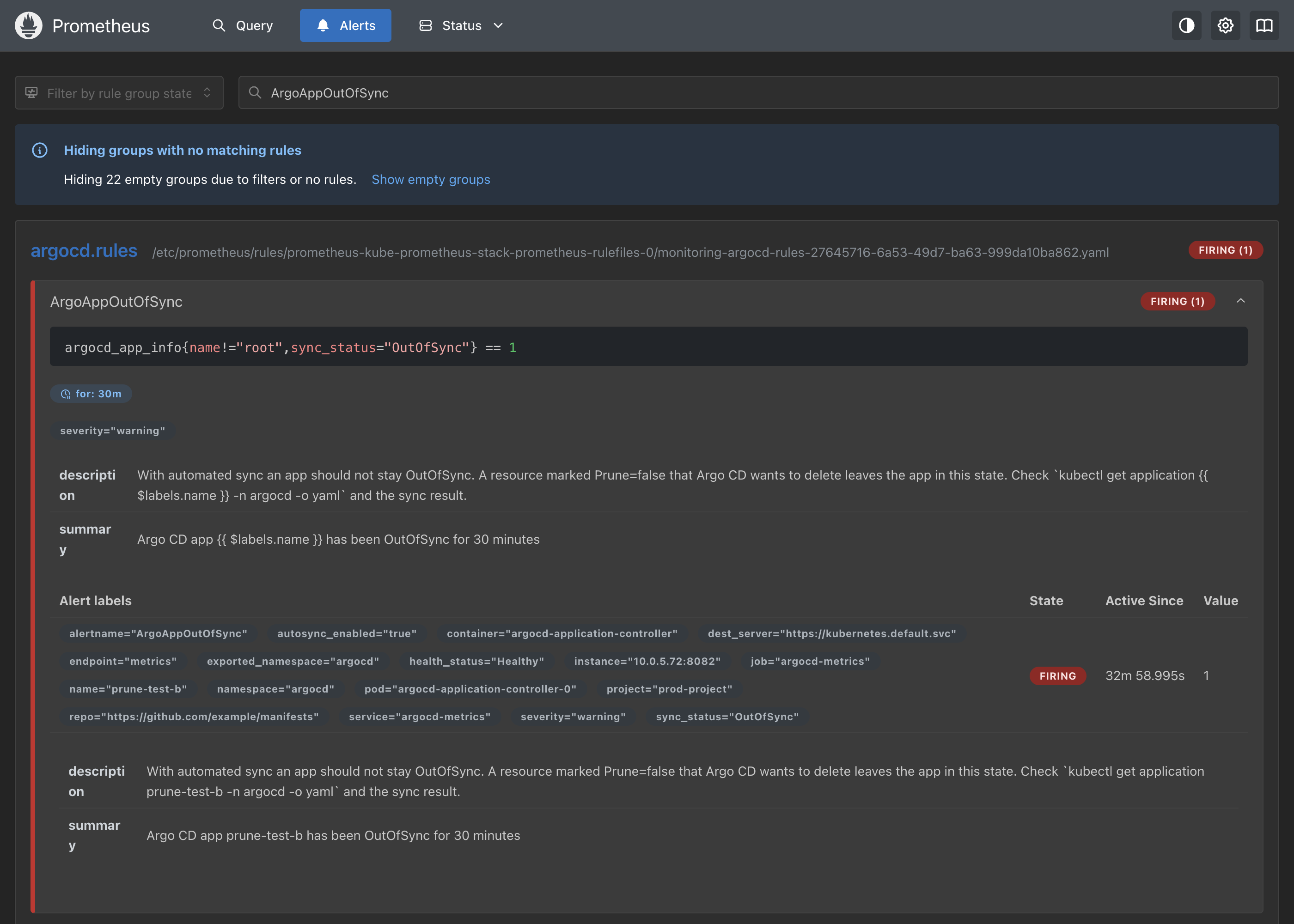
          expr: argocd_app_info{sync_status="OutOfSync", name!="root"} == 1
          for: 30m
          labels:
            severity: warning
root is excluded because it is permanently OutOfSync for an unrelated reason: one Application is defined both in argocd-apps/ and by the ApplicationSet. That is not fixed here.
State after. At 19:31 all 8 live Namespaces carried Prune=false,Delete=false and were Active with their original creationTimestamp; istio had automated: {prune: false, selfHeal: true}; the 8 Applications and istio were Synced. At 19:39:18 check 1 printed 8 lines, each ending sync-options=Prune=false,Delete=false, and no CRD line. At 19:37:38, after the monitoring Application had synced (its first Helm hook pod waited about 9 minutes on an image pull), up{job="argocd-metrics"} was 1, count by (sync_status) (argocd_app_info) returned Synced 21 and OutOfSync 1 (root), and the rule ArgoAppOutOfSync was loaded and inactive.
The alert, tested. At 19:43:12 we pushed prune-test-b again, with the annotated Namespace, and at 19:44:43 removed its namespace.yaml. The alert ArgoAppOutOfSync{name="prune-test-b"} became pending at 19:48:49 and fired at 20:18:49, 30 minutes later. Alertmanager shows it active from 20:18:49 with receiver discord. At 20:19:02 the Application was OutOfSync / Healthy, the Namespace result was PruneSkipped / ignored (no prune), and the Namespace was Active, 34 minutes old. We then removed the directory and deleted the Namespace by hand.
What it costs
The Argo CD documentation says of Prune=false: "The app will be out of sync if Argo CD expects a resource to be pruned." We saw two consequences.
- The Application stays OutOfSync until someone puts the manifest back or deletes the object by hand. A Namespace you do want removed now has to be deleted by hand, as we did with prune-test-b.
- The controller keeps starting sync operations. In the first test prune-test-b started 5 sync operations in 28 s (19:18:10, :12, :14, :20, :38), and the controller logged growing waits between them ("retrying in 1.25s", "5.65s", "17.66s", "53.60s"). In the alert test it logged "Initiated automated sync" 26 times for the Application between 19:44:20 (the initial sync) and 20:17:16.
kubegap after the fix
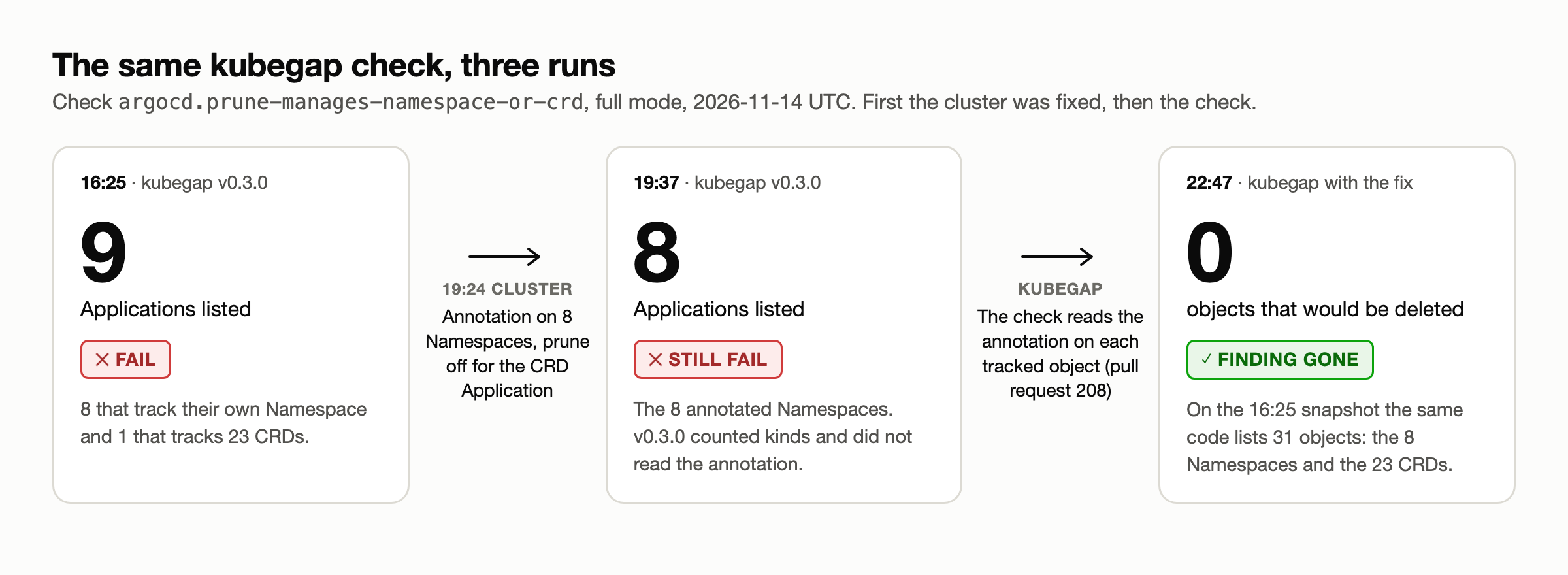
A full kubegap v0.3.0 run at 19:37:43, after our fix: its list prune_with_namespace_or_crd went from 9 Applications to 8 (istio was gone), and the finding argocd.prune-manages-namespace-or-crd.cluster was still fail for the 8 Applications whose Namespace now carried Prune=false,Delete=false. Version 0.3.0 counted the kinds an Application with prune tracks and did not read the annotation (lib/summaries/argocdctl.py lines 173–174 and 289). The check's own suggestion is that annotation, and a problem that has been fixed has to be gone from the next run, so this was a defect of the check. We filed it as kubegap issue 207 and fixed it in pull request 208: the summary now opens each tracked Namespace and CRD and judges it as the installed Argo CD version does, Prune=false against prune, Delete=false or helm.sh/resource-policy: keep against the cascade, and no CRD on the cascade path.
A full run with that change at 22:47:56 lists no object for prune and no Namespace for the cascade, and the finding is gone. The same code on the snapshot taken at 16:25:29, before our fix, lists 9 Applications, 31 objects for prune (the 31 lines of our check at 19:11) and 8 Namespaces for the cascade. Until a kubegap release contains pull request 208, version 0.3.0 keeps reporting an annotated Namespace; confirm it with check 1 above.
Not changed, and what stays exposed
- `preserveResourcesOnDeletion` on the ApplicationSet. Deleting a directory still deletes that Application's tracked Deployments, Services and Git-declared PVCs. Only the Namespace and what Argo CD does not track in it survive, as the prune-test-b result shows.
- `Prune=confirm` / `Delete=confirm`. Not adopted and not tested; with these values Argo CD waits for a confirmation before it prunes or deletes the object.
- The `root` Application's own prune. Unchanged; root still has automated prune: true. It tracks Applications, and the 19:11 check printed no Namespace or CRD line for it.
- The other Applications. 20 of the 22 Applications still have automated prune: true. The annotation protects the 8 Namespaces, not the Deployments, Services or PVCs those Applications declare.
Limits
- A manual sync with force or replace was not tested. A record in the Incident Library, a public collection of incident write-ups (IL-0058, from GitHub issue argoproj/argo-cd#28630, which we did not open; it is the third case under "Public cases where Argo CD deleted resources" below), reports that Prune=false did not stop a force sync from deleting and recreating a Namespace. Our fix does not cover that path.
- Pruning of a CRD was not reproduced. What we say about CRDs is from the Argo CD source and the Kubernetes documentation.
- Whether argocd app sync --prune on v3.2.0 exits with resources require pruning on a Prune=false resource was not tested.
- No Argo CD web UI screen was captured, so the result texts in this article are from the Application status and the controller log, not from the UI panel.
- Whether the Discord message arrived was not looked at. What is confirmed is that Alertmanager holds the alert as active for that receiver.
Public cases where Argo CD deleted resources
The Incident Library is a searchable collection of public post-incident reports. Each case is classified by symptom, component and cause, so you can look up who else had the failure you are looking at and what they changed afterwards. Filtered to the component Argo CD and the symptom "resources deleted" it has three cases, each of them Argo CD deleting resources after a configuration change. The summaries below are the library's records; of the three linked sources we opened the InfluxData post. None of them is a Namespace manifest dropping out of a kustomize render; the triggers differ.
- InfluxData, 2022-06-24: a pull request gave a new Argo CD Application the name of the existing production one; Argo CD replaced it and deleted the InfluxDB Cloud production environment. Service was back in just under six hours and no data was lost. Afterwards the team put Prune=false on its stateful resources and on the Namespaces Argo CD manages, set every volume to retain its data, and turned on FailOnSharedResource=true (their write-up).
- Skyscanner, 2021-08-25: a templating change that dropped its {{ }} delimiters made Argo CD delete all 478 services in every region (their write-up).
- One Argo CD user, GitHub issue, 2026-07-08: on Argo CD v3.3.9, namespaces declared by several Applications were deleted by a manual sync with force, and about 97 Applications were stuck Missing and OutOfSync; Prune=false did not stop the force replace (argoproj/argo-cd#28630).
These are the set Argo CD + resources deleted, 3 cases. The same outcome from other tools and from commands run by hand, for example a Crossplane change and a namespace deleted on the wrong kubeconfig context, is in resources deleted, 18 cases.
Timeline
All times UTC, 2026-11-14.
| Time | Event |
|---|---|
| 16:25:29 | kubegap v0.3.0 full run reports problem 3: 9 Applications with automated prune track a Namespace or CRDs. |
| 19:11 | Check run by hand: 31 lines (8 Namespaces, 23 CRDs). No sync-options annotation on any of the 8 Namespaces. No Argo CD metrics in Prometheus. |
| 19:13:54 | Test: three throwaway directories pushed (prune-test-a, -b, -c; only b annotated). |
| 19:14:36–47 | ApplicationSet creates the three Applications; all Synced / Healthy. |
| 19:14:45 | Secret not-in-git created by hand in each test namespace. |
| 19:15:03 | Commit removes namespace.yaml from prune-test-a and prune-test-b. |
| 19:17:51 | prune-test-a: automated sync, Namespace Pruned / pruned. Gone at the 19:18:05 sample. |
| 19:18:00 | prune-test-a: ConfigMap fails with namespaces "prune-test-a" not found; retries until 19:23:10. |
| 19:18:10 | prune-test-b: automated sync, Namespace PruneSkipped / ignored (no prune); Application OutOfSync / Healthy. |
| 19:18:10–38 | prune-test-b starts 5 sync operations in 28 s. |
| 19:18:55 | Commit removes all three directories. |
| 19:19:17 | ApplicationSet deletes the Applications; cascade deletes Namespace prune-test-c. prune-test-b stays. |
| 19:23:10 | Application prune-test-a deleted after its sync operation failed (5 retries). |
| 19:23:48 | Only Namespace prune-test-b is left, Active, with not-in-git. |
| 19:23:57 | prune-test-b deleted by hand. |
| 19:24:03 | Fix pushed: annotation on 8 Namespace manifests, prune: false on istio, ServiceMonitor and alert rule. |
| 19:31 | 8 live Namespaces carry Prune=false,Delete=false; istio has prune off; all 9 Synced. |
| 19:37:38 | argocd_app_info scraped: Synced 21, OutOfSync 1 (root). Rule ArgoAppOutOfSync loaded. |
| 19:37:43 | kubegap v0.3.0 rerun: 9 Applications become 8; the finding is still fail for the 8 annotated Namespaces. |
| 19:39:18 | Check 1 prints 8 lines, all sync-options=Prune=false,Delete=false, no CRD line. |
| 19:43:12 | Alert test: prune-test-b pushed again. |
| 19:44:43 | Alert test: its namespace.yaml removed. |
| 19:48:49 | Alert ArgoAppOutOfSync{name="prune-test-b"} pending. |
| 20:18:49 | Alert firing; active in Alertmanager for receiver discord. |
| 20:22:55 | Prometheus Alerts page captured. After this the test directory was removed and the Namespace deleted by hand. |
| 20:27:55 | Follow-up commit corrects the CRD counts in the istio comment (15 and 8). |
| 22:47:56 | kubegap rerun with the fix of its check (pull request 208): no object listed, the finding is gone. |
Frequently asked questions
argocd deleted namespace / argocd prune deleted my namespace: argocd prevent namespace deletion
Put argocd.argoproj.io/sync-options: Prune=false,Delete=false on the Namespace manifest. Prune=false makes an automated sync report PruneSkipped / ignored (no prune) when the manifest leaves Git. Delete=false keeps the Namespace when its Application is deleted with the resources finalizer. In our test the annotated Namespace survived both, and the two unannotated ones were deleted.
argocd applicationset deleted application and resources
The ApplicationSet controller adds resources-finalizer.argocd.argoproj.io to generated Applications unless preserveResourcesOnDeletion is true. When a git directory disappears, it deletes the Application, and the application controller then deletes every tracked resource because of the finalizer. Delete=false or helm.sh/resource-policy: keep on an object exempts that object; CRDs are always skipped. In our test only the annotated Namespace remained.
argocd CRD deleted prune
In Argo CD v3.2.0, prune skips an object only when it carries Prune=false; helm.sh/resource-policy: keep is not read on that path. The cascade on Application deletion skips CRDs, and prune does not. If a chart cannot annotate its CRDs, set prune: false on that Application. We did not reproduce a CRD prune; this is from the source.
auto-sync will wipe out all resources
That message is the allow-empty protection: automated sync with prune refuses to run when every resource of the Application would be pruned and allowEmpty is not set. It does not fire when one manifest is missing and the rest still render. In our test a Namespace was pruned while its ConfigMap stayed in Git.
argocd_app_info{sync_status="OutOfSync"} alert
Scrape the application controller's metrics port (8082) and alert on argocd_app_info{sync_status="OutOfSync"} == 1 with for: 30m. A resource that Prune=false keeps from being pruned leaves its Application OutOfSync, so this alert is what tells a person that a deletion was skipped. In our test the alert became pending at 19:48:49 and fired at 20:18:49.