Pollen forecasts list everything. You react to two things.
A typical pollen forecast is a table for an area: hazel, alder, ash, birch, grass, rye, mugwort and ragweed, each with its own level. If birch is your problem, you read down the list every morning looking for one row, and a headline that says High may be about a tree you have never reacted to. General weather apps squeeze the same table into a single pollen icon, which is quicker to read and tells you even less.
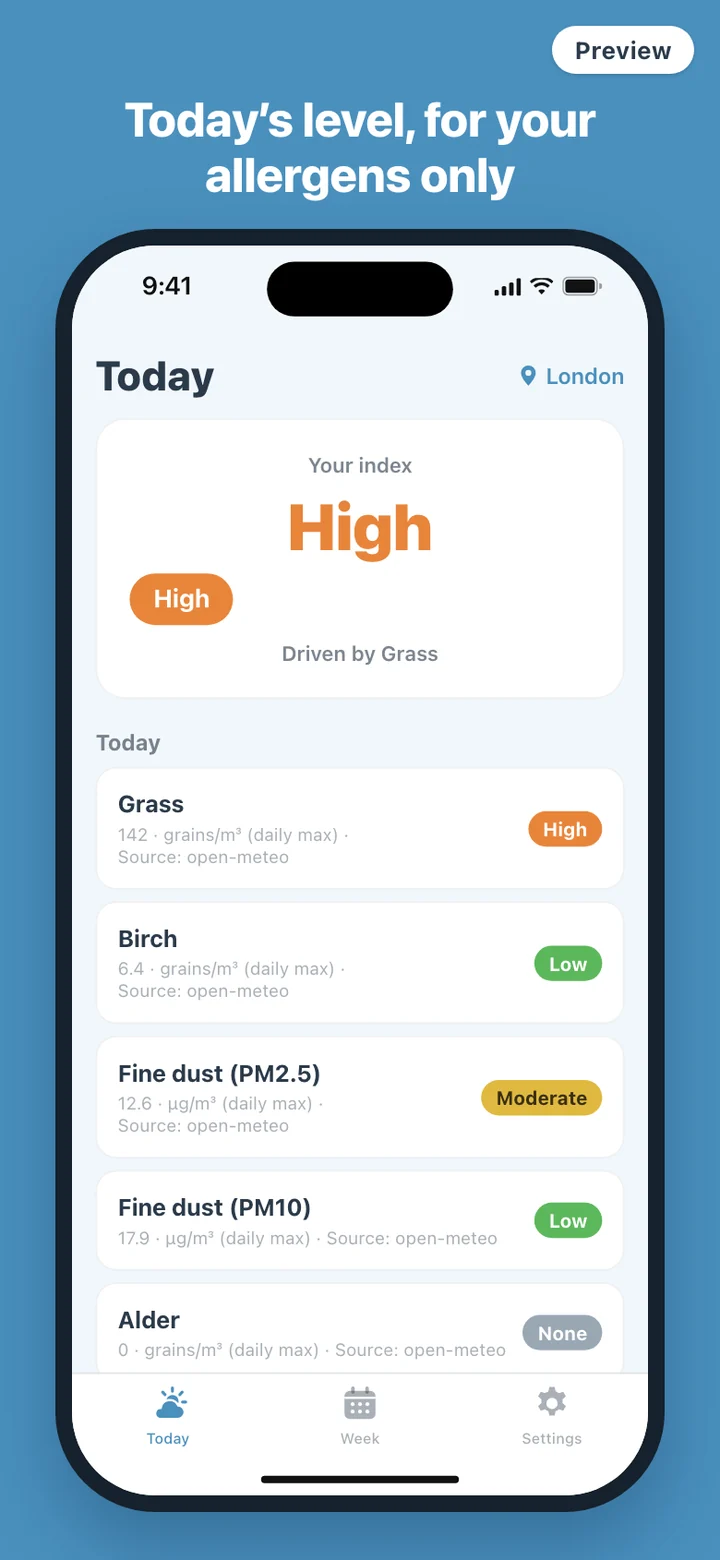
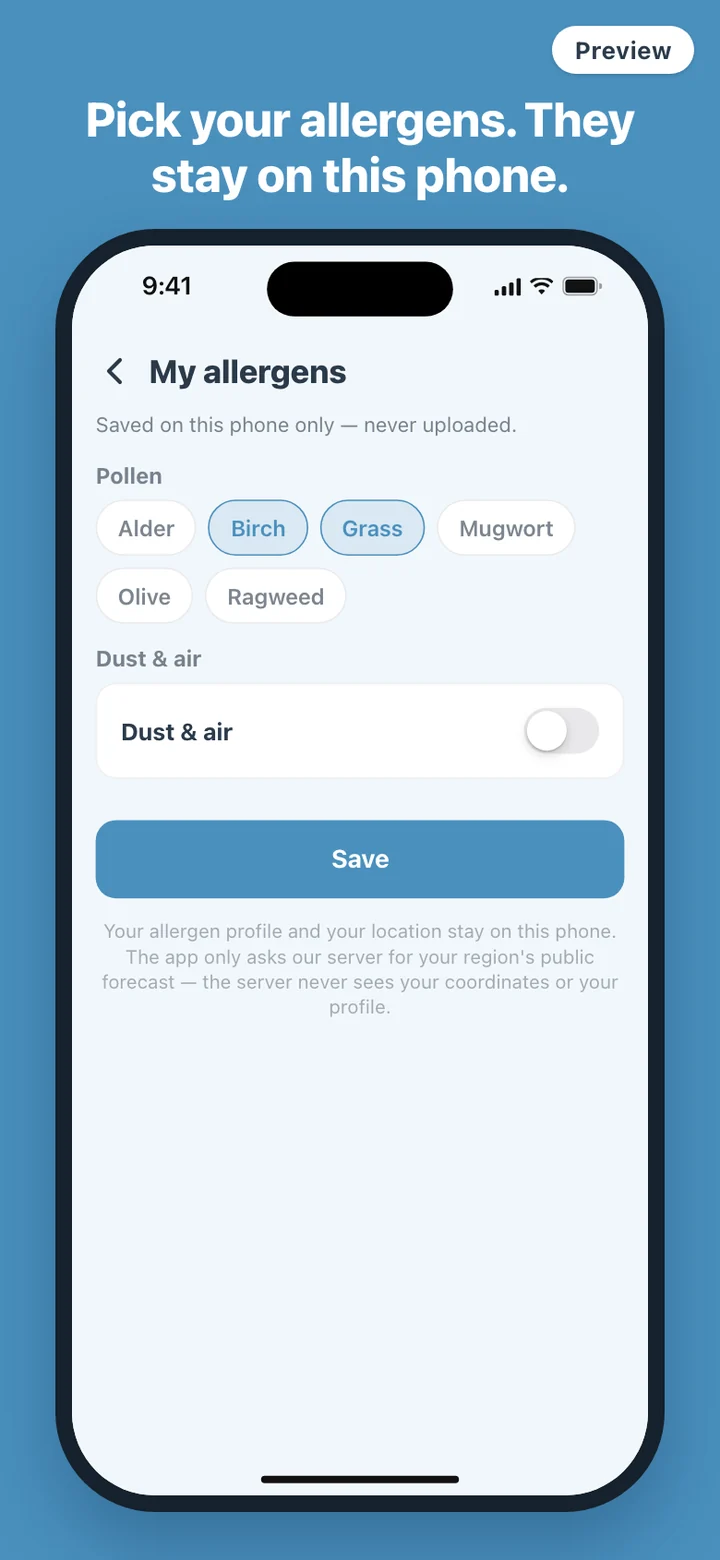
Pollergo starts with the area view. Allow location once or choose a city, and Today shows the overall index for your region, the highest level across every allergen the source reports. A card then offers to make it personal. Once you save a profile, the headline answers the question you opened the app for: how bad is it today for the things I react to.
Where the forecasts come from
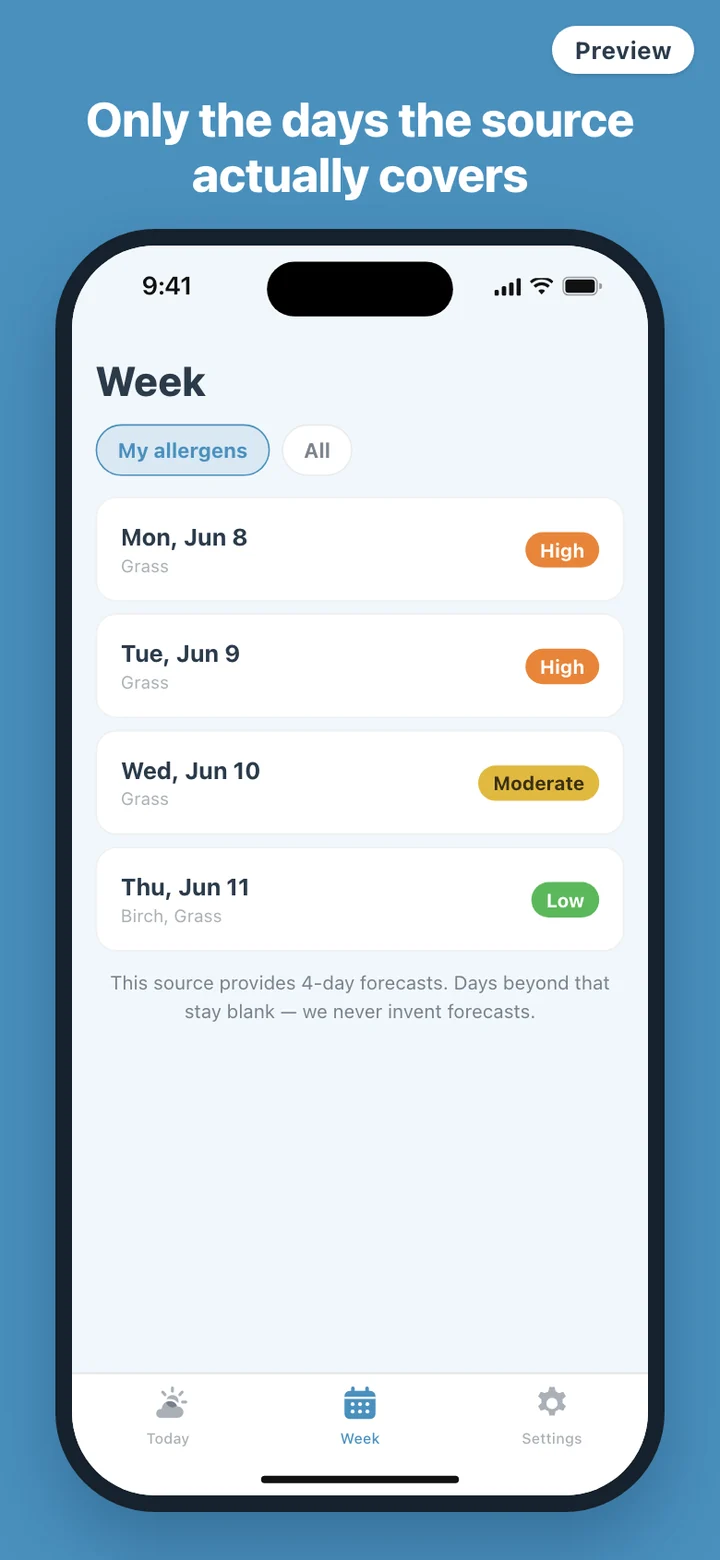
In Germany, Pollergo uses the pollen hazard index (Pollenflug-Gefahrenindex) from the German Weather Service, DWD: 27 forecast regions, eight pollen types, and a forecast for today, tomorrow and the day after. For London, Paris, Amsterdam, Madrid, Rome, Vienna, Zurich and Warsaw it uses the CAMS European air quality forecast through Open-Meteo, which covers six pollen types and fine dust (PM10 and PM2.5) four days ahead. For ten US cities and eight cities in Japan only the fine dust forecast exists in the sources Pollergo uses, so that is all it shows there.
Each source speaks its own scale. DWD reports steps from 0 to 3 with half steps in between; CAMS reports grains of pollen per cubic metre. Pollergo puts every reading on one five-step scale, None, Low, Moderate, High and Very high, so the colours mean the same thing everywhere, but it never hides the original. Every card shows the raw value, the scale it came from and the source, for example 142 grains/m³ (daily max), Source: open-meteo.
Pollergo's server collects these public forecasts on a schedule, and the app asks it for one region at a time. If a source stops updating, the last forecast stays on screen with a note such as Last updated 30h ago rather than passing for fresh. The Data sources screen in Settings lists each source with its attribution and the time it was last collected.
A spring morning with Pollergo
On iPhone, the home screen widget answers before you open anything: your region, today's level in its colour, and the allergens driving it. The medium size adds tomorrow's level. Open the app and Today has the same index on top, a card for each allergen below it, and a Tomorrow row, so you know what the next day looks like before you plan it.
If you want a nudge, turn on notifications in Settings and pick a briefing time of 6, 7, 8 or 9 a.m. The morning message carries your region's overall level. A second alert comes when tomorrow's regional level is at least two steps above today's and reaches High or more, once per region per day. Your personal breakdown is worked out on the phone when you open the app, because the server never has your allergen list to work with.
What stays on the phone
Location is read once, while you set up, and only to find the nearest forecast region. That calculation happens on the phone and the coordinates are never sent. If you would rather not share location at all, pick a country and a region from the list instead. There is no account and no sign-in, because the server holds nothing about you that an account would protect.
Your allergen profile is saved on the phone and never uploaded. If you turn on notifications, the server stores a push token, your region code, your briefing hour and the app language, and nothing else about you. Reset my data in Settings deletes the profile and region from the phone and removes the notification subscription from the server in the same step.
What Pollergo leaves out on purpose
Pollergo covers pollen and fine dust and nothing else. There are no UV, heat or storm warnings, no general weather and no map. It does not keep a symptom diary, score how you feel, or suggest what to take. When a source has no forecast for a day, that day stays blank; Pollergo does not fill gaps with estimates of its own.
Pollergo is a forecast tool. It does not give medical advice, diagnose allergies or recommend treatment. If pollen or air quality affects your health, talk to a pharmacist, doctor or allergist.