Three deadlines, three hiding places
Ask a driver in Germany when the next HU is due and they will walk round to the back of the car. The month sits at the top of the round sticker on the rear plate and the year sits in the middle, which works until the car is parked two streets away. The insurance cut-off lives in the yearly letter announcing next year's premium, and winter tyres live in the memory of the last frosty morning. Three dates, three hiding places, and nowhere that shows them side by side.
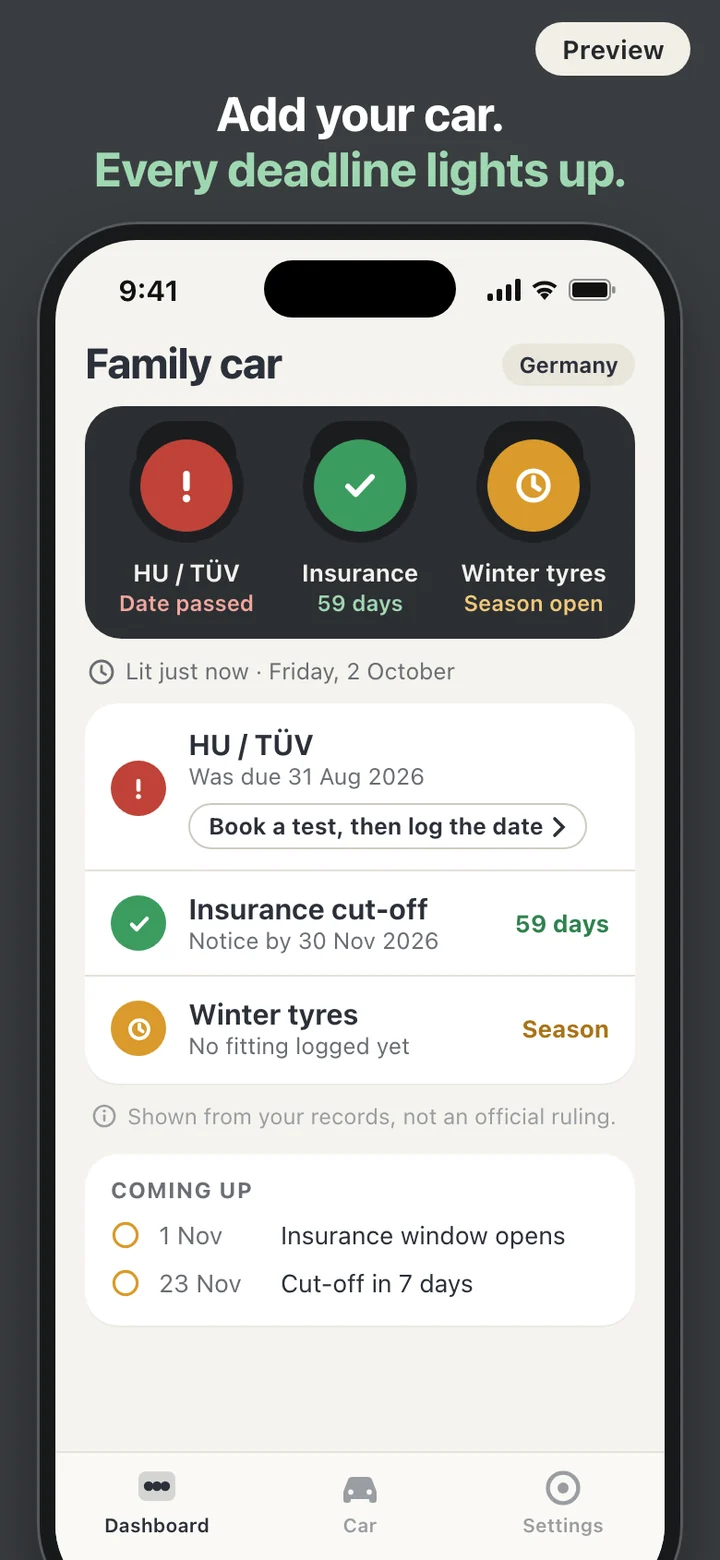
Japan has the same problem in a different shape. The 車検 expiry is on the inspection certificate, the 自賠責 certificate carries its own end date, and the two have to line up. Autofrist puts each of these dates for your car on one board and keeps it current from the dates you type in.
Red, amber and green, and what they do not mean
Every deadline gets one lens. Red means an inspection date has passed, or there is no record yet to count from. Amber means an inspection is 30 days away or less, or a seasonal window is open: the month before the insurance cut-off, or the winter tyre season. Green means the date is logged and still ahead. Each lens also carries an icon and a word, so the board reads the same for anyone who struggles to tell red from green.
The colours describe your records and nothing more. If the car passed its HU last week and you have not logged it, the lens stays red until you do, and a line under the board says the status comes from what you entered, not from any authority. Winter tyres never turn red, because Germany sets no fixed date for them. Nothing blinks and nothing beeps; a light changes only when a date or a record does. Tap any lens for the rule behind it, its source and the date that source was last checked.
The German board: HU, Kündigungsstichtag, winter tyres
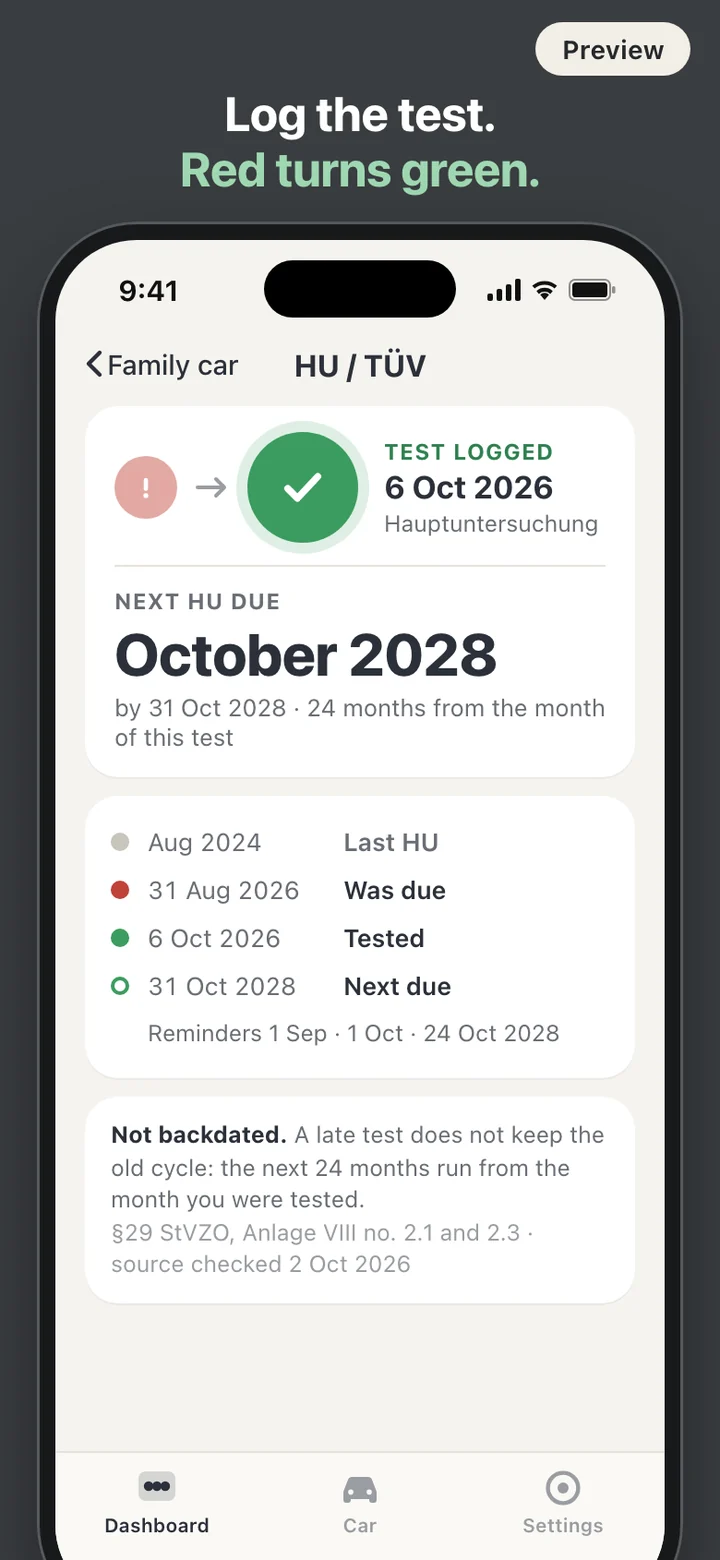
HU (Hauptuntersuchung). A new car's first HU is due 36 months after it was first registered and every 24 months after that, as set out in §29 StVZO and its Anlage VIII. Autofrist counts from the first registration month until you log a test, then from the month of the last HU. The deadline is the end of that month, the same month your sticker shows. Reminders arrive 60, 30 and 7 days before.
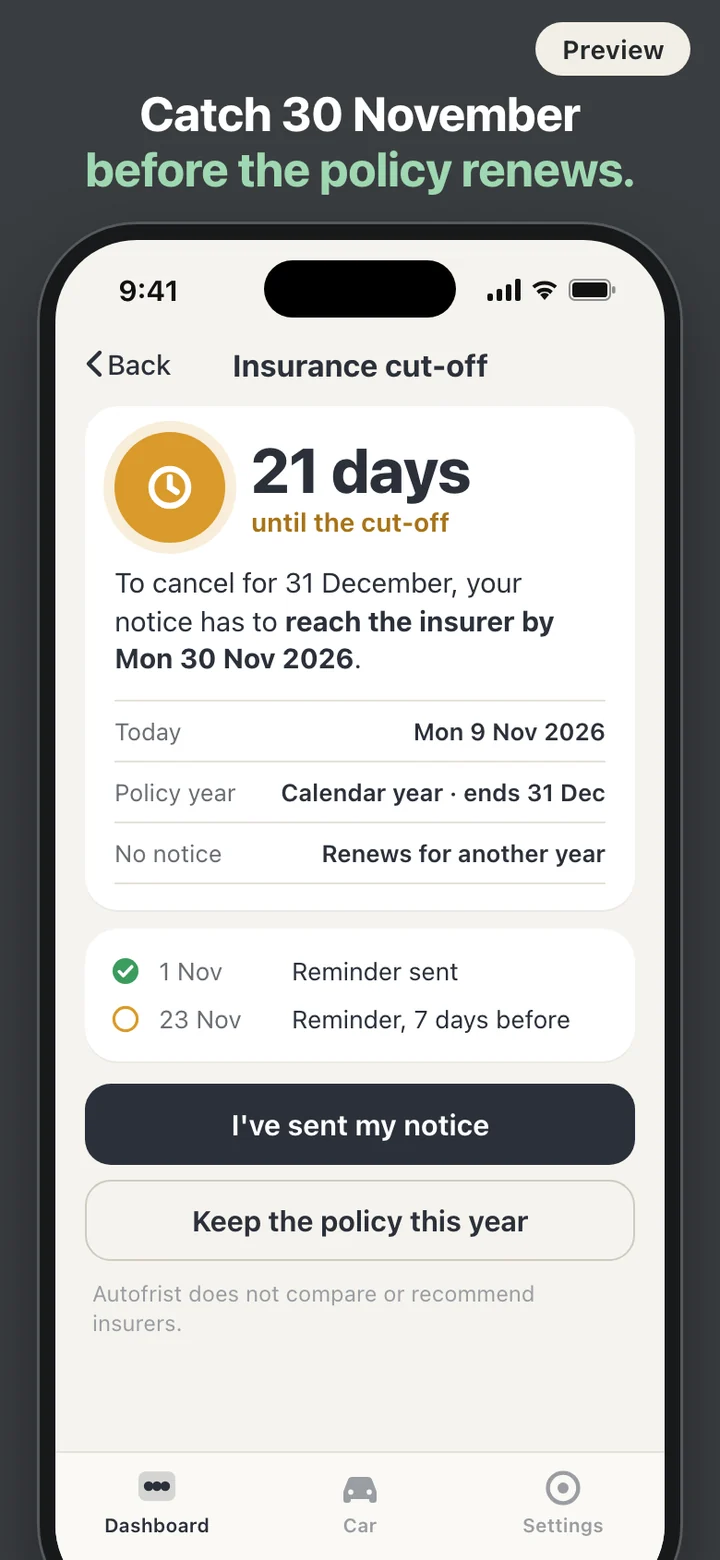
Insurance cut-off (Kündigungsstichtag). Most German car insurance runs with the calendar year and can be cancelled with one month's notice, which is why 30 November matters: ADAC points out that the cancellation has to reach the insurer by then. If your policy year ends on another date, enter it and the cut-off moves with it. The insurance date is optional; leave it out and the item simply rests. Once you mark a year as notice sent or keeping it, that year is settled.
Winter tyres. German law has a situational rule rather than a calendar date: on black ice, packed snow, slush, ice or hoar frost, a car may only be driven on tyres with the Alpine symbol (§2(3a) StVO). The familiar O bis O, October to Easter, is a rule of thumb with no legal weight, as ADAC notes. Autofrist reminds you once in early October and lets you log the day the winter set goes on and the day it comes off.
The Japanese board: 車検 and 自賠責
Choose Japan for the car and the board changes to two items. According to Japan's Ministry of Land, Infrastructure, Transport and Tourism, the first inspection certificate for a private passenger car is valid for three years and each renewal for two. The ministry also notes that the renewal inspection, 継続検査, can be taken from two months before the expiry date.
自賠責, the compulsory liability insurance, sits beside it as a linked item. The ministry's glossary states that for vehicles subject to 車検 the insurance period has to cover the whole inspection period, so 自賠責 appears as a linked item that you confirm once it runs at least as long as the new 車検. Autofrist does not sell or renew insurance; it only shows whether you have recorded that the two dates line up.
How the year runs
Most of the year the board sits still, which is the point. In early October one reminder says winter tyre season has started. On 1 November the insurance cut-off turns amber and a reminder arrives, with a second on 23 November, a week before the deadline. Inspection reminders come 60, 30 and 7 days before the due date, which leaves time to get a slot at a testing station before the month runs out.
Reminders are local notifications planned on the phone itself. On the lock screen they say a car paperwork date is coming up and nothing more: no number plate, no nickname, no talk of fines. You open the app to see which date it is. If you sell or scrap the car, archive it and its reminders stop.
Where Autofrist stops
Autofrist does not compare insurance, recommend a provider, or work out what you might save by switching, and it has no field for an insurer's name or your premium. It does not book inspections or guess whether a car will pass. It is not a maintenance log either, so there is nowhere to record oil changes, mileage or repair bills, and no place to keep photos of your documents. Each item has one free-text note, handy for a testing station or a certificate number, and that is all.
There is no account and no server behind it. Your car's dates live on the phone, can be exported to a backup file and restored on a new one, and can be wiped from Settings in one step. Autofrist is not affiliated with TÜV, DEKRA, ADAC or any insurer.
Autofrist is a deadline organiser, not legal advice. Rules change and contracts differ, so confirm dates with your insurer, your testing station or, in Japan, the local transport bureau (運輸支局).