The sums you are meant to do in your head
In 501 you have to land exactly on zero, and the last dart has to be a double or the bull. Every visit near the end of a leg becomes a small puzzle: which treble sets up which double, what is left if the first dart drifts into the single, and which numbers can't be finished at all. Most players learn it from a chart pinned beside the board or from years of league nights.
A chart on the wall never tests you. DartDrill covers both halves: look routes up until they feel familiar, then get asked for them cold. It is a trainer, not a scorer, so there are no matches, no opponents, and no legs or sets anywhere in the app.
Where the routes come from
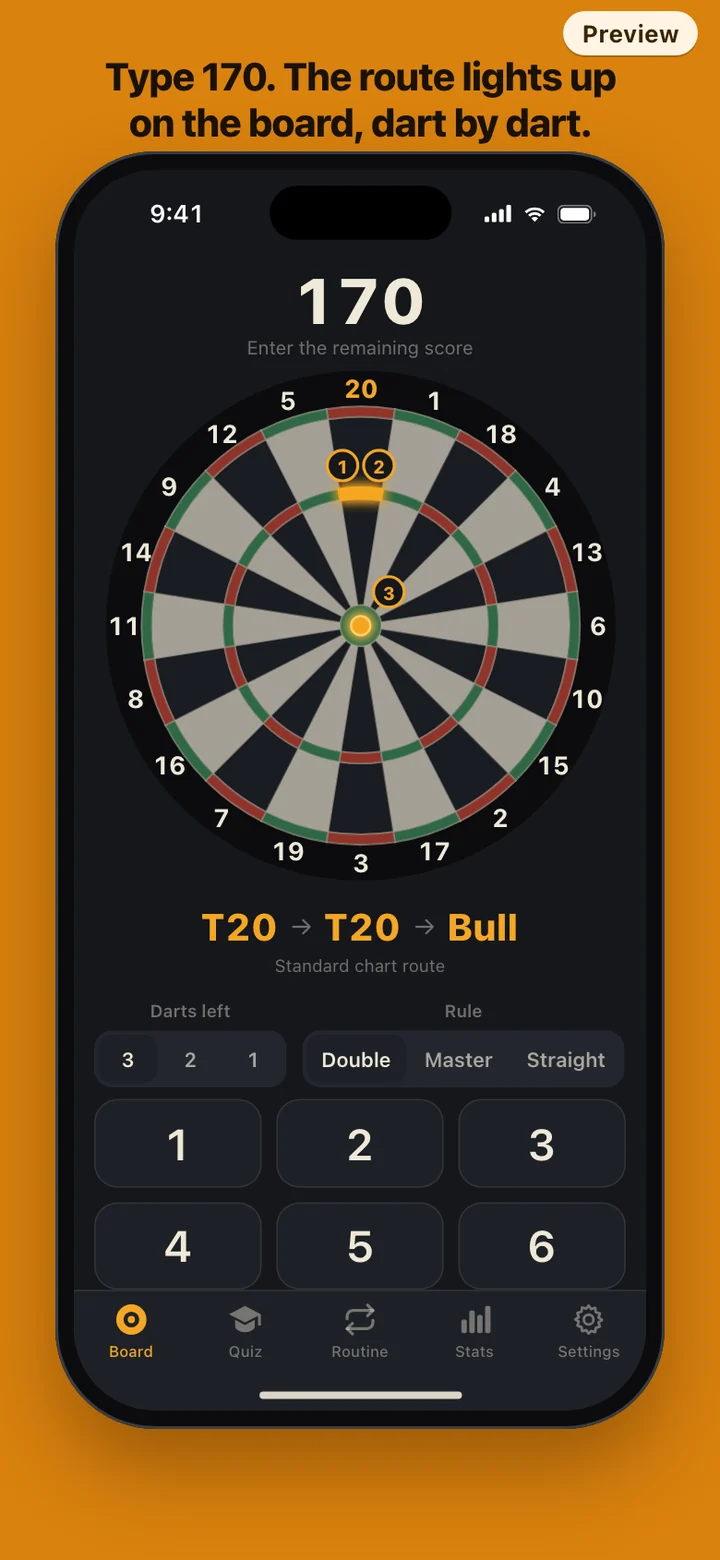
For 60 to 170 the recommended route comes from one published checkout chart, used as it is rather than stitched together from several. Charts disagree on a fair number of scores, and a blend would give you routes nobody actually teaches. Below 60 the route sets up a familiar double: 41 is S9 then D16, 55 is S15 then D20. Every entry has been checked against the app's own route engine, which confirms the darts add up and the last one is a double or the bull.
The engine also covers what a chart doesn't. With two darts or one in hand, or with master out or straight out selected, it searches every legal finish, shows the shortest, and labels it as calculated rather than charted. Up to three alternatives sit in a line below, and if you pick a favourite double in Settings (D20, D16 or D8), routes ending there move up that list.
Bogey numbers and setup shots
Seven scores can't be finished in three darts: 159, 162, 163, 165, 166, 168 and 169. DartDrill doesn't rely on a typed-in list; the engine finds them by trying every combination, and the board says so calmly when you enter one. It then suggests a setup for this visit, preferring to leave 32 or 40.
The same help appears above 170 and when you have fewer darts in hand than a score needs. Type 170 with two darts left and it suggests T20, T20 to leave the bull.
A practice night with DartDrill
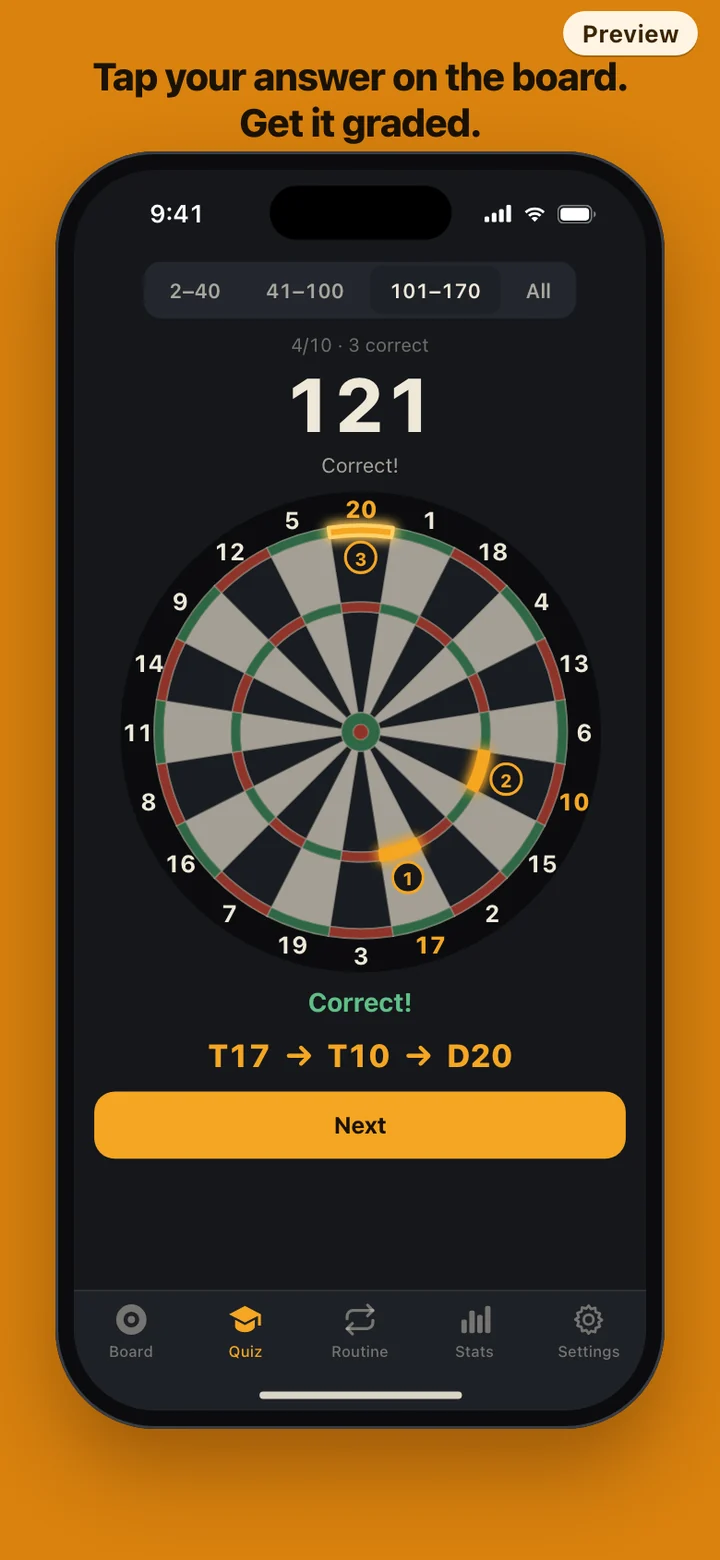
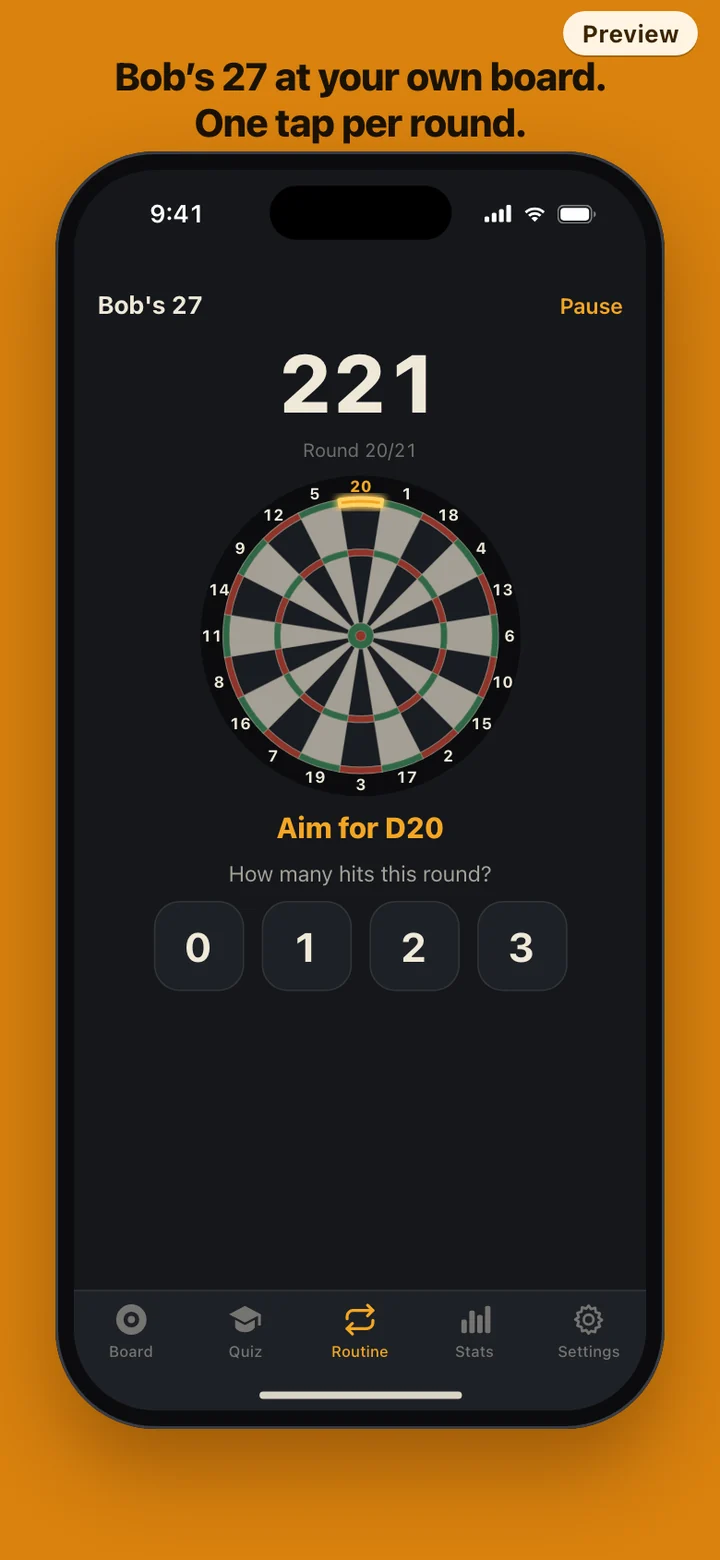
Before league, run a quiz round on the 101 to 170 range: ten scores, each timed, with a running count of correct answers. Any valid finish in the fewest possible darts counts as correct, and the chart's route still lights up afterwards so you see both. At the board, start a routine. The current target is lit on a smaller board above four large buttons, so you can enter a round with one thumb while the other hand holds your darts.
Pause a routine and it waits until you resume. Finish one and you get a card with the final score and your best round, or a plain Busted if the score ran out. The Stats tab gathers it all: the doubles heatmap with your three weakest doubles named underneath, quiz accuracy and average answer time, and recent scores for each routine with your best.
The three routines
Bob's 27, credited to former world champion Bob Anderson, runs from D1 to D20 and ends on the bull: 21 rounds of three darts. A perfect game scores 1,437, and the app's scoring is tested against exactly that number. Doubles Round the Clock gives you three darts at each double from D1 to D20 and counts the hits out of 60, with no bust; its rounds feed the heatmap too. Around the Clock does the same with the numbers 1 to 20, a scored warm-up for newer players.
What DartDrill leaves out
No match scoring, no camera and no automatic dart detection: you tell the app what happened at the board. There is no account, no cloud copy and no network connection, so the practice log lives only on your phone and there is no export. No reminders or streaks either. A light and a dark theme cover bright rooms and dim pubs, and one button in Settings deletes every practice record.