Built on the rules a BaZi chart uses
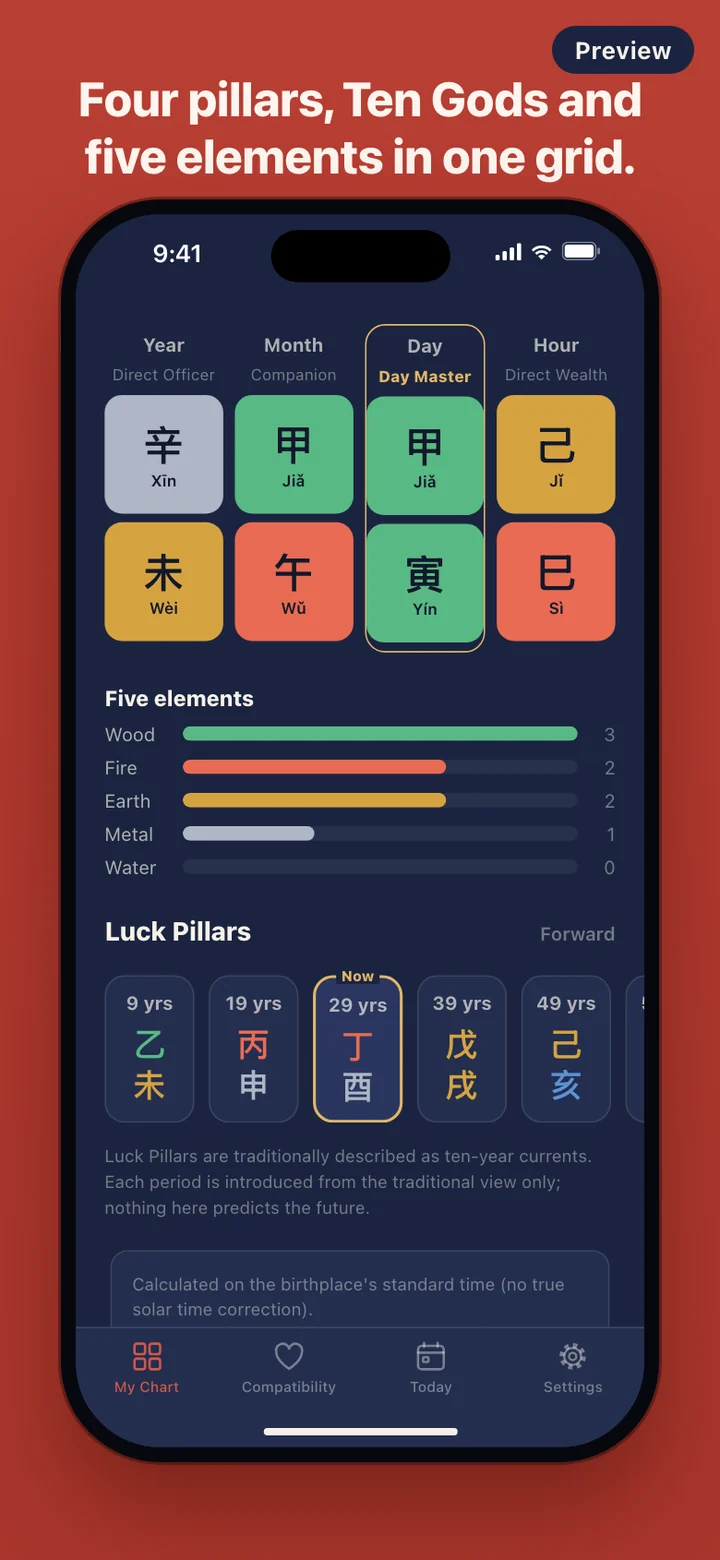
BaZi, also called the Four Pillars of Destiny, comes from classical Chinese metaphysics. A chart is four pairs of characters, a Heavenly Stem and an Earthly Branch for each of the year, month, day and hour of birth, and the stem of the day pillar is the Day Master. DayMaster computes the pillars with lunar-javascript, an open-source Chinese calendar library, and settles each point where calculators disagree with one stated rule.
The year changes at the exact moment of Li Chun, the Start of Spring solar term in early February, not at Lunar New Year. Each month changes at the solar term that opens it, to the minute, so a birth a few hours before Jing Zhe still belongs to the previous month. The day and hour pillars use the birthplace's standard time: a clock reading taken during daylight saving time is moved back to standard time first, and a birth between 11 pm and midnight counts as the Zi hour of the next day.
True solar time is not applied, and the chart says so in a footnote instead of correcting part of the way. Luck Pillars run forward or backward from the month pillar depending on whether the year stem is yang or yin and on the gender you enter, which is used for nothing else. When the first one begins is worked out from the days between birth and the next month-opening solar term, or the previous one when they run backward, counted at three days to a year.
Why the same birthday can give different charts
Working a chart out by hand means a printed table of pillars, and some calculators ask only for a date and a time. Both get shaky at the edges: a birth close to Li Chun or to a month's solar term, a summer birth recorded in daylight saving time, a birth just before midnight. Each of these can change a pillar, and when it is the day pillar, it changes the Day Master itself.
DayMaster asks for the city whose time zone you were born in, from a searchable list of 41 cities, and uses that zone's own daylight saving history to pin down the moment of birth. If your chart differs from another calculator's, compare these five points first: Li Chun, the month solar terms, daylight saving, the 11 pm rule and true solar time.
Readings written as introductions
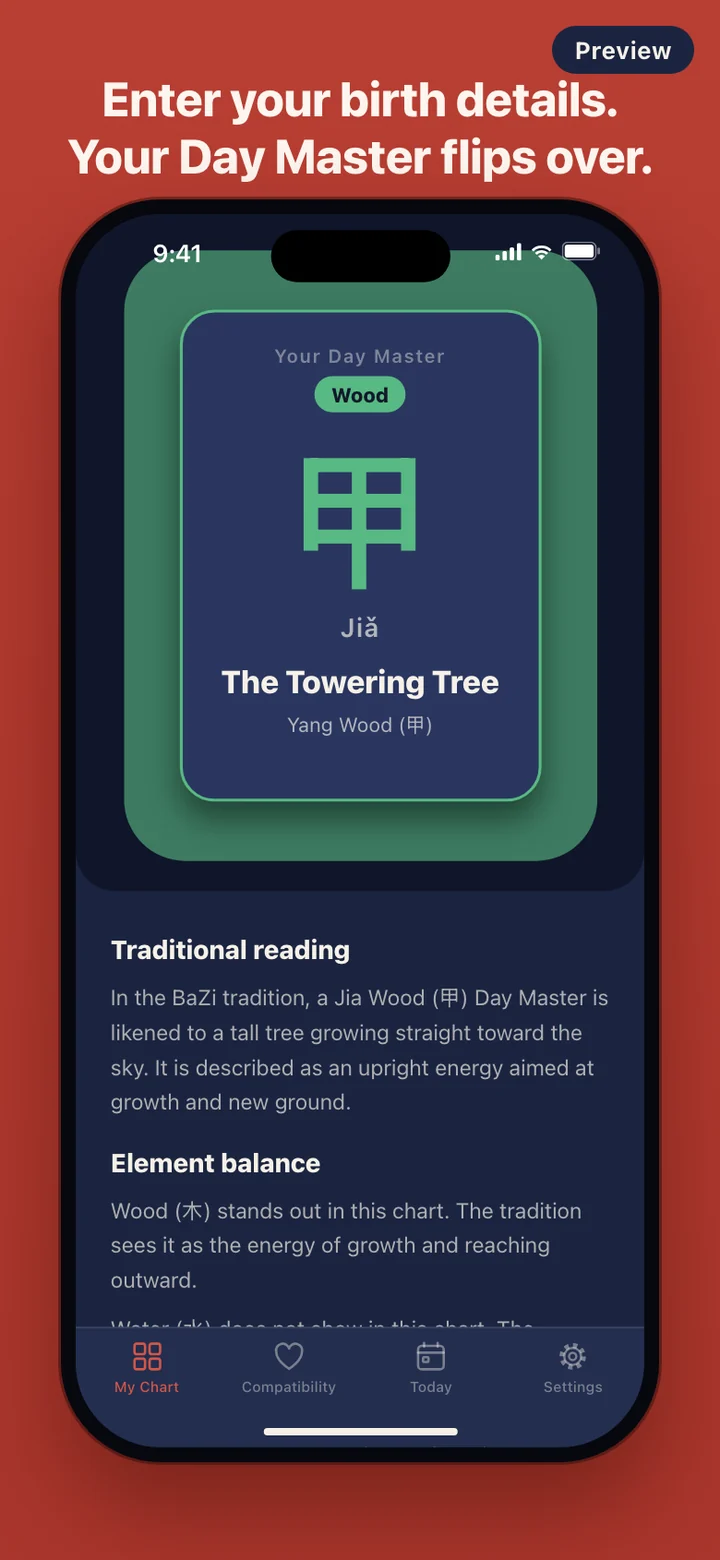
Under the card, a short reading introduces your Day Master through the tradition's own imagery, followed by a note on the element that stands out in your chart and any element that does not appear at all. Every line is phrased as how the BaZi tradition reads something, never as what will happen to you, and the Luck Pillars carry a note that says the same.
Profiles, comparisons and today's pillar
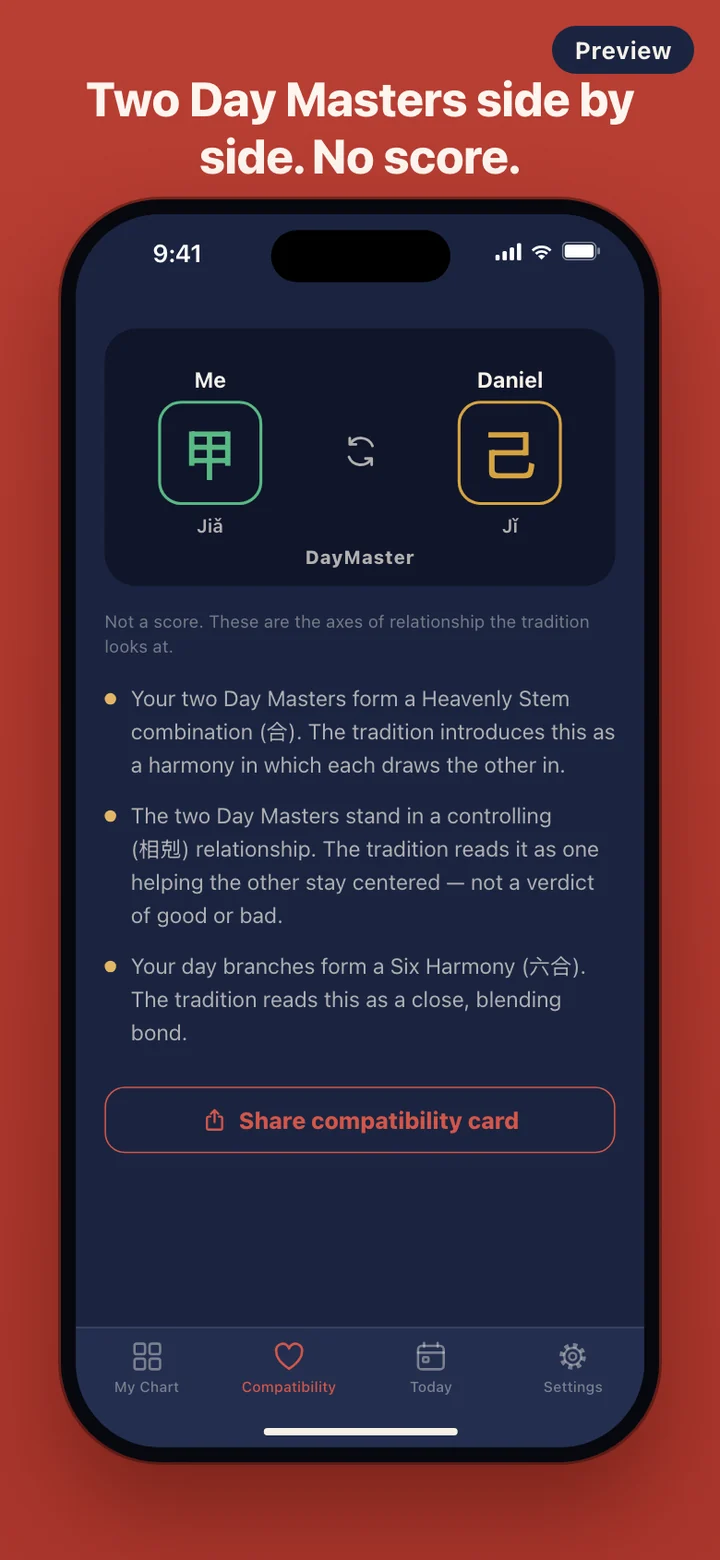
Add a partner, a parent or a friend as a profile, and edit or delete it later. Pick any two in the Compatibility tab to see both Day Masters side by side, followed by only the traditional relationships that apply: a stem combination, how their two elements relate, and a six harmony, three harmony or clash between their day branches. There is no percentage and no verdict.
The Today tab shows the day pillar for today's date and one line on how it relates to your Day Master. An optional reminder, off until you switch it on, asks you once a day to check today's pillar and never puts a reading on your lock screen. Your Day Master card or a comparison card can be shared as an image through the share sheet, with a small DayMaster mark at the bottom.
What it leaves out on purpose
DayMaster is a calculator with traditional readings, not a fortune teller. It does not predict events, rate a relationship, weigh hidden stems into the element count, or apply true solar time. There is no account, no server and no analytics SDK. Birth details are stored on the phone, nothing is sent anywhere, and Settings has one button that deletes every profile and setting.
DayMaster introduces traditional BaZi readings for entertainment and self-reflection. It does not predict specific outcomes and is not medical, financial, legal or relationship advice.