A deadline that hides inside the newborn weeks
Elterngeld is Germany's parental allowance, and you can only apply for it once the baby is born. Under section 7 of the Federal Parental Allowance Act (BEEG), it is paid backwards only for the three Lebensmonate before the Lebensmonat in which your application arrives. Wait too long and the earliest months simply fall away.
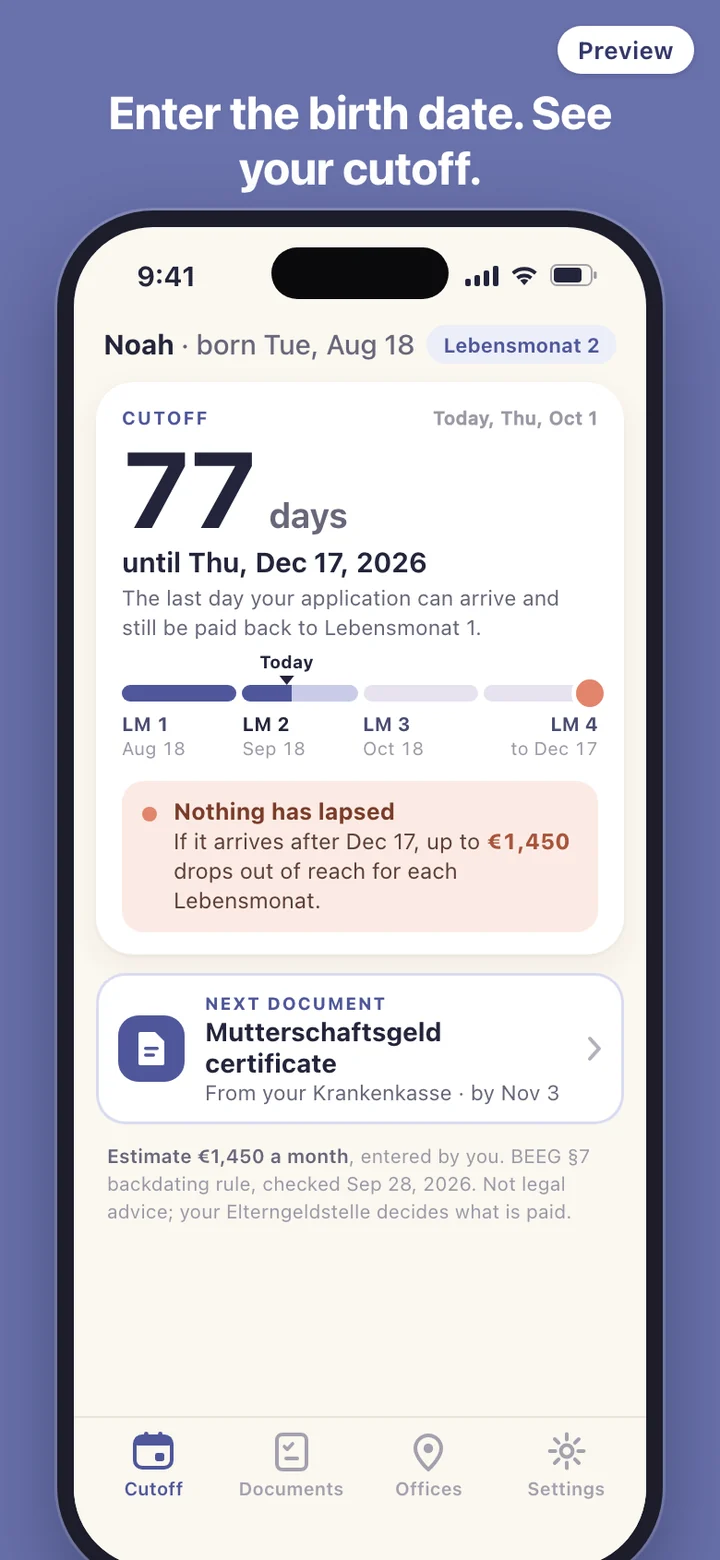
The catch is the unit. A Lebensmonat is not a calendar month. It runs from your baby's birthday, so a child born on 18 August has a first Lebensmonat from 18 August to 17 September, a second from 18 September to 17 October, and so on. "Apply within three months" sounds simple until you are counting from a date in the middle of a month at four in the morning.
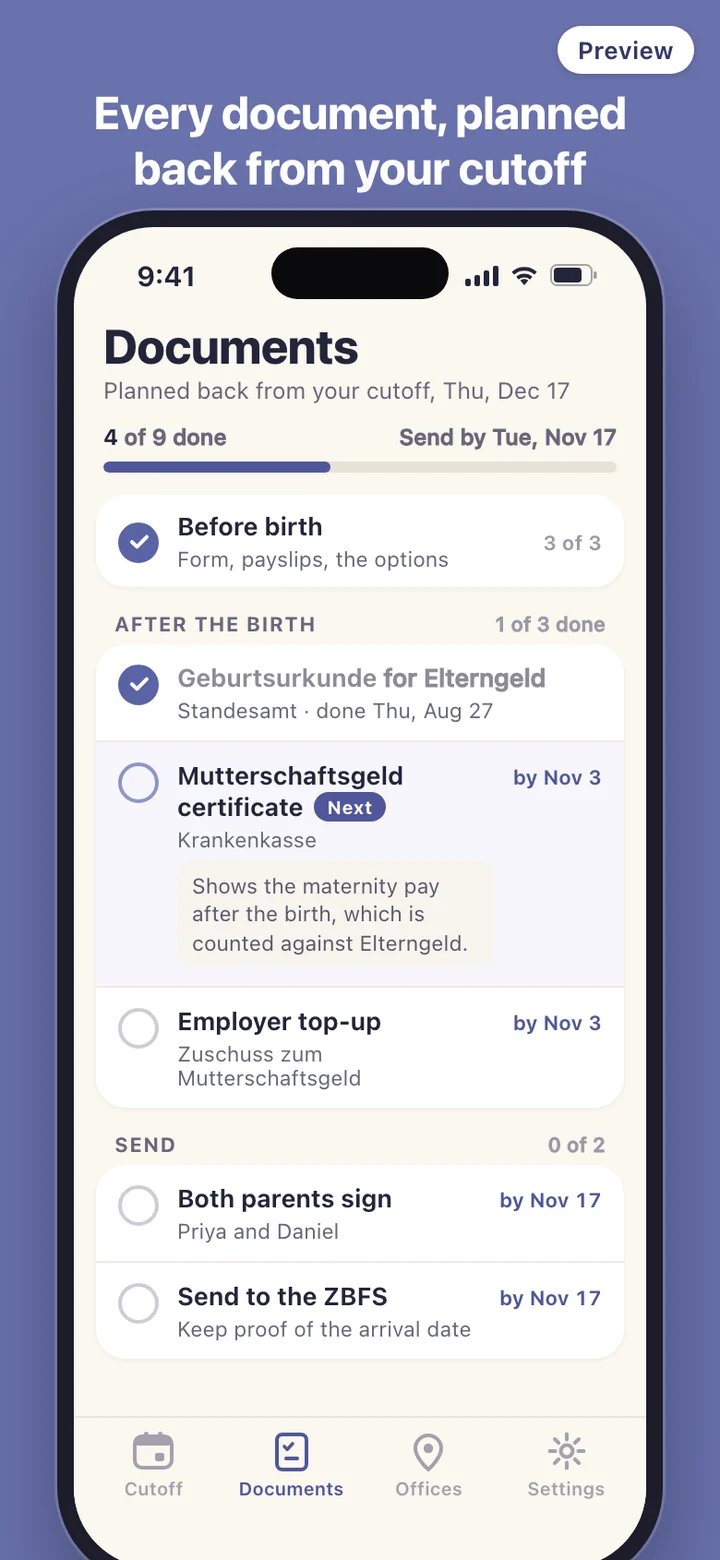
Meanwhile the paperwork waits on other paperwork. A typical application needs the birth certificate from the Standesamt, payslips, the Mutterschaftsgeld certificate from the Krankenkasse if the mother is employed, and both parents' signatures if both can claim. Often the date lives in one parent's head, on a sticky note, or in a phone reminder set for "three months". Calculator sites answer how much Elterngeld you might get. ElternFrist answers by when, and with which documents.
How the countdown stays honest
Before the cutoff, nothing has been lost, and the screen says so. The big number is the days left until the last day an application can arrive and still reach back to Lebensmonat 1. Underneath, one line says what happens after that day: up to a certain amount per Lebensmonat drops out of reach. That amount is the monthly estimate you typed in. If you leave it blank, ElternFrist quotes the legal maximum of €1,800 a month for Basiselterngeld and labels it as the maximum, not as your figure.
If the cutoff has passed, the counter switches to the number of Lebensmonate that can no longer be paid back, multiplied by your estimate, always written as "up to". It moves one step when a new Lebensmonat begins and you open the app; it does not tick by the second. When you mark the application as sent, the counter stops on that date.
The words "up to" are deliberate. The estimate is yours, the €1,800 fallback is a ceiling, and for mothers, Mutterschaftsgeld paid after the birth is counted against Elterngeld, so the real difference in the first weeks can be smaller. A footnote under the counter repeats all of this, with the date the rules in the app were last checked. The Elterngeldstelle decides what is actually paid.
From due date to Bescheid
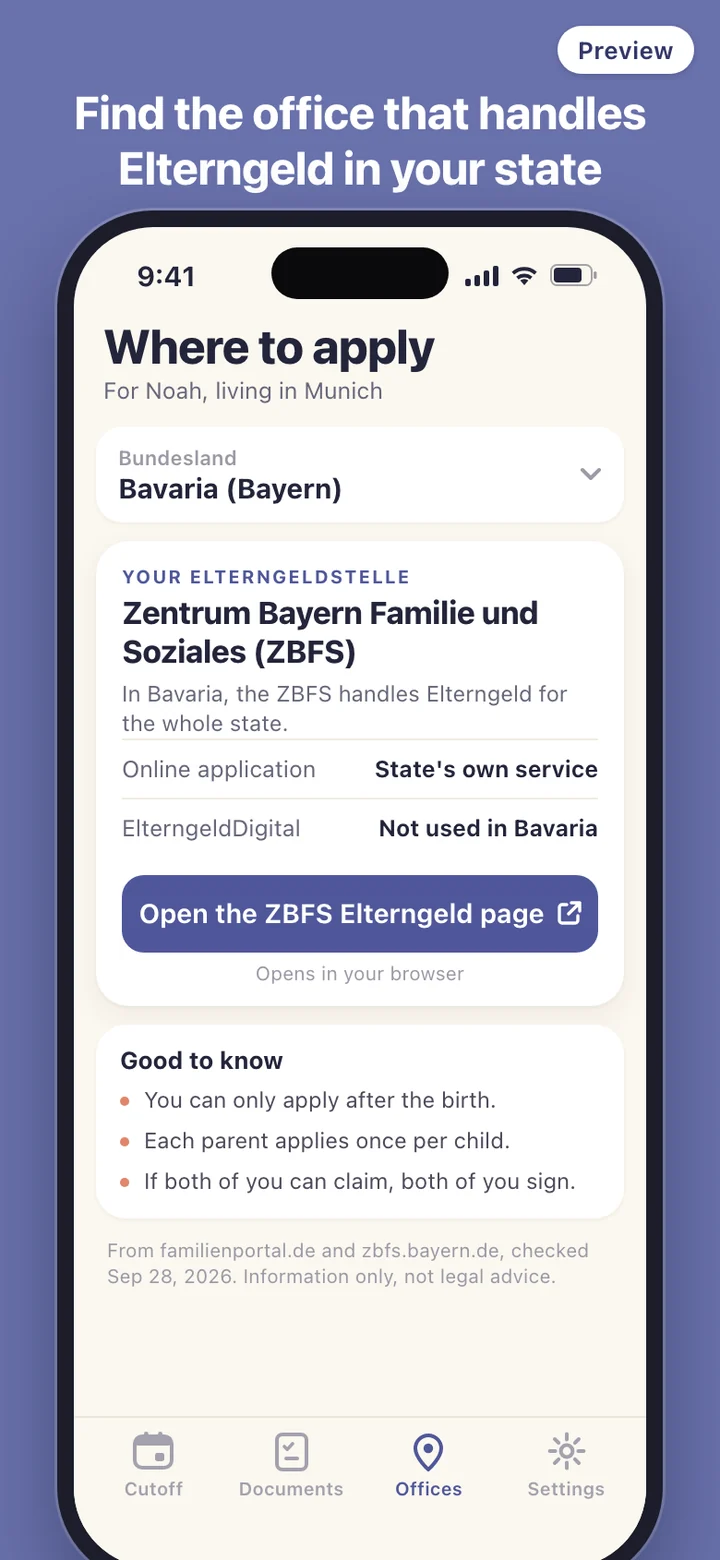
Set it up before the birth with the due date and nothing else; the amount and your Bundesland are optional. Until the baby arrives, every date is marked as an estimate. Once the due date has passed, a small card asks whether your baby is here. Switch to the actual birth date and the Lebensmonate, the cutoff, the checklist dates, and the reminders all move with it.
After that, the app is mostly the next document card. It sits on every screen that shows the countdown and names one thing: order the Elterngeld copy of the birth certificate, ask the Krankenkasse for the Mutterschaftsgeld certificate, sign, send, keep proof of when it arrived. Tick it off and the next one moves up. When the decision letter, the Bescheid, comes back, there is a last box to tick for keeping it.
Reminders are local and quiet. They come at 10 a.m. by default, never more than one a day, before your document milestones and 30, 14 and 7 days before the cutoff. The lock screen only says there is a document to look at, with no amounts and no warnings, because a phone on the kitchen table during a newborn visit is not the place for them.
German terms, kept as they appear on the forms
Parents who moved to Germany run into the same words on every form: Elterngeld, Elterngeldstelle, Lebensmonat, Geburtsurkunde, Mutterschaftsgeld, Bescheid. ElternFrist keeps them in German, so they match what the office and the Krankenkasse will say, and puts a short plain explanation next to each one.
Every rule value in the app, such as the three-Lebensmonate backdating rule and the €1,800 maximum, is stored with its source and the date it was checked, and that date is shown under the counter. If the check is more than 180 days old, the app says the rules may have changed and points you to the official information.
What it deliberately does not do
ElternFrist does not calculate your Elterngeld. For that there is the official Elterngeldrechner on familienportal.de, and the app links to it in your browser. It does not tell you whether you qualify, does not recommend how to split Basiselterngeld, ElterngeldPlus or Partnerschaftsbonus months between parents, and does not fill in or send the application. It has no fields for contact details and does not pass anyone to a consultant.
There is no account and no server. Dates, your estimate, and your ticks stay on the phone, and the app makes no network requests of its own; official pages open in your browser. Settings has one button that deletes everything and takes you back to the start.
ElternFrist organises public information about Elterngeld. It is not legal or tax advice and not information from an authority. Rules and amounts can change, and your Elterngeldstelle decides what is paid. For your own case, ask the Elterngeldstelle responsible for where your child lives.