The morning weigh-in, written down
Falconers weigh their birds every day and write the number down. The International Association for Falconry's welfare guidelines say it plainly: monitor the weight daily on proper scales and document it in written form. In practice that record lives in a pocket notebook, on a board in the mews, or in a chat thread with yourself, next to what the bird ate and how she flew.
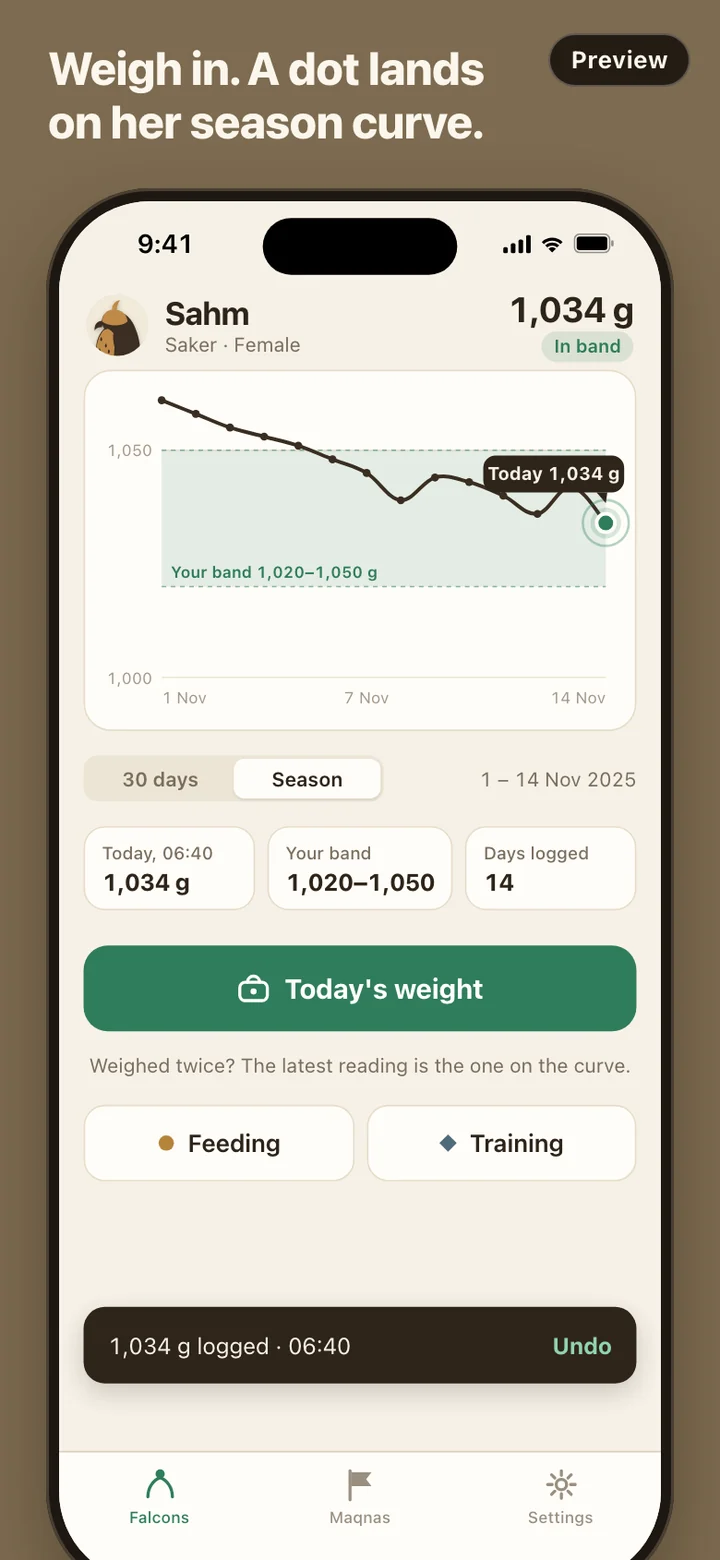
That works until you want to see the season. A notebook shows today's number and yesterday's. It does not show, at a glance, that she has been sitting a few grams under the top of her band for a week, or where the line turned. Falqora keeps the same daily habit and gives it one picture: a weight curve that grows by a dot each morning, with the band you work to drawn behind it.
A card for your falcon
Start with two fields, a name and a species: saker, peregrine, gyrfalcon, a hybrid, or anything you type. Sex, a photo, the date she joined you and free notes can wait. The card opens on the curve, because that is what you check first, and you can switch it between the season and the last 30 days. Under the curve sit three plain numbers: the latest weight, your band, and how many days you have logged.
Weight is recorded in grams only. You can weigh more than once a day, before and after flying for example; every reading is kept and the latest one is the dot on the curve. Every entry can be edited or deleted, from a single weight to the whole card, and the curve redraws when you do.
The band is yours, and so is the judgement
A good flying weight differs from bird to bird and from falconer to falconer. Falqora asks you for your falcon's band as two numbers, low and high, and draws it behind the curve. It never suggests a band, never works one out from another weight, and never calls a reading good or bad.
What you get is a statement of fact: In band, or 18 g above band, or 12 g below. There are no warnings, no feeding suggestions and no alarm colours. The band can also be left empty; the curve works without it, and Falqora will ask about it once, quietly, after your first reading.
A day with Falqora
- Early morning, before she eats: weigh her, type the grams, and the dot lands with its band label.
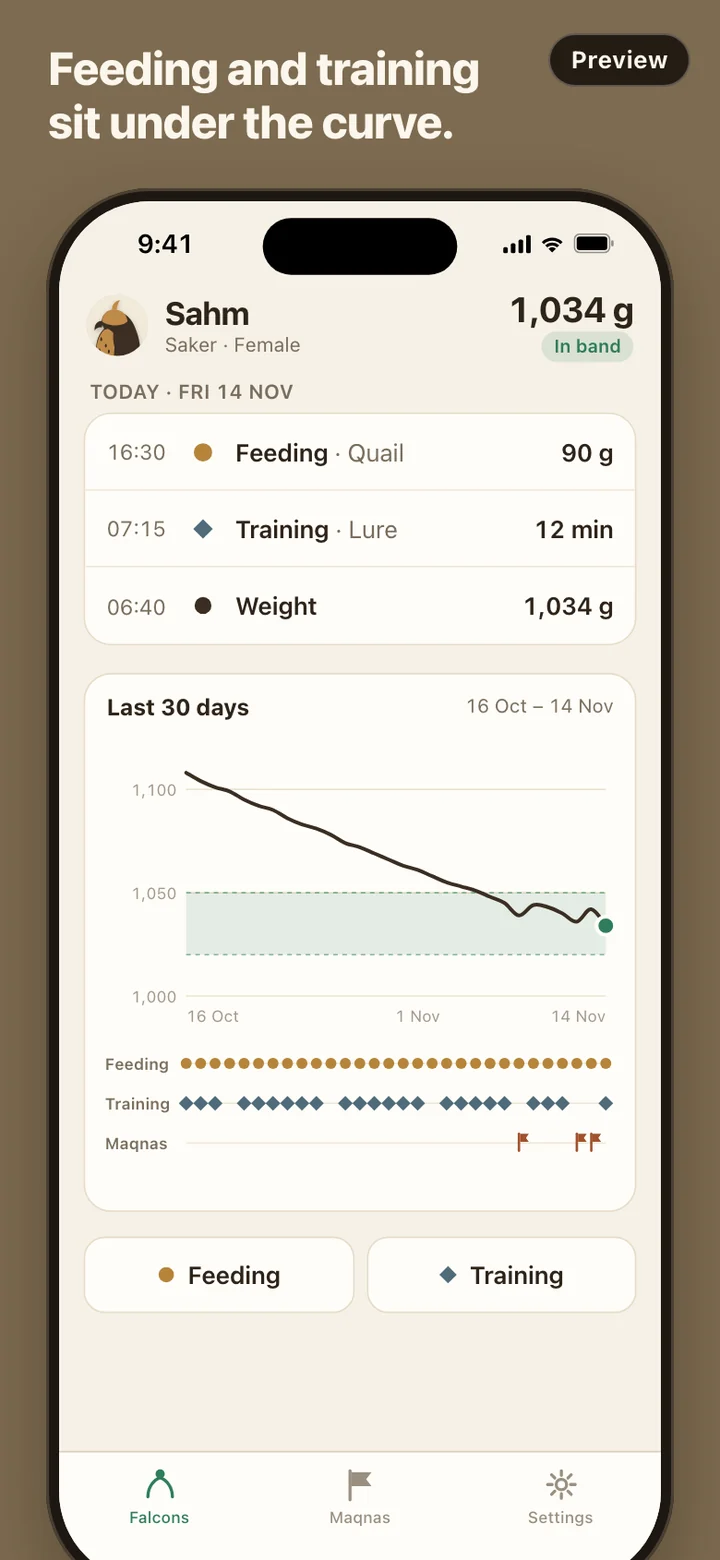
- Later in the morning: a session on the lure goes in as a training entry, twelve minutes and one line of notes.
- Afternoon: feeding is logged with the food and, if you weighed it, the grams.
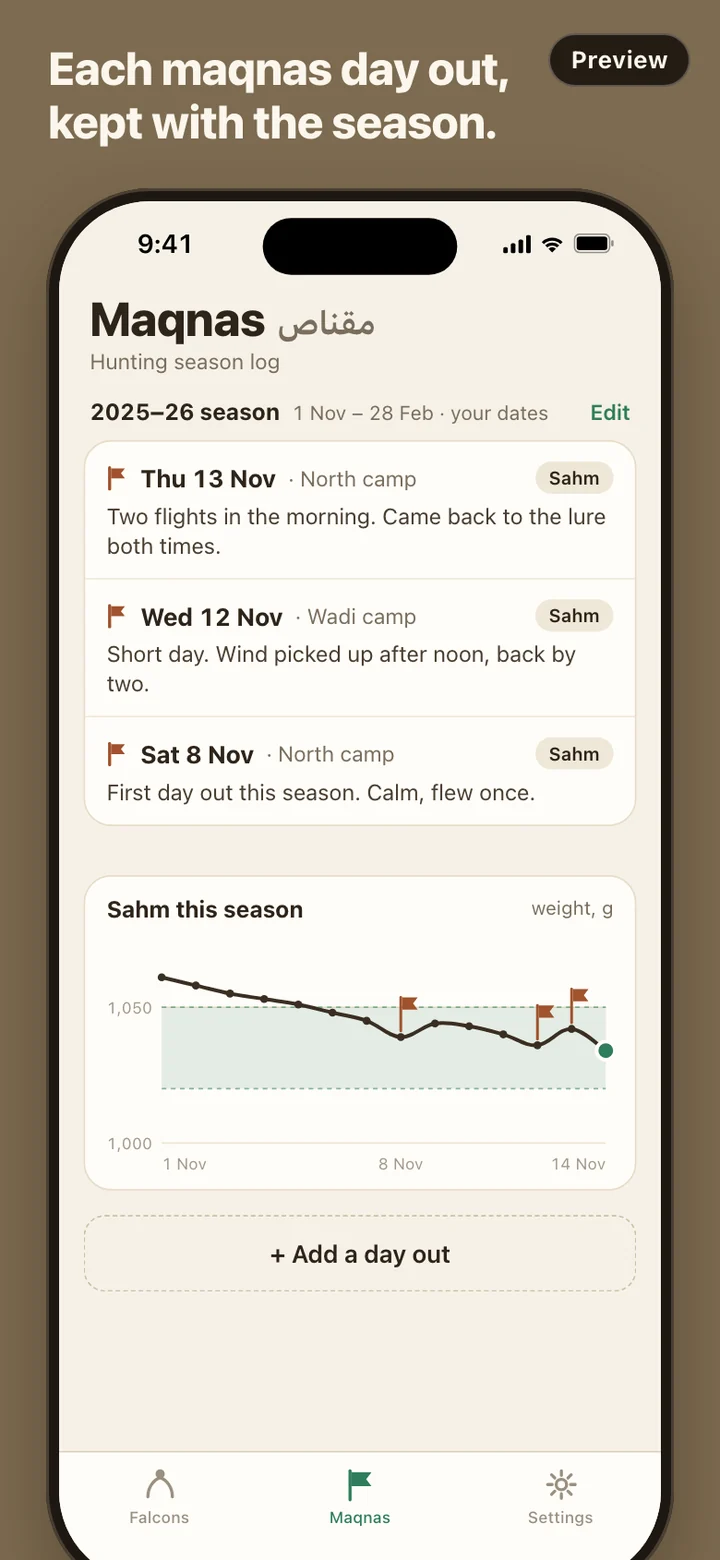
- On a day out in the season: add the place and a sentence about the flights, and a flag joins the curve on that date.
Right to left, and no signal needed
Falqora is designed for an Arabic, right-to-left layout from the start rather than flipped at the end, because most of the falconers it is made for read Arabic first. Dates use the Gregorian calendar in your phone's regional format, and weights stay in grams.
Desert camps often have no signal, and Falqora never needs one. There is no server, no account and no analytics, and photos stay in the app's own storage on your phone. You can export everything to a single JSON file through the share sheet and restore it on a new phone; photos are not inside that file, and the app tells you so. One option in Settings deletes all data, photos included.
What it deliberately leaves out
Falqora is a record, not an adviser. It does not recommend flying weights or feeding amounts, interpret how food and weight move together, grade a training session, or offer anything that reads like veterinary care. It carries no content on hunting permits, quotas, protected species or CITES; those rules differ by country and by year and belong to the authorities that set them.
There are no quarry tallies and no rankings: a day out is a date, a place and a few words. There are no reminders either. Weighing the bird is already the first thing a falconer does in the morning, and the app does not need to ask.
Falqora is a record-keeping tool. It does not give veterinary advice or tell you what your falcon should weigh or eat. For your bird's health, talk to an avian veterinarian; for hunting rules, permits and moving falcons across borders, follow your national wildlife authority.