The service history usually lives on a scrap of paper
Ask a generator owner when the oil was last changed and the answer is often a guess, a date written in marker on the shroud, or a receipt somewhere in a kitchen drawer. The machine sits for months, runs hard for three days after a storm, and then sits again. That rhythm is exactly what makes it hard to remember what was done, and when.
Some generator makers offer apps that monitor their own connected models remotely. That is a different job. Plenty of generators in garages and side yards have no connectivity at all, and a monitoring screen is not a service log. GenReady is the log: any brand, any model, typed in by the person who did the work.
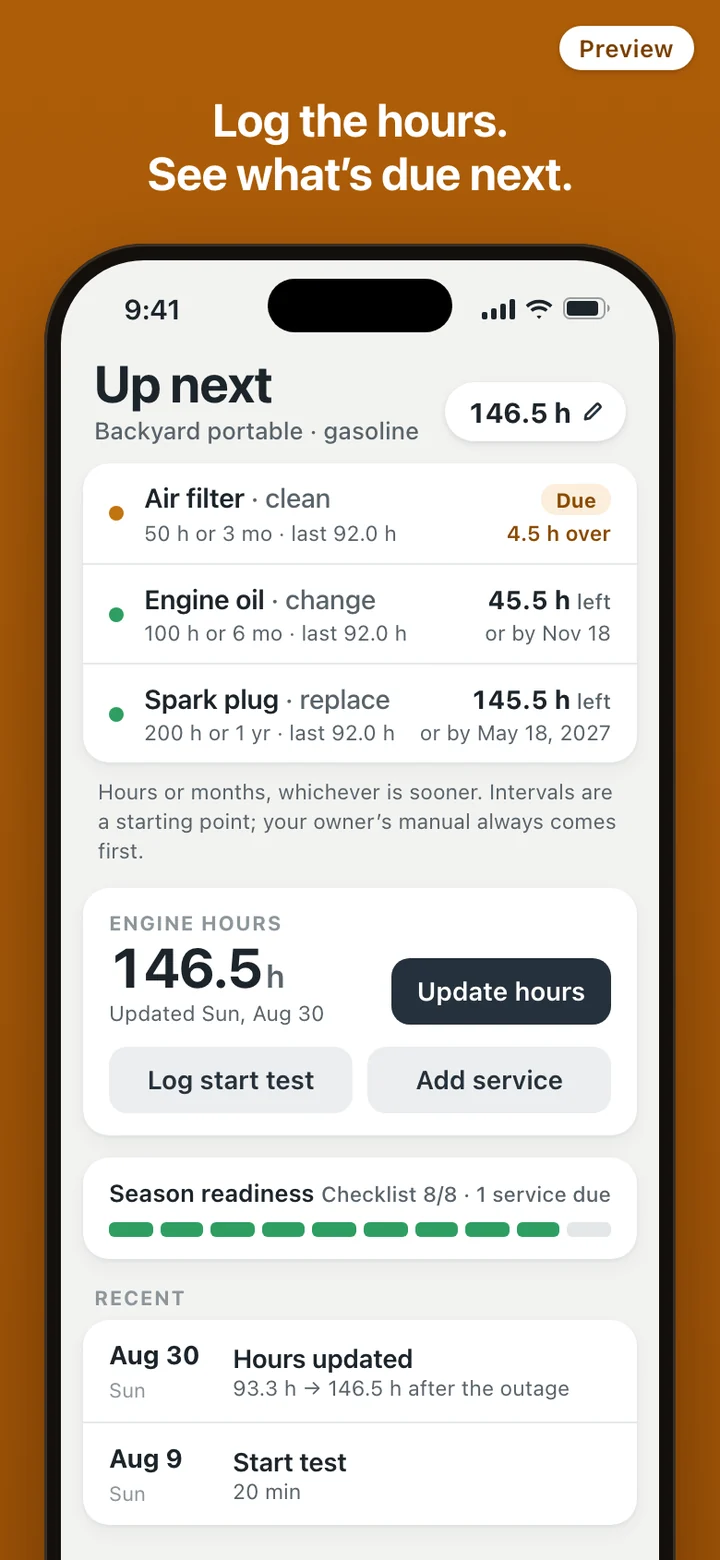
Hours or months, whichever comes first
Owner's manuals schedule service two ways at once. Honda's manual for the EU2200i, for example, lists an oil change every 6 months or 100 hours, whichever comes first, so a generator that barely runs still gets fresh oil and one that runs through a long outage gets it sooner. GenReady applies the same rule to every item it tracks.
When you add your generator you pick its type, standby, portable, or inverter, and either a preset for a popular model or a custom model. A preset is only a starting point drawn from published manual practice, and every interval can be changed to match your own manual. The schedule screen says it plainly: your owner's manual comes first.
A service record takes a couple of taps: the item, the date, the engine hours at the time, and if you want them, the cost, a note, and a photo of the receipt. Any record can be edited or deleted later, and the due list recalculates when you do. If a new hour reading is lower than the last one, say after a meter swap, the app asks before saving it instead of refusing.
The pre-season check, one item at a time
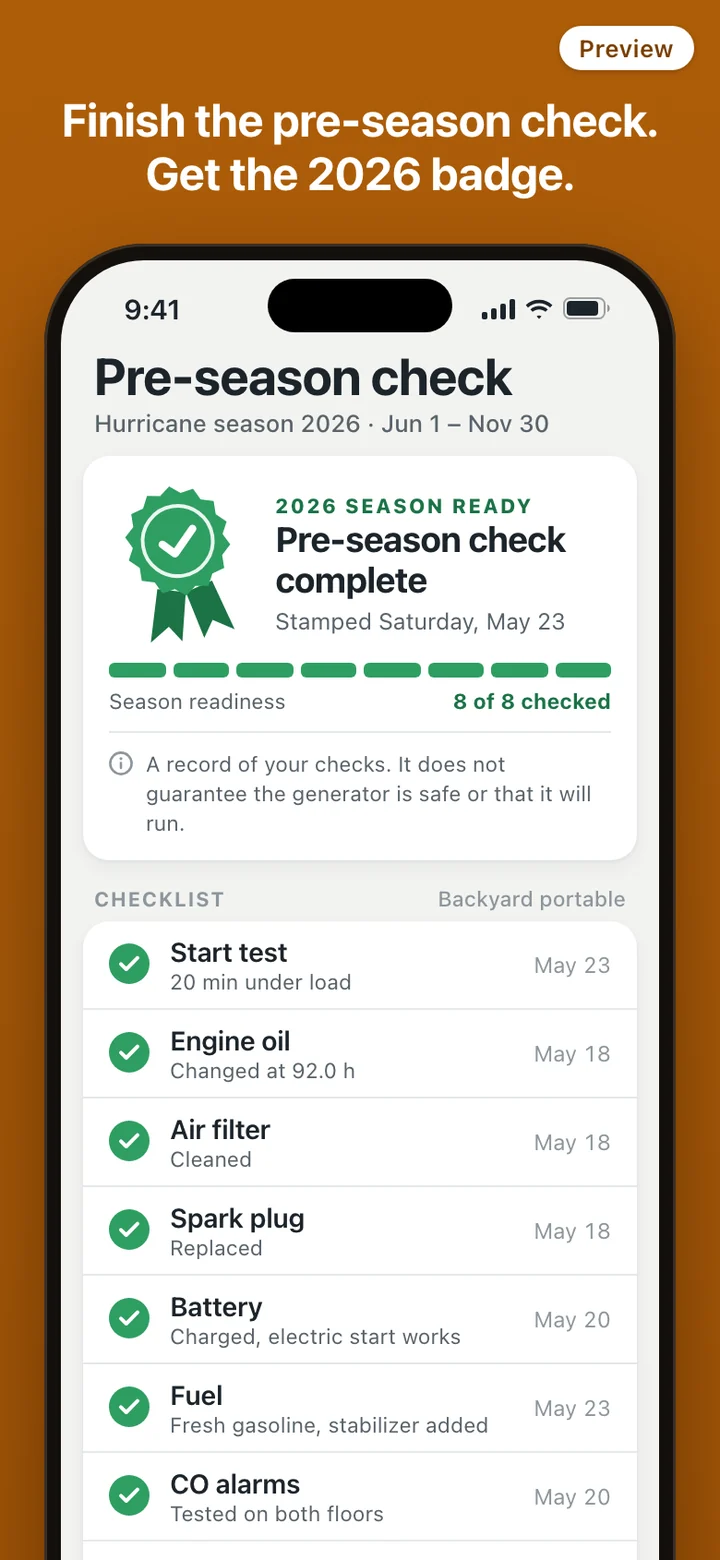
In hurricane mode the season follows the National Hurricane Center's dates for the Atlantic, June 1 to November 30. Ahead of each season the checklist resets for the new year, and if reminders are on, one tells you it is time to start. You do not have to finish in a single Saturday. Each item records the day you checked it, with an optional note, and the gauge holds its place between sessions.
The readiness gauge lights its first segment the moment you add a generator, and the first check moves it visibly, so the app is just as useful in January as it is in May. When the last item is checked, the badge for that season is stamped once, with a short haptic tap. The next year the list resets and there is a new badge to earn.
Checks can be undone and dates corrected. Unfinished items show as what is left, such as three items remaining, without red warnings or streak counters. A service that slipped is a normal state for a machine that sits most of the year.
Built for the day the power is out
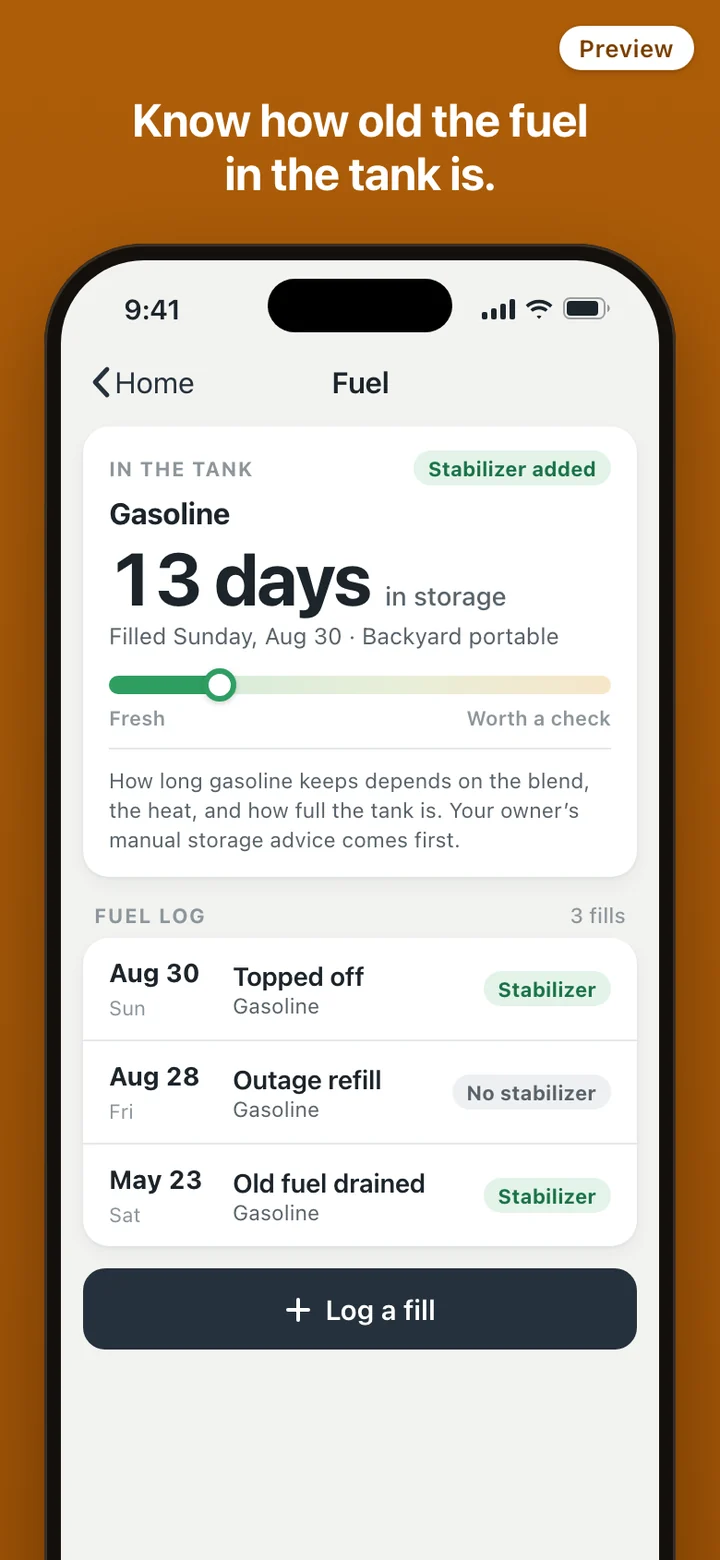
GenReady makes no network requests and has no account. Everything is stored on the phone, so the log, the checklist, and the fuel dates open the same way when the cell network is down and the house is dark. There is no analytics SDK in the app.
Reminders are optional and arrive as a short weekly digest rather than a ping for every item, with neutral wording that keeps your generator's name, your address, and costs off the lock screen. A JSON backup can be exported through the share sheet and restored on a new phone, and Settings has a single option to delete all data.
Not on the hurricane coast
Where the grid goes down on a schedule rather than with the weather, a hurricane season means little. Load shedding mode keeps the checklist year-round and resets it on a cycle instead of once a year, and the gauge is labeled for year-round readiness. A general mode works the same way with neutral wording. The mode is a setting, and you can switch it at any time.
What it leaves out on purpose
There is no Bluetooth, Wi-Fi pairing, or remote monitoring, and no parts store, wattage calculator, or serial-number lookup. GenReady does not teach installation or repair. The checklist records that you checked something, not how to do it; your owner's manual and a qualified technician cover that part.
GenReady is a record-keeping tool. A full gauge or a badge means you logged your checks; it does not mean the generator is safe or that it will start. The U.S. Consumer Product Safety Commission says to run a portable generator outdoors only, at least 20 feet from the home, with the exhaust pointed away from windows, doors, and vents, and to keep battery-operated or battery-backup CO alarms on every level of the home.