Three pieces of paper for one visit
Most one-truck lawn businesses run on three pieces of paper. The route lives in a spreadsheet or a printed client list. The application notice is a pre-printed door hanger filled in with a pen on the tailgate. The invoice gets typed up at the end of the month from whatever the route sheet says. Each one works on its own. The trouble is that the same visit gets written down three times, by someone who has eleven more yards to do before dark.
That is where things slip. A door hanger smudged in the rain is missing the time. A treated yard never makes it onto the invoice because the route sheet only said mowed. A customer calls in July to ask what went down on the lawn in May, and the answer is in a stack of carbon copies somewhere behind the seat. LawnRound records the visit once, at the yard, and builds the notice and the invoice line from that one record.
A Thursday on the round
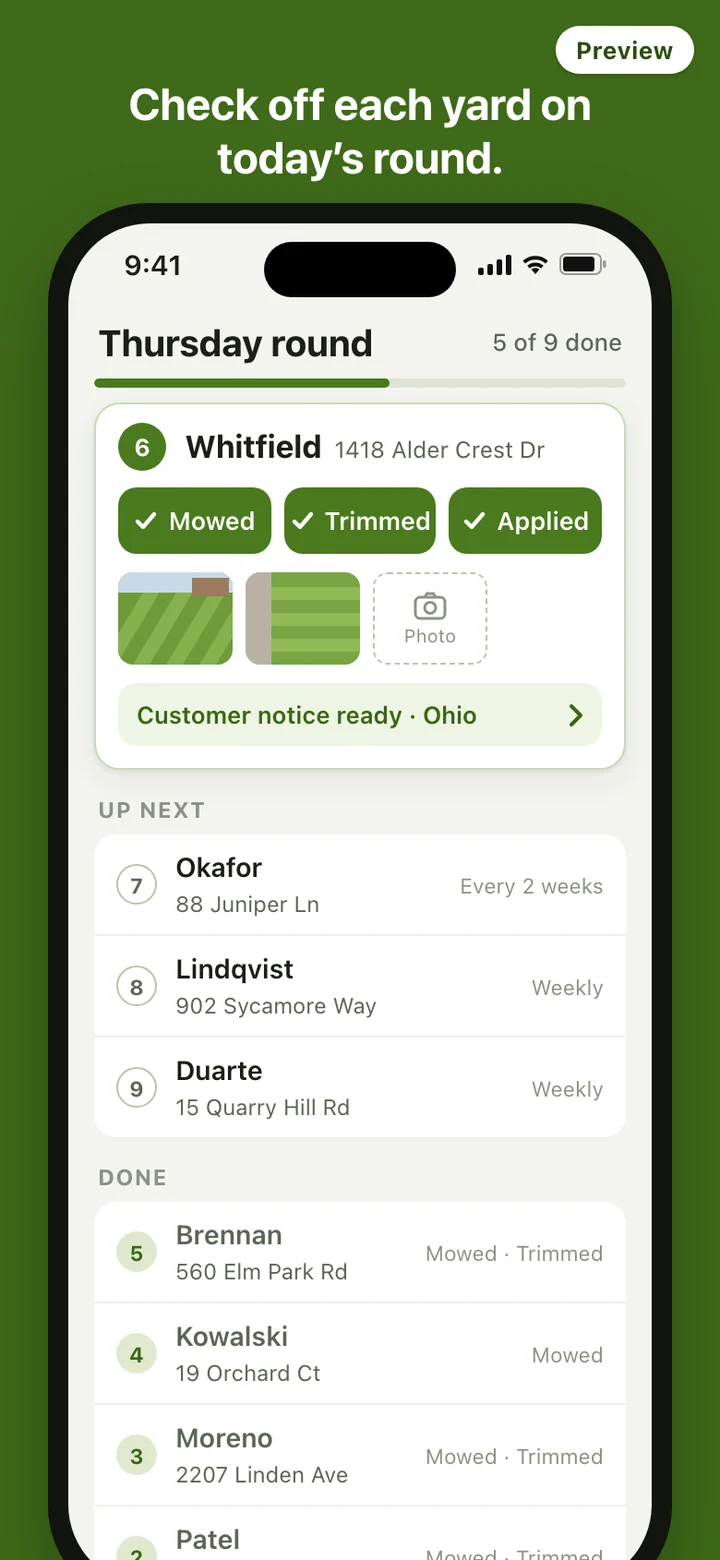
Open the app and today's round is already there: every customer due that day, in stop order, with the address and how often they are on the schedule. Weekly yards come up every week, and every-two-weeks yards come up on their turn. A progress line at the top counts the stops done.
At each yard you tap the stop and check what you did: mowed, trimmed, applied. A photo or two of the finished lawn goes on the same visit, which settles most of the did-you-come-this-week calls before they start. Then the next stop moves up.
When the last yard is done, the day is already written down. There is nothing to copy over at the kitchen table.
The notice, built from the visit
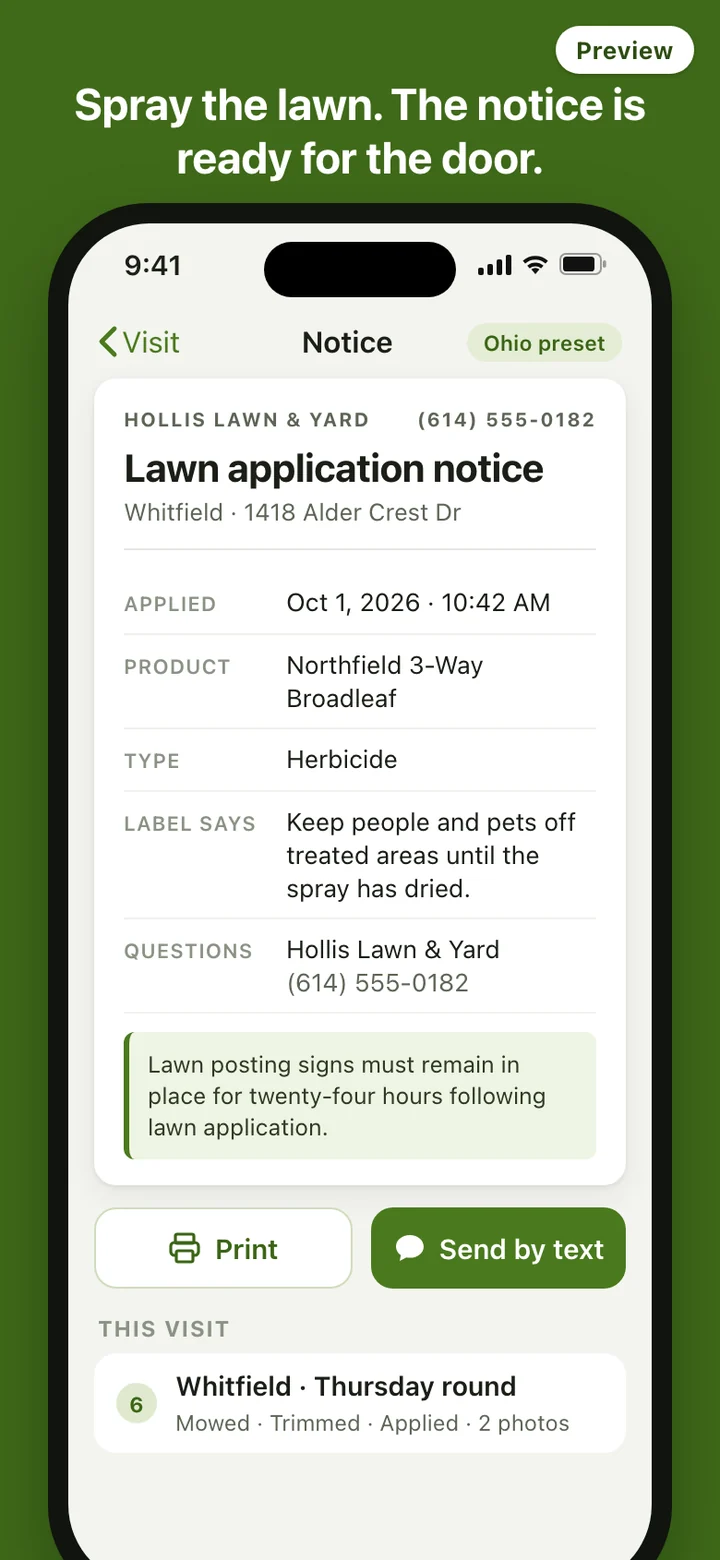
Checking applied opens the notice. You enter the product, and the notice fills in around it: product name, chemical type, the label instructions that apply to the customer, such as keeping people and pets off the treated area until the spray has dried, the date and time of the application, and your company name and phone number.
Three states get their own layout. With the Ohio, Wisconsin or Michigan preset, the notice asks for the customer items those states' lawn application rules list, so an Ohio notice carries the sentence about lawn posting signs staying in place for twenty-four hours, and a Wisconsin notice asks for the EPA registration number and the applicator's license number. Anywhere else, the notice comes out as a general visit report with the same core details.
The notice is a one-page PDF. Print it and hang it on the door, or send it to the customer by text message. They do not need an app, an account or a login to read it.
Customer cards and the season ledger
Every customer has a card with the address, the frequency and your rates: a price per cut and a price per application. The card keeps the visit history too, so last spring's treatments are a scroll away when the customer asks.
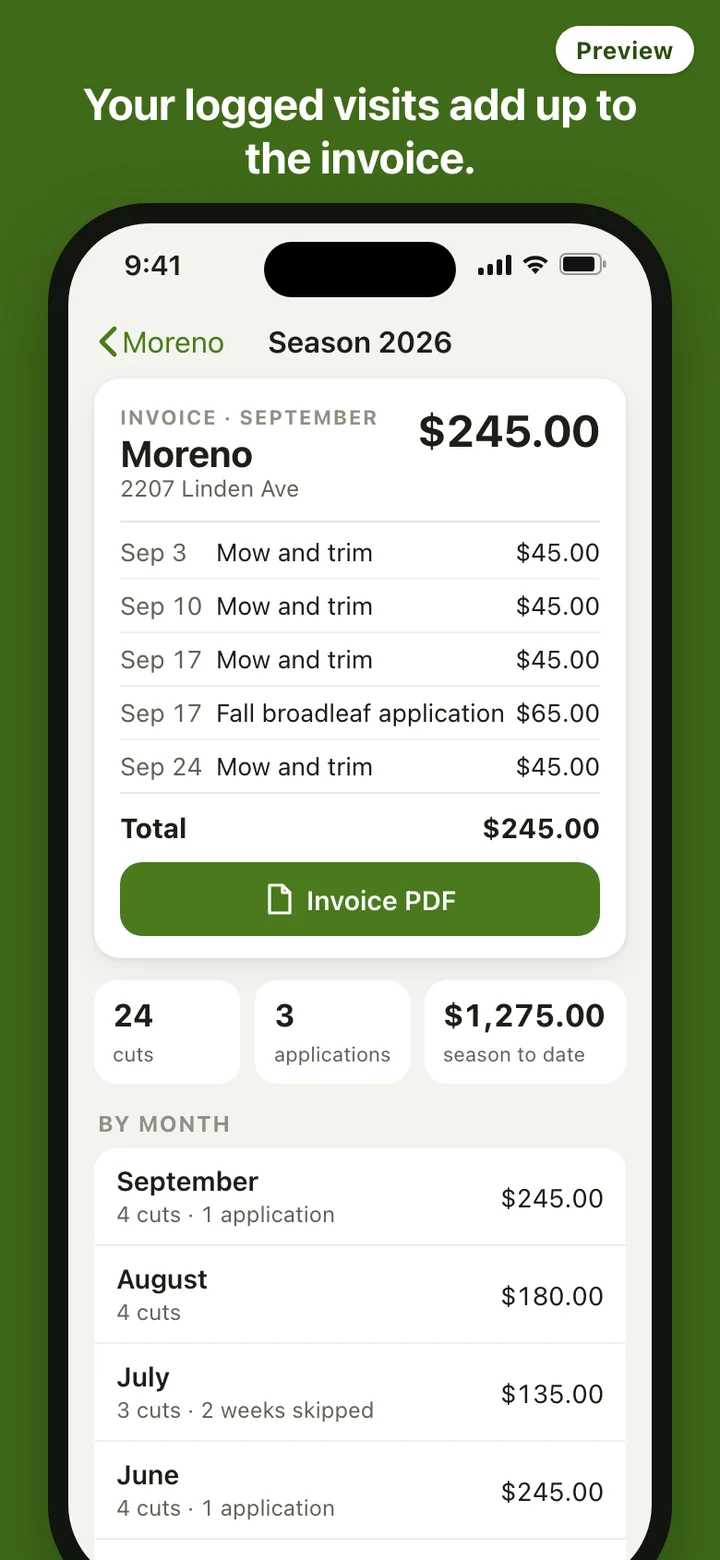
Each checked visit lands on that customer's season ledger at the rate on the card. A weekly customer at $45 a cut who gets a fall broadleaf application at $65 in September shows four cuts and one treatment that month, $245 in all. Pick the month, or the whole season, and the invoice PDF lists every date and service with the total.
Skipped weeks simply do not appear. If the grass stopped growing in a dry July, the ledger shows the three cuts you actually made, not the five you planned.
What LawnRound leaves out
LawnRound is built for one operator and one truck. It does not dispatch crews, track employee hours or follow your truck on GPS. There is no customer portal, no card processing and no estimating from satellite photos. It does not pick products, calculate mix rates or tell you what a lawn needs; the product label does that, and the choice of what to apply is yours. It also does not make the posting signs some states require on the lawn itself. Those are physical markers with their own size and wording rules. The notice in the app is the paper or text that goes to the customer.
Everything lives on your phone. There is no account to create, and the round, the visits, the photos and the notices all work without signal at the back of a subdivision. A text simply goes out once you have a connection again.
LawnRound is a record-keeping and paperwork tool. It does not give legal advice and does not guarantee that a notice meets your state's rules. The pesticide label and your state's pesticide regulatory agency have the final word, and rules change, so check the current text where you work.