Five checks, each with its own clock
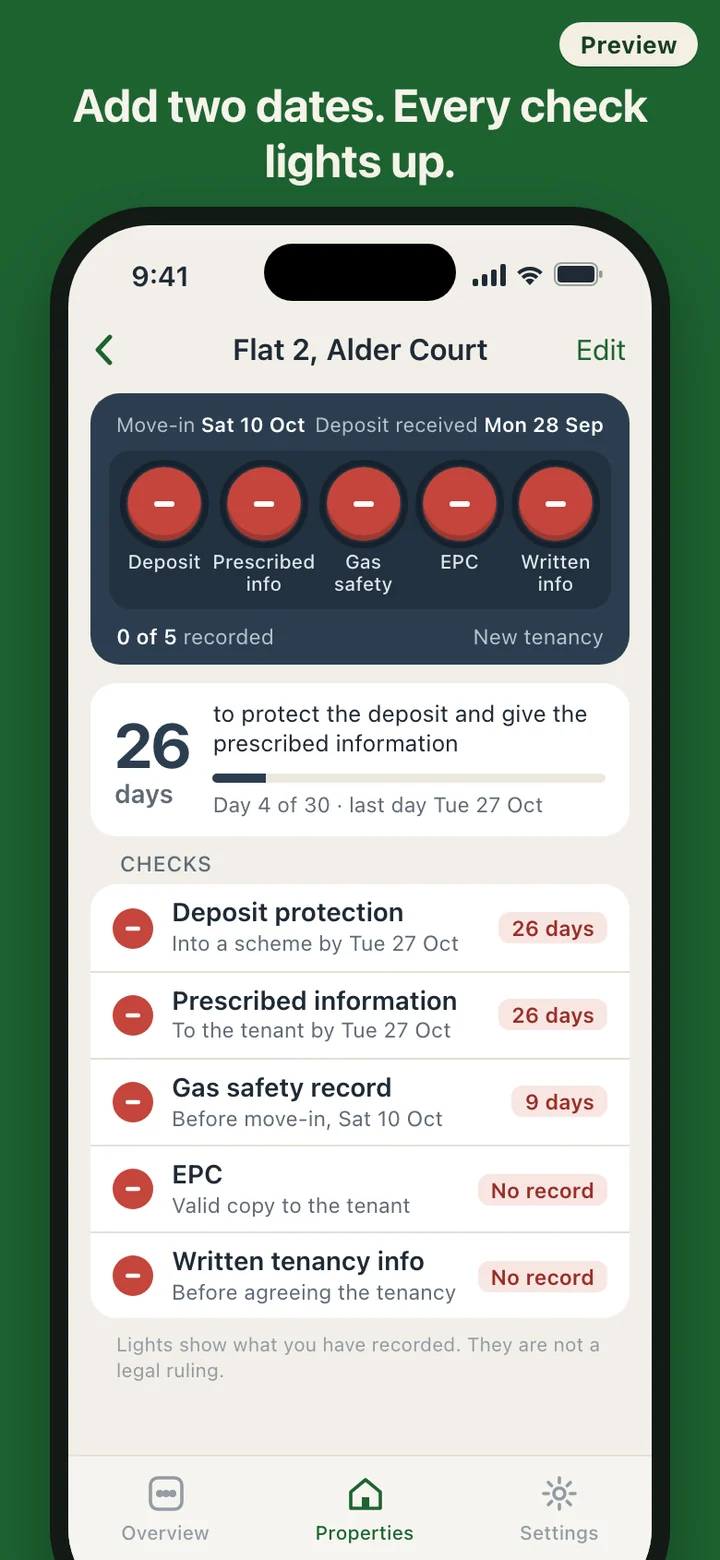
Letting a home in England puts several dates on the landlord, and they do not all start from the same day. Under section 213 of the Housing Act 2004, a deposit has to go into a government-approved scheme within 30 days beginning with the day you receive it, and the prescribed information about that scheme has to reach the tenant within the same 30 days. GOV.UK lists three approved schemes for England and Wales: the Deposit Protection Service, MyDeposits and the Tenancy Deposit Scheme.
The gas rules run on a different clock. Regulation 36 of the Gas Safety (Installation and Use) Regulations 1998 requires each gas appliance and flue to be checked at intervals of no more than 12 months, a copy of the latest record to go to a new tenant before they move in, and a copy to existing tenants within 28 days of each check. A valid EPC has to be given to the person who becomes the tenant, and GOV.UK says an EPC lasts 10 years. Since 1 May 2026, a new tenancy also needs written information about its key terms, given before the tenancy is agreed.
LetClock turns those rules into five checks per tenancy and works out each deadline from the dates you enter. Gas safety and the EPC belong to the property and carry over to the next tenancy. The deposit, the prescribed information and the written tenancy information belong to the tenancy and start again with each new one.
Where the dates usually live
Most landlords with one to a handful of properties keep these dates in several places at once: a diary entry for the gas engineer, the confirmation email from the deposit scheme, a spreadsheet tab per house, a folder of paper certificates. A letting agent tracks them if you pay for full management, and property management software does it inside a subscription with an account.
The gaps show up at the edges. The deposit deadline gets counted from move-in instead of from the day the money arrived. The annual gas check drifts because last year's record is in a different folder. A second property arrives and the spreadsheet grows a tab nobody opens. And the rules changed on 1 May 2026, so a checklist written in 2024 may still list the How to Rent guide, which GOV.UK withdrew that day.
What the lights mean
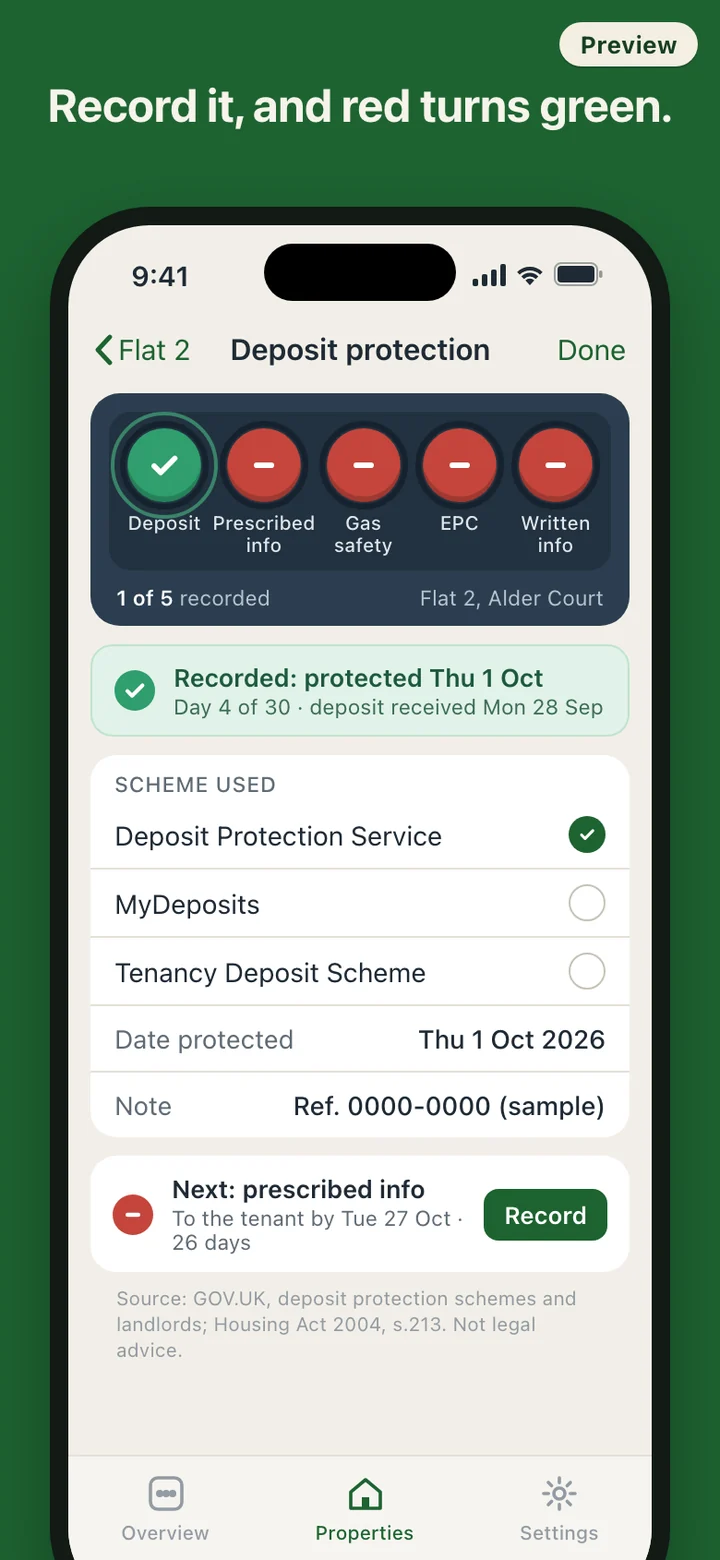
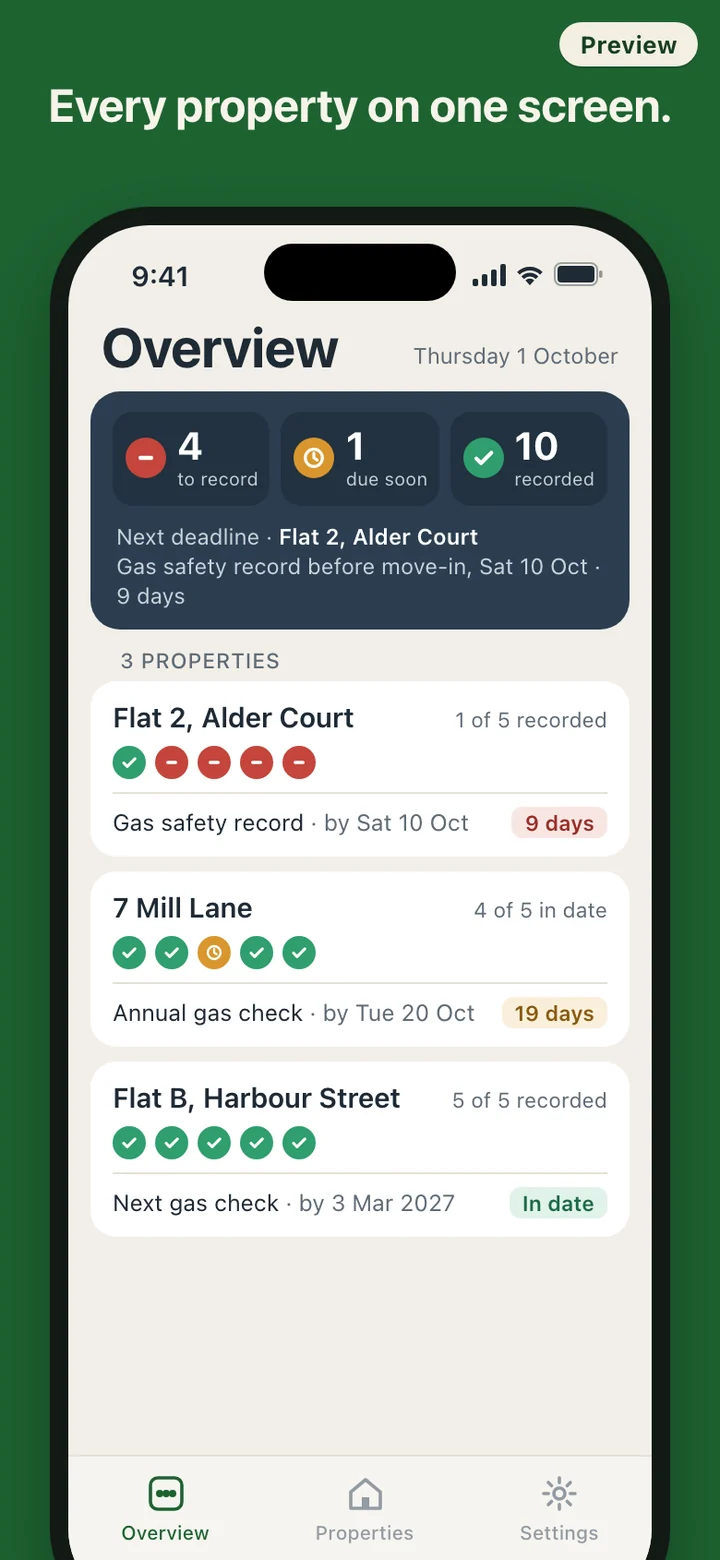
Red means a check still needs a record, or its deadline has passed without one. Amber means a date is close: a deadline within seven days, or an annual gas check within 30 days. Green means recorded and in date. Every light also carries a symbol and a word, so the status reads without relying on colour.
The board is a picture of what you have written down, not a ruling on whether you have complied. If you protected a deposit and never recorded it, LetClock still shows red. That is deliberate: the app only knows what you tell it, and a line under the board says so.
Nothing flashes or beeps. A light changes at the moment you record something, with one short haptic tap, and then stays still. A board full of red is the normal first view of a tenancy you have just added, and a tenancy entered months after move-in may show several deadlines already past. The card for each one starts with what you can do now.
Why the dates carry more weight since 1 May 2026
Part 1 of the Renters' Rights Act 2025 came into force in England on 1 May 2026. Section 21 can no longer be used, and a landlord seeking possession gives notice under section 8, relying on one or more grounds for possession. GOV.UK's possession guidance says that where a deposit was taken, a court will only make a possession order if the deposit was protected, the scheme's requirements were met and the tenant was given the correct information, or the deposit was returned, or a court challenge about it was decided, settled or withdrawn. Grounds 7A and 14, for antisocial behaviour, are outside that rule.
Separately, a tenant can apply to the county court if a deposit was not protected or the information was not given in time, and section 214 of the Housing Act 2004 sets the award at between one and three times the deposit.
LetClock answers that with a date and a next step rather than a warning. Each check opens a card that says what is due, by when, and where to do it, with links to GOV.UK and the three schemes that open in your browser, and the date its source was last checked.
From one tenancy to the next
When a tenancy ends, the property goes quiet rather than disappearing. Start a new tenancy and a fresh 30-day deposit track begins from the new receipt date, while the gas safety and EPC records you already hold carry across. Changing a move-in or receipt date later recalculates every deadline and keeps the checks you have already recorded.
Reminders are local notifications from your phone: seven days and one day before the deposit deadline, 30 and seven days before an annual gas check, 30 days before an EPC runs out, and a week before move-in for anything due by then. Several on the same day arrive as one. The lock-screen wording stays neutral and never shows the property address.
What LetClock leaves out on purpose
LetClock tracks compliance dates and nothing else. There is no rent ledger, no repair tickets, no tenant contact list and no store for certificate scans. A tenancy is identified by a property label and its dates, so you never type a tenant's name. It does not write the prescribed information, the written tenancy information or any notice for you, and it does not judge whether a notice would be valid.
There is no account and no server. Everything stays on your phone, the app sends nothing anywhere, and there are no analytics. A backup file you can restore on a new phone covers a lost or replaced device, and Settings has one option that deletes everything. LetClock is not affiliated with GOV.UK or any deposit scheme, and its checklist follows the rules for England only.
LetClock is a deadline and record-keeping tool, not legal advice. It does not decide whether you have met your obligations as a landlord. The rules change; check GOV.UK, your deposit scheme or a solicitor about your own tenancy.