A number carried from one Ramadan to the next
Fasts are missed for ordinary reasons: illness, travel, menstruation, pregnancy, nursing. The count usually lives on a scrap of paper, in a phone note, or in a message sent to yourself, and after a few years the scrap and the note no longer agree. Plenty of people only know roughly how many fasts they owe, and that uncertainty alone makes it hard to begin.
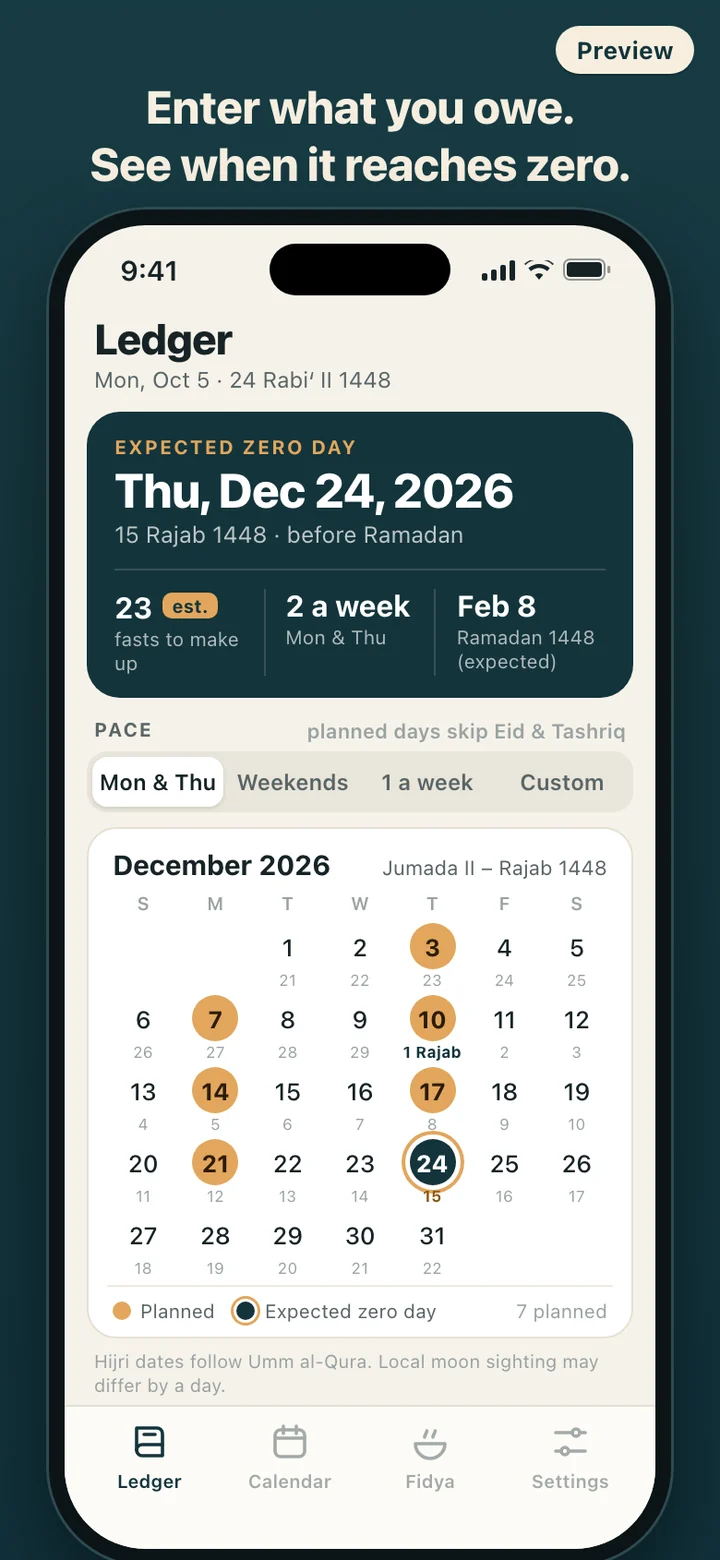
The harder question is the plan. If you fast two days a week, when are you done? Does that land before the next Ramadan or after it? Working it out by hand means counting weekdays around the Eid days on a calendar that runs on two systems at once. QadaBook keeps the balance in one place and does that counting for you.
One balance, one pace, one expected date
The first screen asks for a single number. If you are not sure, enter your best estimate and mark it as an estimate; you can correct it whenever you remember better. A reason can be added to an entry from neutral labels such as travel, illness, menstruation or nursing, or left blank. It is never required and it never leaves the phone.
Then choose a pace. Mondays and Thursdays comes first, matching the weekly sunnah fasting days; weekends, one day a week and a custom set of weekdays are there too. QadaBook lays the planned days on the calendar, skips Ramadan, both Eids and the three days of Tashriq, and shows the date your balance is expected to reach zero. It also shows when the next Ramadan is expected to begin and says plainly whether the plan finishes before or after it.
On a day you make up a fast, tap Made up a fast today. The balance drops by one and the zero day moves closer. You can log a past date, undo a tap within a few seconds, and edit or delete any entry later; the forecast recalculates each time. A planned day you did not fast is simply carried forward. Nothing is flagged, counted against you, or coloured red.
Hijri dates, with room for local sighting
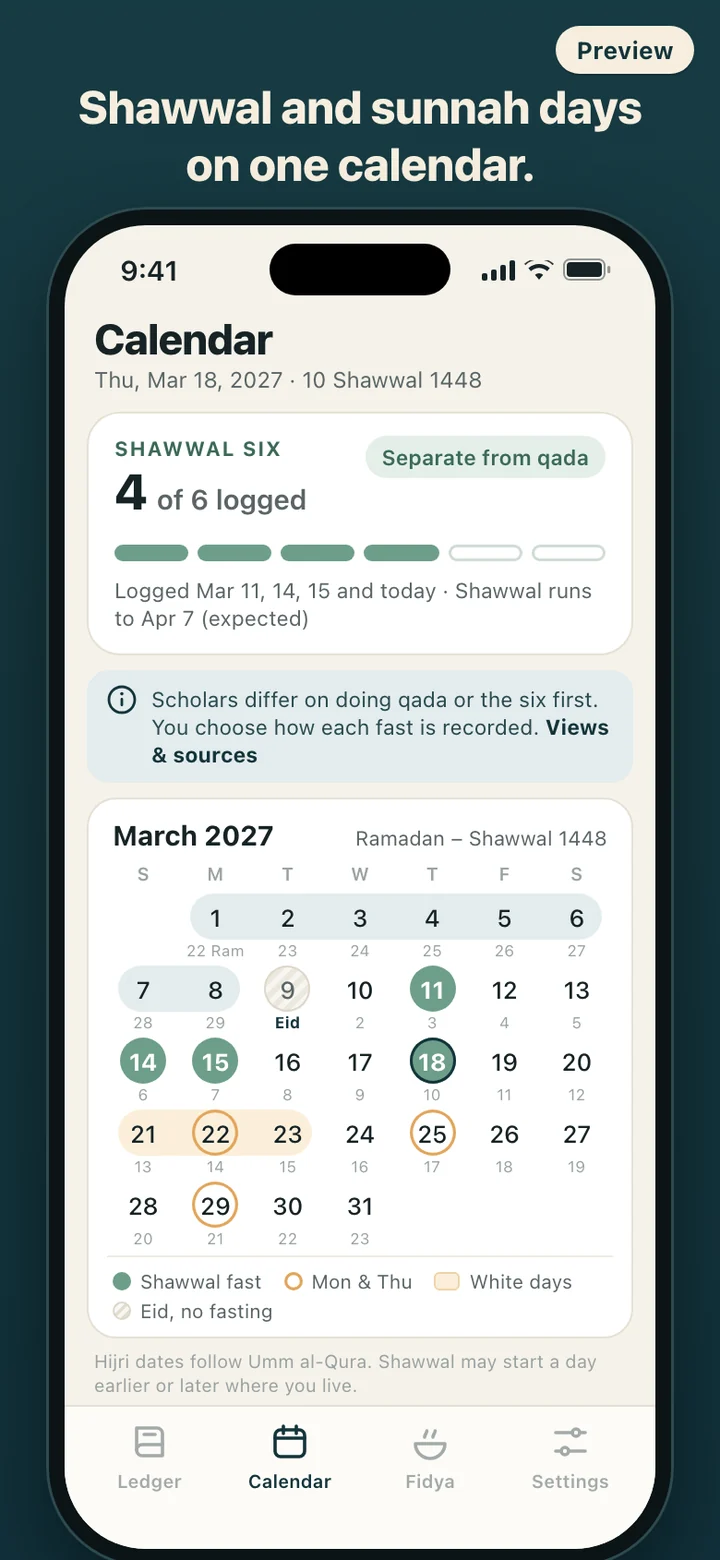
Every date in QadaBook carries its Hijri date, calculated from the Umm al-Qura calendar. The start of Shawwal, the white days, Arafah, Ashura and the expected start of Ramadan all come from it.
Months in your community may begin a day earlier or later, depending on local moon sighting announcements. The calendar says so wherever it matters, and a setting shifts every Hijri date by a day in either direction so it matches what your mosque announced.
Fidya, with your own numbers
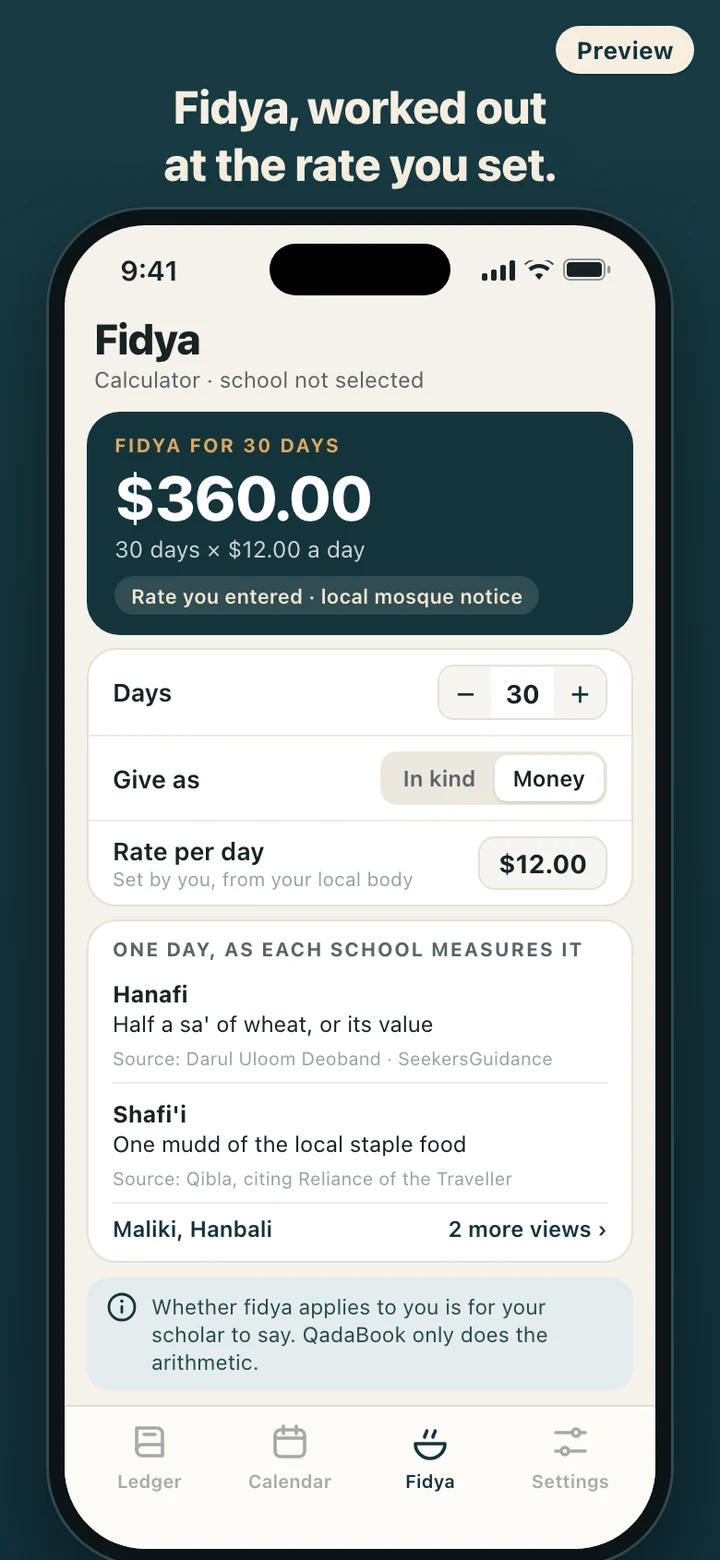
Fidya is the compensation of feeding a person in need for each day that cannot be fasted, usually discussed for old age or a long-term illness with no expected recovery. Schools differ on who owes it, how one day is measured, whether it can be given as money, and whether delaying qada past the next Ramadan adds it. QadaBook does not decide any of that for you.
What it does is the arithmetic. Choose in kind or money, enter the rate per day your local mosque or zakat body has published, and the total appears with the working shown. QadaBook never fetches prices, so the figure on screen is always built from the number you entered. Leave your school unselected and each school's measure is listed side by side with its source; choose one and only its view is shown. Payments can be noted with a date and a memo.
What QadaBook leaves alone
It does not calculate prayer times, suhoor or iftar times, or anything measured in hours and minutes; its smallest unit is a day. It carries no Quran or hadith readings and no exhortations. There are no streaks, badges or scores, and no messages about how far behind you are.
Reminders are off until you turn them on. If you do, one arrives on the evening before a planned day at a time you pick, and by default the lock screen text does not mention fasting, qada or your balance. If a planned day passes without a fast, no reminder chases it; the next planned day simply comes round.
There is no account and no server. The ledger lives on your phone, makes no network requests and carries no analytics. You can export the whole record to a file, keep it wherever you like, restore it on a new phone, or delete everything from Settings.
QadaBook is a record-keeping and calculation tool. It does not issue religious rulings or tell you which view to follow. Schools of Islamic law and individual scholars differ on making up fasts, fidya and the Shawwal fasts, so check your own situation with a scholar you trust or your local Islamic authority.