The paper pad, without the adding up
At most game tables the scorekeeper is whoever ends up holding the pencil. Yahtzee comes with a pad of score cards, Wingspan comes with a scorepad, and every other game gets the back of an envelope. Paper works until it doesn't: the pad runs out halfway through a series, someone adds a long column wrong at midnight, the upper bonus gets forgotten, and the sheet with last month's results goes out with the recycling.
TallyDeck keeps the shape of the paper pad, players across the top and categories or rounds down the side, and takes over the arithmetic. Subtotals, bonuses, totals and places are worked out while you write, by the same rules during the game and after it ends. Fixing a wrong number means tapping the box again, not scribbling over it.
Four sheets to start with
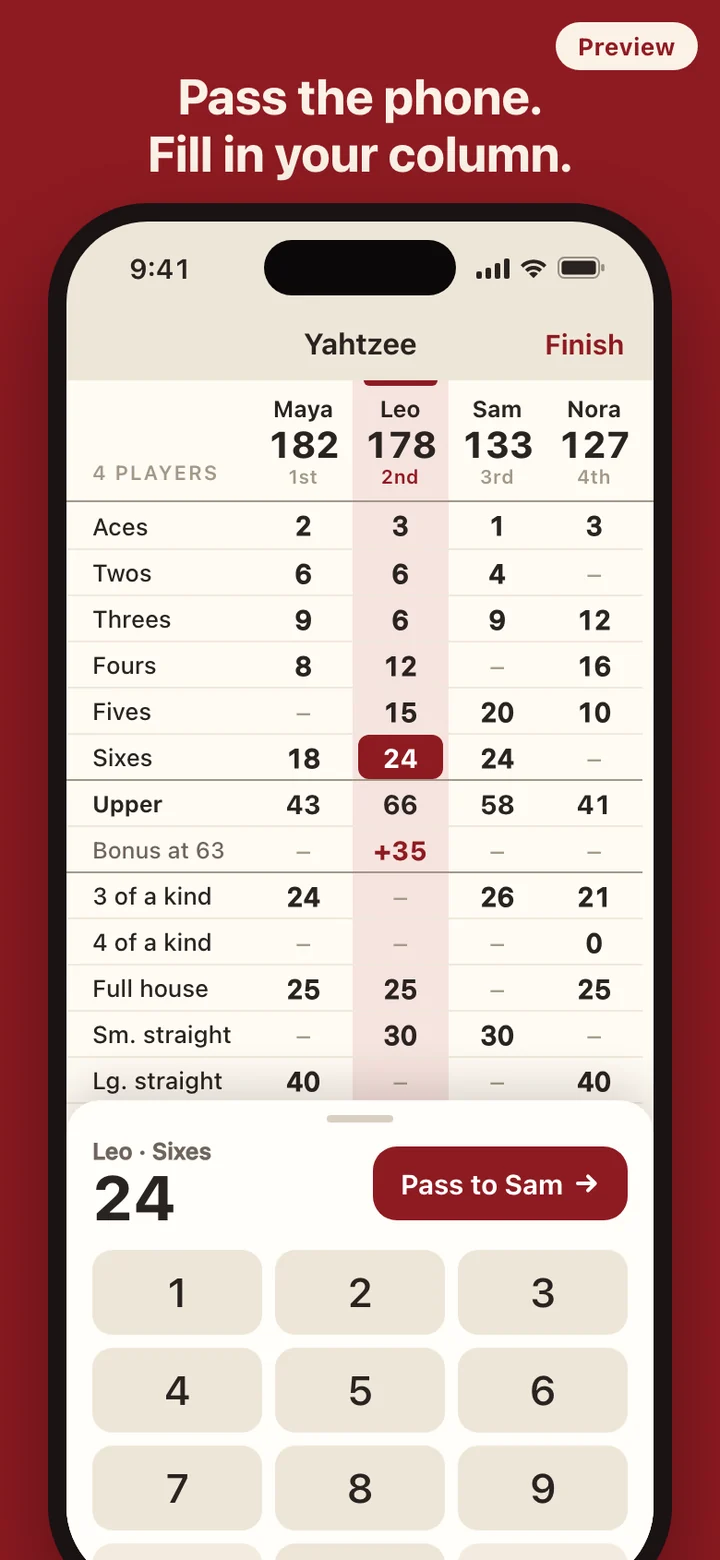
Yahtzee. The six upper boxes from Aces to Sixes with a running subtotal, and the 35-point bonus once that subtotal reaches 63, as the published rules set it. Below that come Three and Four of a Kind, Full House at 25, Small Straight at 30, Large Straight at 40, Yahtzee at 50, and Chance.
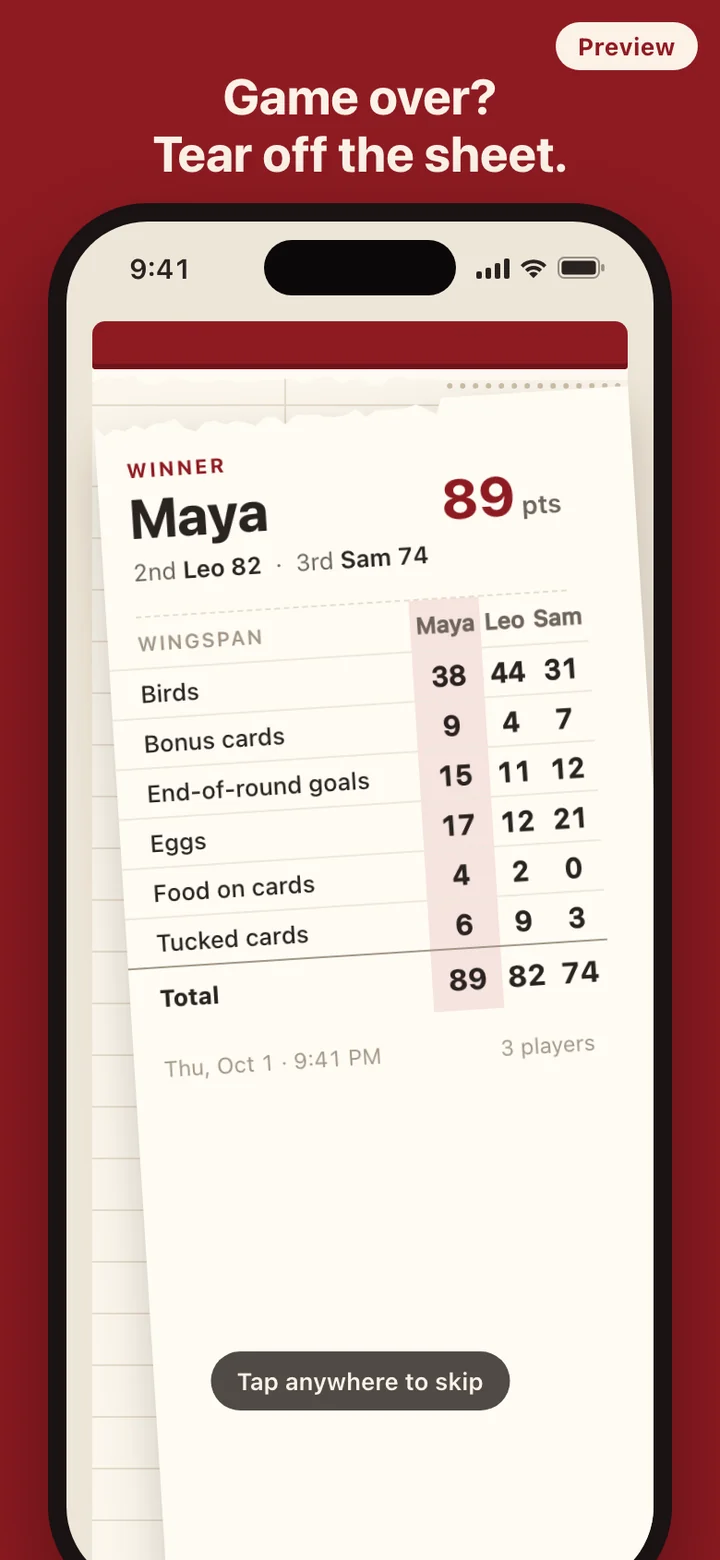
Wingspan. One row for each end-of-game category: birds, bonus cards, end-of-round goals, eggs, food on cards and tucked cards. You enter what you counted on the table, and the sheet adds the six rows for every player.
Truco. A counter for two teams that ends the game when a team reaches 12, the target in the Brazilian game.
Any game. A blank sheet for everything else. Add a round whenever you need one, enter plus or minus points for each player, name the rounds if you like, and see each round's score next to the running total.
Two ways to fill a sheet
In games like Yahtzee everyone writes their own score on their own turn. The phone goes around the table, the current player's column is highlighted so whoever is holding it knows where to write, and the next-player button hands it on.
In games scored at the end, like Wingspan, one person usually reads out everyone's numbers. Type a number and the next box is selected, so a whole table can be entered in one go. Both ways happen on the same grid; there is no mode to switch.
By default the screen stays awake while a sheet is open, so the phone does not lock between turns. The keypad and the boxes are sized for a dim living room or a game café rather than a desk, with dark numbers on light paper. The tearing sound follows the phone's silent switch and can be turned off in Settings.
A game night, start to finish
- Open the app and you are on a new sheet. Tap names from the people you played with last time, type new ones, or skip names entirely and start as P1 and P2. A sheet holds two to eight players.
- Pick Yahtzee, Wingspan, Truco or Any game.
- Play. Pass the phone or keep it, and correct any box by tapping it again.
- When the game is over, tap Finish. The sheet tears off, and the winner and the final places are on it.
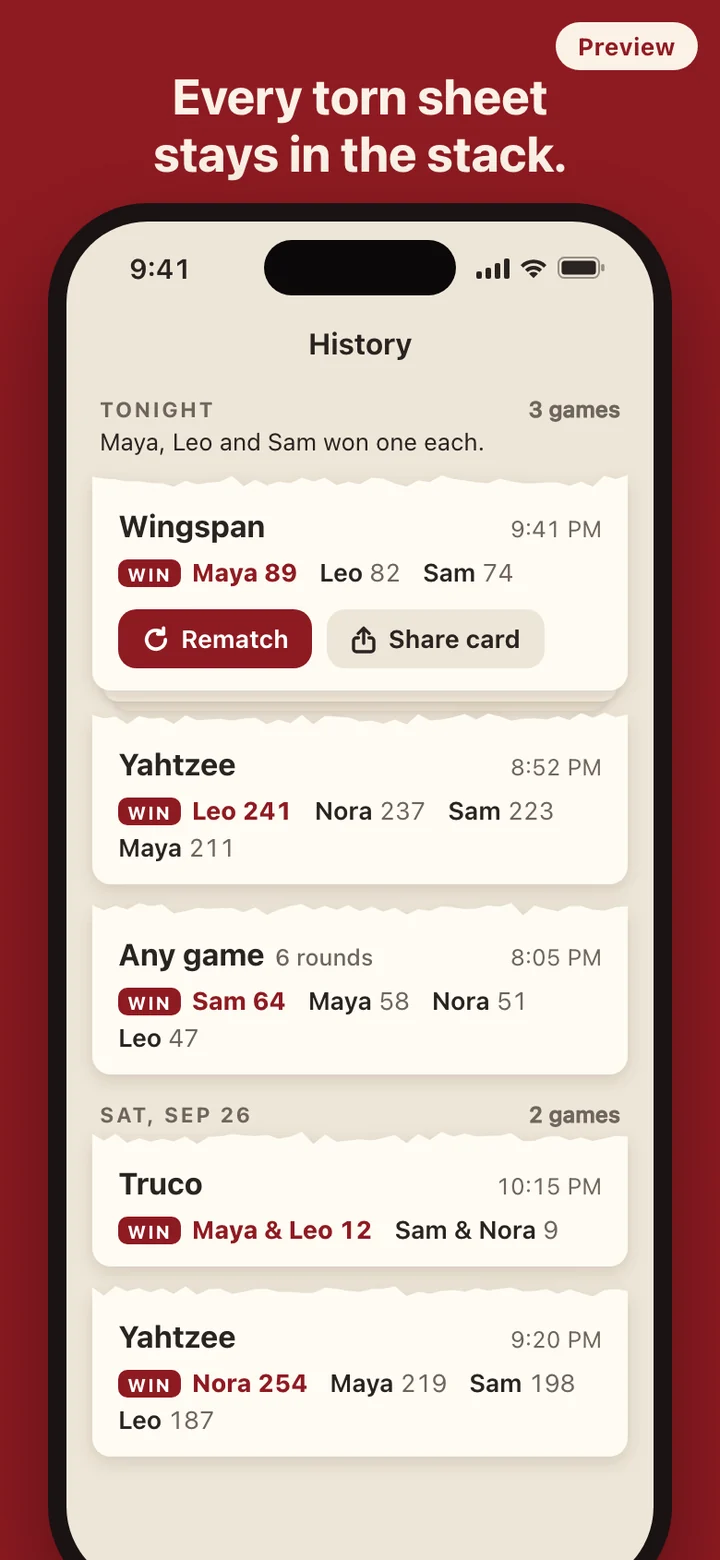
- Tap Rematch for another game with the same players and the same sheet, or start a fresh one.
- At the end of the night, share a result card to the group chat through your phone's share sheet. The card is an image of the torn sheet, ragged edge included.
On the phone, nowhere else
TallyDeck has no account and makes no network requests, so it works the same in a basement game café, at a cabin with no signal, or in airplane mode. Sheets, players and history are stored on the phone. There is no analytics SDK and there are no notifications; the game night decides when the app opens.
To move to a new phone, make a backup file, send it wherever you like through the share sheet, and restore it on the other phone. Delete all data in Settings clears sheets, players and saved result card images in one step, and the app starts again from a blank sheet.
What it leaves out
TallyDeck keeps score. It does not roll dice, deal cards, run turns, or explain how to play, so the game itself still sits on the table. Yahtzee, Wingspan and Truco are named only to say which scoresheet you are picking. TallyDeck is not affiliated with the publishers of these games, and it contains no game art, logos or rulebook text.
Players are a name and a color, with no photos or profiles. Renaming someone does not rewrite old sheets; a torn sheet keeps the names as they were on the night.