
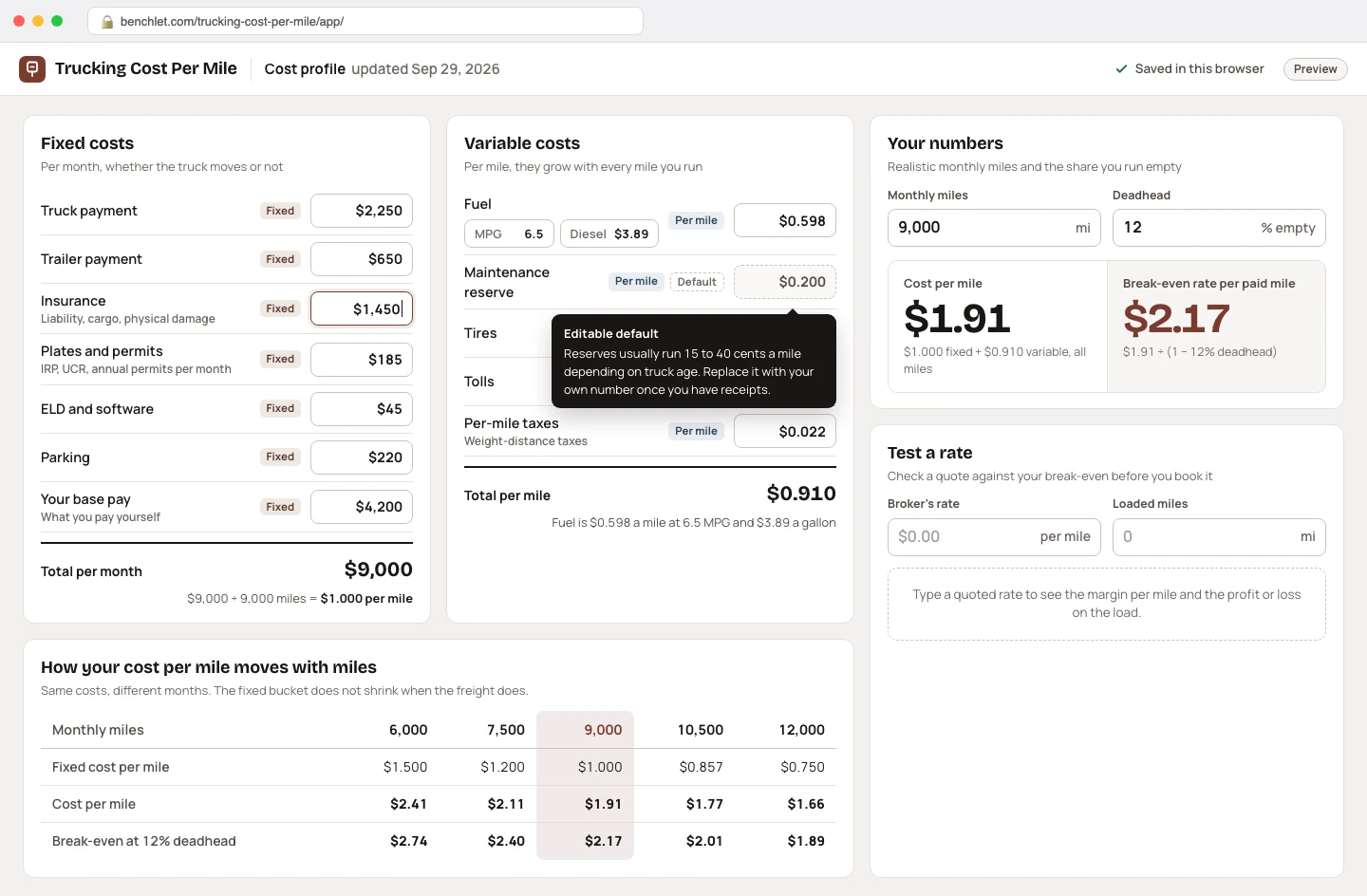
Fill the two cost columns
Monthly fixed costs on one side, per-mile variable costs on the other. Editable defaults cover anything you do not know yet, and every line shows whether it is fixed or variable so nothing lands in the wrong bucket.
Trucking · for owner-operators

Trucking Cost Per Mile Calculator takes your fixed monthly costs and per-mile variable costs and returns two numbers every owner-operator negotiation runs on: your true all-in cost per mile, and your break-even rate after deadhead. Free, in your browser, and your financials never leave your machine.
Monthly fixed costs on one side, per-mile variable costs on the other. Editable defaults cover anything you do not know yet, and every line shows whether it is fixed or variable so nothing lands in the wrong bucket.
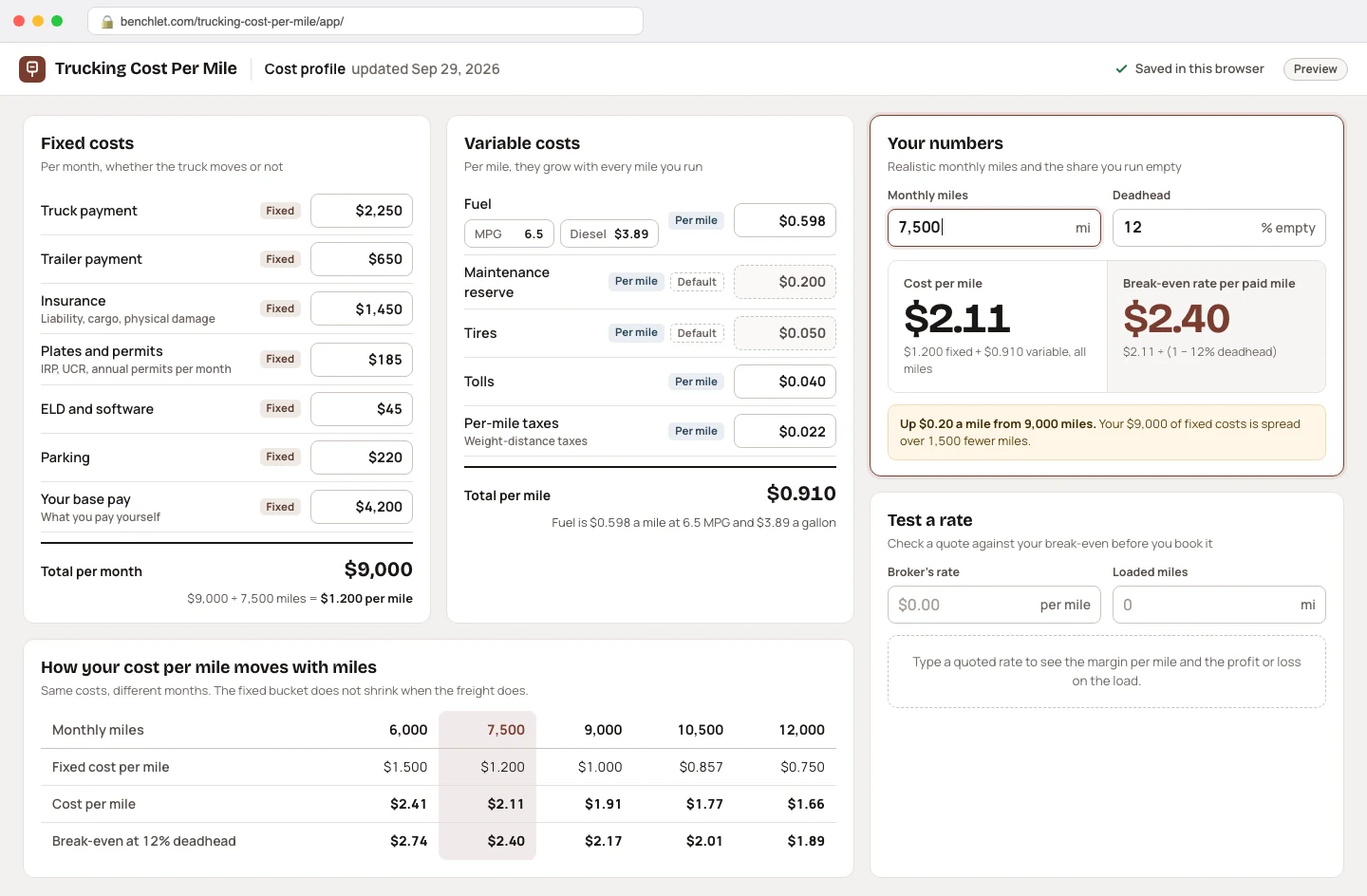
Your realistic monthly miles and your empty-mile percentage. The calculator computes all-in cost per mile, then marks it up to the break-even rate a paid mile must clear.
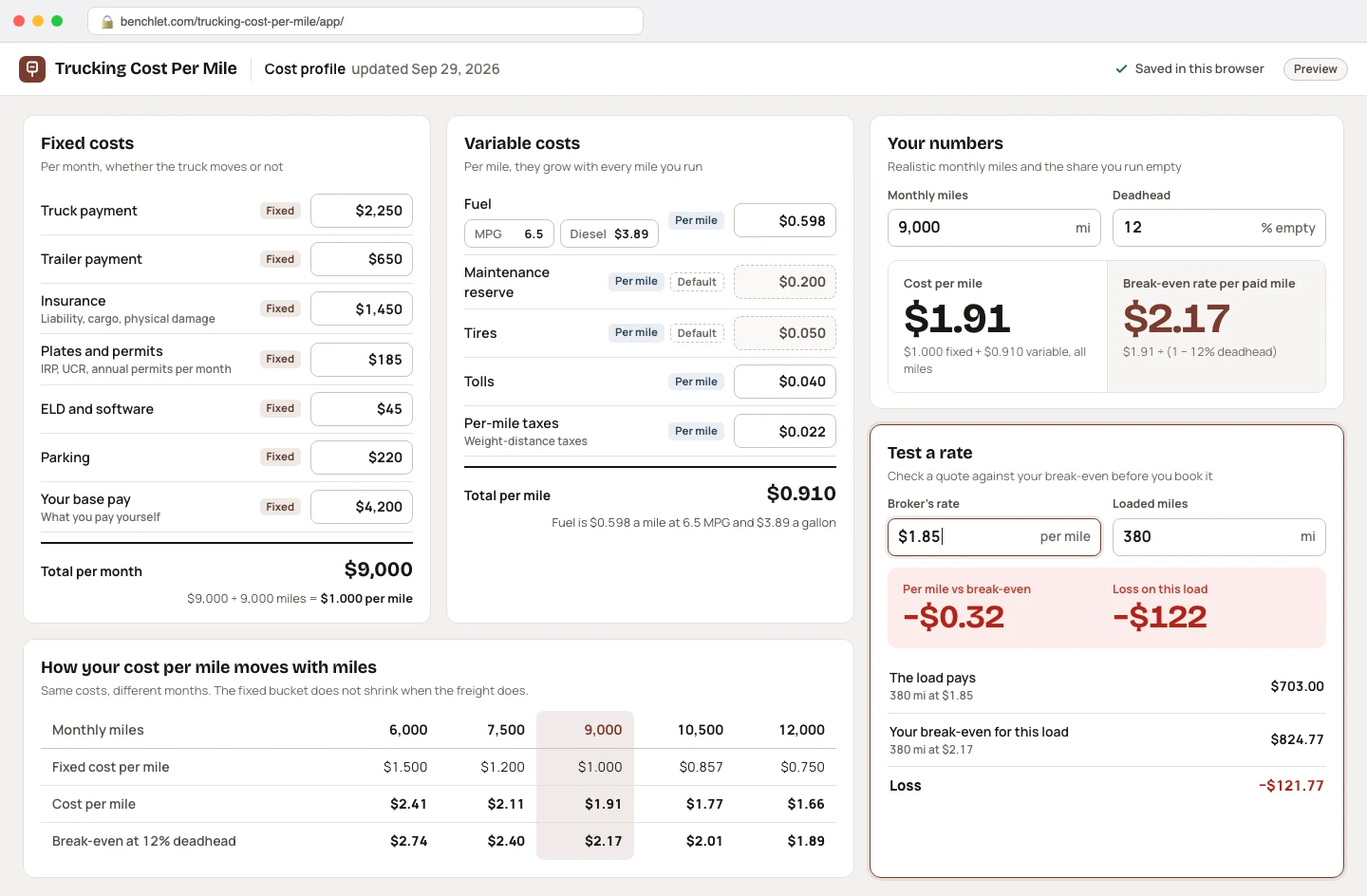
Type a broker's quoted rate and see the per-mile and per-load margin instantly, green or red, with the profit in dollars for the load's distance. Your cost profile stays saved in the browser for next month.
Ask ten owner-operators their cost per mile and several will quote the industry average, not their own. The averages are real — ATRI measured $2.336 per mile industry-wide for 2025, the highest since its cost series began — but an average blends 500-truck fleets with your one truck, your payment, and your lanes. Meanwhile the tools for computing a personal number have not kept up: the long-standing association calculators are dated, spreadsheet-era forms, and much of what ranks in search is either a factoring company's lead-capture page or a paid spreadsheet. In a market where contracted owner-op rates averaged near $2.08 in 2025, hauling without your own CPM means discovering unprofitable loads at tax time instead of at the negotiation.
The method is bookkeeping, not rocket science, and the calculator keeps it visible. Fixed costs — truck and trailer payments, insurance premiums, plates, permits, ELD subscription, your own salary — are summed per month and divided by the miles you actually run that month. Variable costs — fuel, maintenance reserve, tires, tolls — are entered per mile directly or derived (fuel from MPG and pump price). The sum is your cost per mile at that mileage, and the calculator immediately shows how it moves: the same cost sheet that yields $1.91 at 9,000 miles a month climbs to $2.11 at 7,500, because the fixed bucket does not shrink when the freight does. That sensitivity view is the part a static spreadsheet never shows you.
This calculator is a sibling of our Trucker Daily Log, the browser tool for ELD-exempt short-haul drivers who need an inspection-ready paper log on exception days — same shop, same rules: free, no account, nothing uploaded. Short-haul and owner-operator economics overlap more than the software market admits; the driver filling out a paper log on an over-radius day is often the same person deciding whether a $1.85 load is worth the diesel.
Fixed costs bill you whether the truck moves or not: truck and trailer payments, insurance, plates and permits, ELD and software subscriptions, parking, and your own base pay. Variable costs scale with miles: fuel, maintenance and tires, tolls, and per-mile taxes. The split matters because fixed costs are divided by your actual monthly miles — which is exactly why your cost per mile goes up in a slow month even though you spent less in total.
Cost per mile is what a loaded-and-empty mile costs you all-in. The break-even rate is what a paid mile must earn, and it is higher, because deadhead miles cost money but pay nothing. Enter your deadhead percentage and the calculator marks up the floor accordingly: at $1.91 all-miles CPM and 12 percent deadhead, a paid mile must gross about $2.17 before you make the first dollar of profit.
For scale: the American Transportation Research Institute's operational-costs study put the industry-average marginal cost of running a truck at $2.336 per mile in 2025, up 3.4 percent from 2024 — while average carrier-contracted owner-operator rates slipped to around $2.08 per mile. That gap is the whole reason to know your own number: averages include megafleet economics, and your CPM might be meaningfully lower or higher depending on your truck payment, insurance history, and lanes.
Use real quotes where you have them (truck payment, insurance) and the calculator's editable defaults where you do not — fuel from your expected MPG and current diesel prices, maintenance reserves in the 15 to 40 cents-per-mile range depending on truck age. Every default is visible and overridable; the point is to replace guesses with your own receipts as they accumulate.
No. The calculation runs in your browser and your cost profile is stored only in your browser's local storage, so next month you update fuel and miles instead of starting over. There is no account and nothing is transmitted. The early-access signup on this page is optional and just gets you one launch email.
 Trucking
DOT driver daily log, printed from your browser
 Planted tanks
EI and PPS-Pro doses for your exact tank
 Training
CSV roster in, a ZIP of print-ready PDFs out
 Soap making
Exact NaOH and KOH amounts for any oil blend
Pick the channel you use.