Why soap makers still argue about calculators
Every soap maker uses a lye calculator, because nobody sane multiplies saponification values by hand for a six-oil blend at 5 percent superfat. The standard-bearer of the genre has served the community faithfully for two decades — and looks it: a dense desktop-era form that fights small screens, no way to save a recipe without screenshots, and no first-class support for the dual-lye recipes that shave-soap and cream-soap makers rely on. Forum threads on the big soap-making boards regularly walk newcomers through workarounds: calculate the KOH portion in one pass, the NaOH portion in another, adjust for purity by hand, and hope no step got fat-fingered. For a craft where the penalty for a lye miscalculation is a caustic batch, the workaround culture is the problem.
Who this is built for
Three makers, mainly. Cold-process bar soapers who want the routine case — pick oils, set 5 percent superfat, get NaOH and water — with less friction and a printable card for the binder. Shave-soap and cream-soap makers who need the NaOH/KOH split computed properly in one pass, purity included. And sellers batching for markets, who resize a proven recipe from a 1,000-gram test batch to a 4,500-gram production run and need every number to scale exactly, not approximately.
How it works
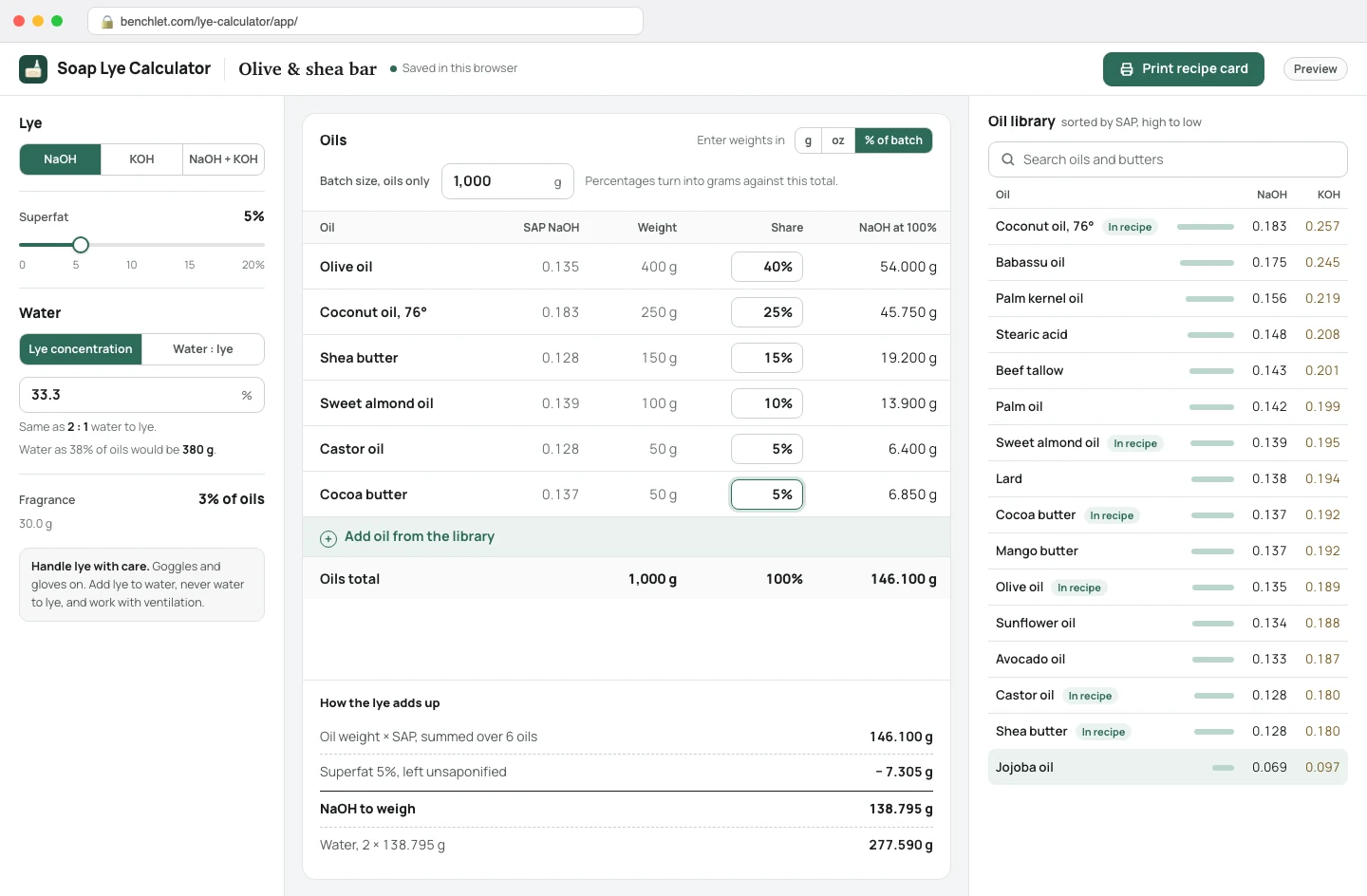
- List your oils. Pick from the oil library — each entry carries its own NaOH and KOH saponification values — and enter weights in grams, ounces, or percentages of a target batch size.
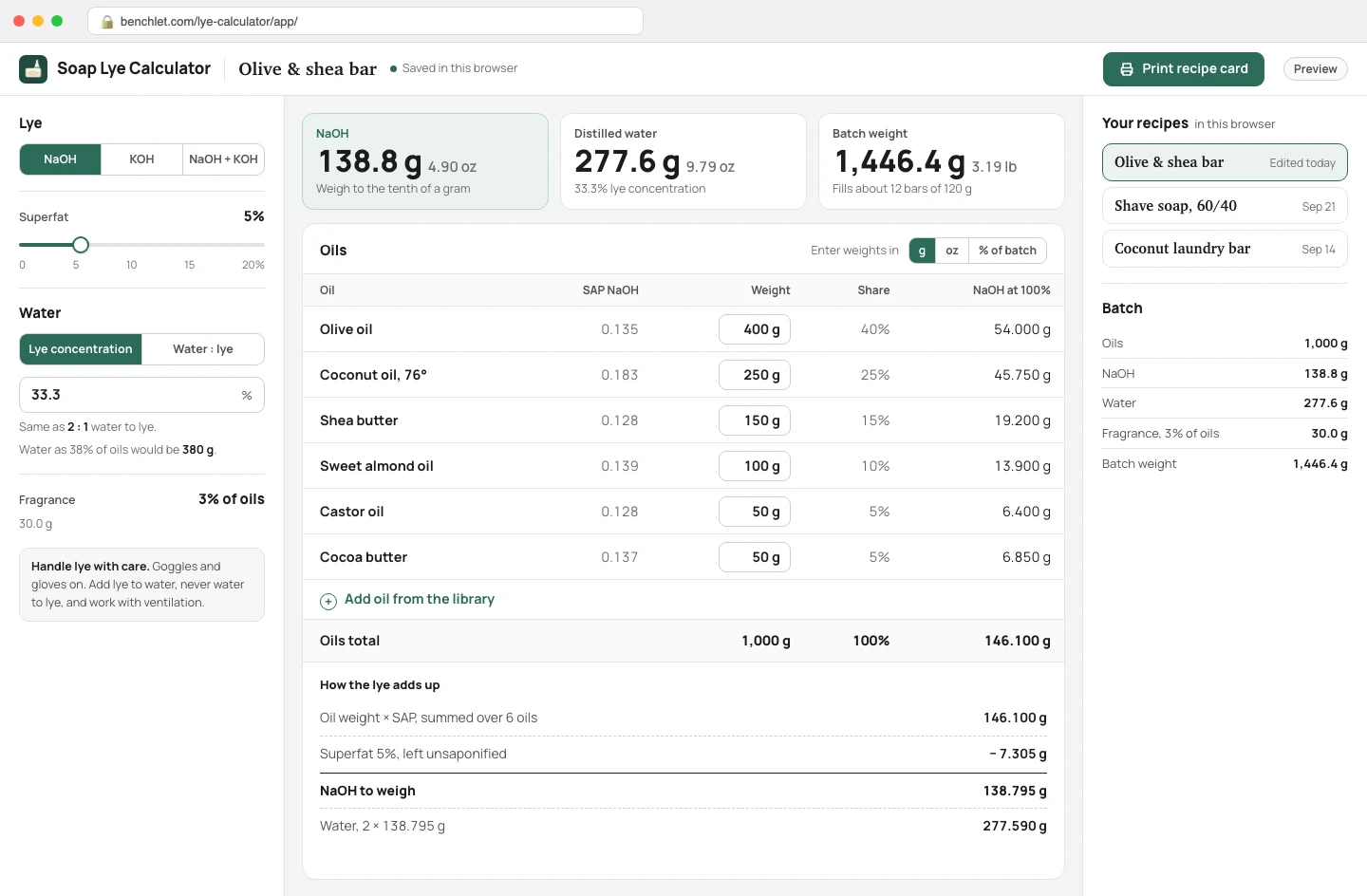
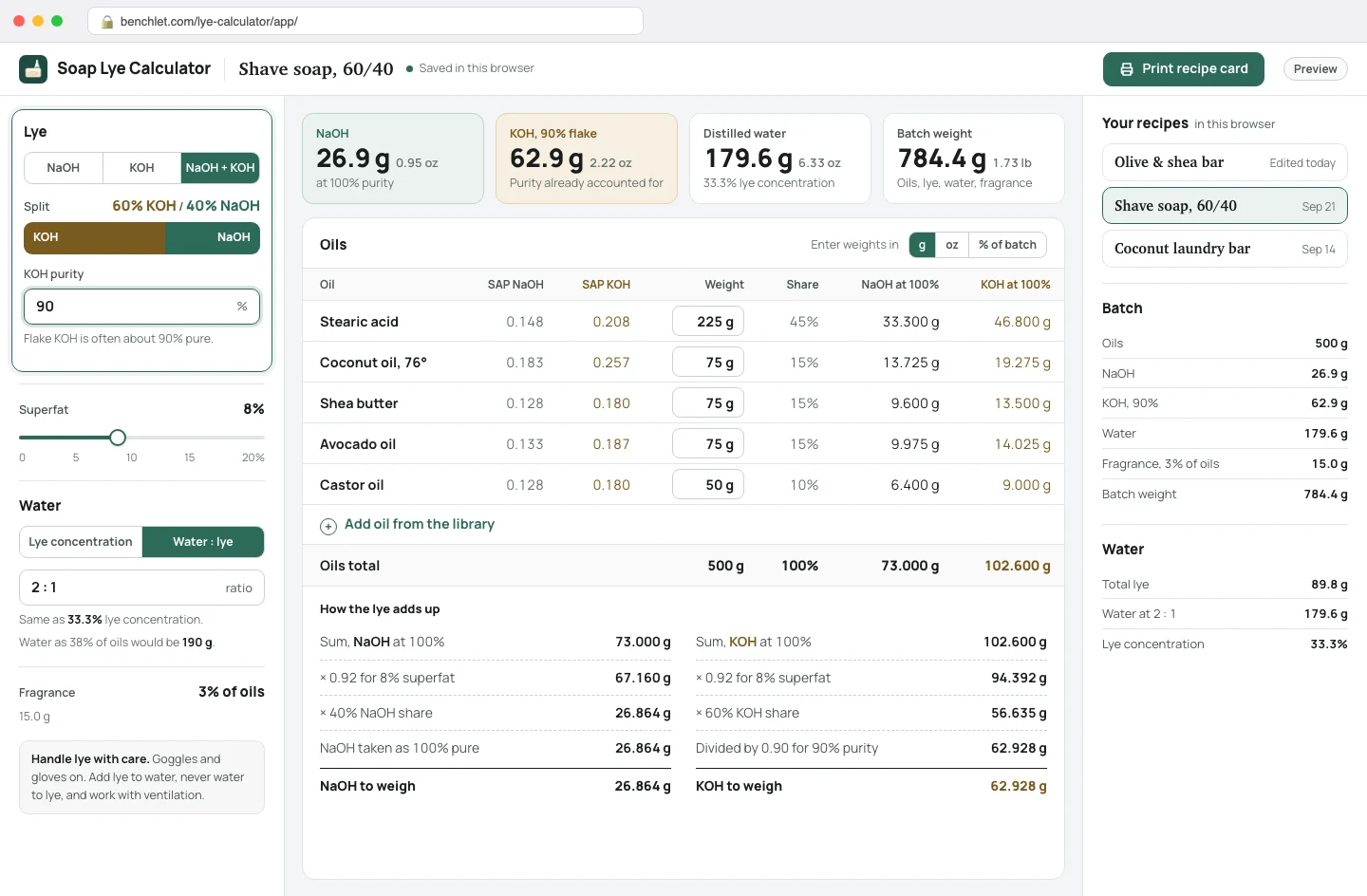
- Set the chemistry. Superfat (0 to 20 percent), lye type (NaOH, KOH, or a dual-lye ratio), KOH purity, and water as either lye concentration or water-to-lye ratio. Defaults are the community norms: 5 percent superfat, 33 percent lye concentration.
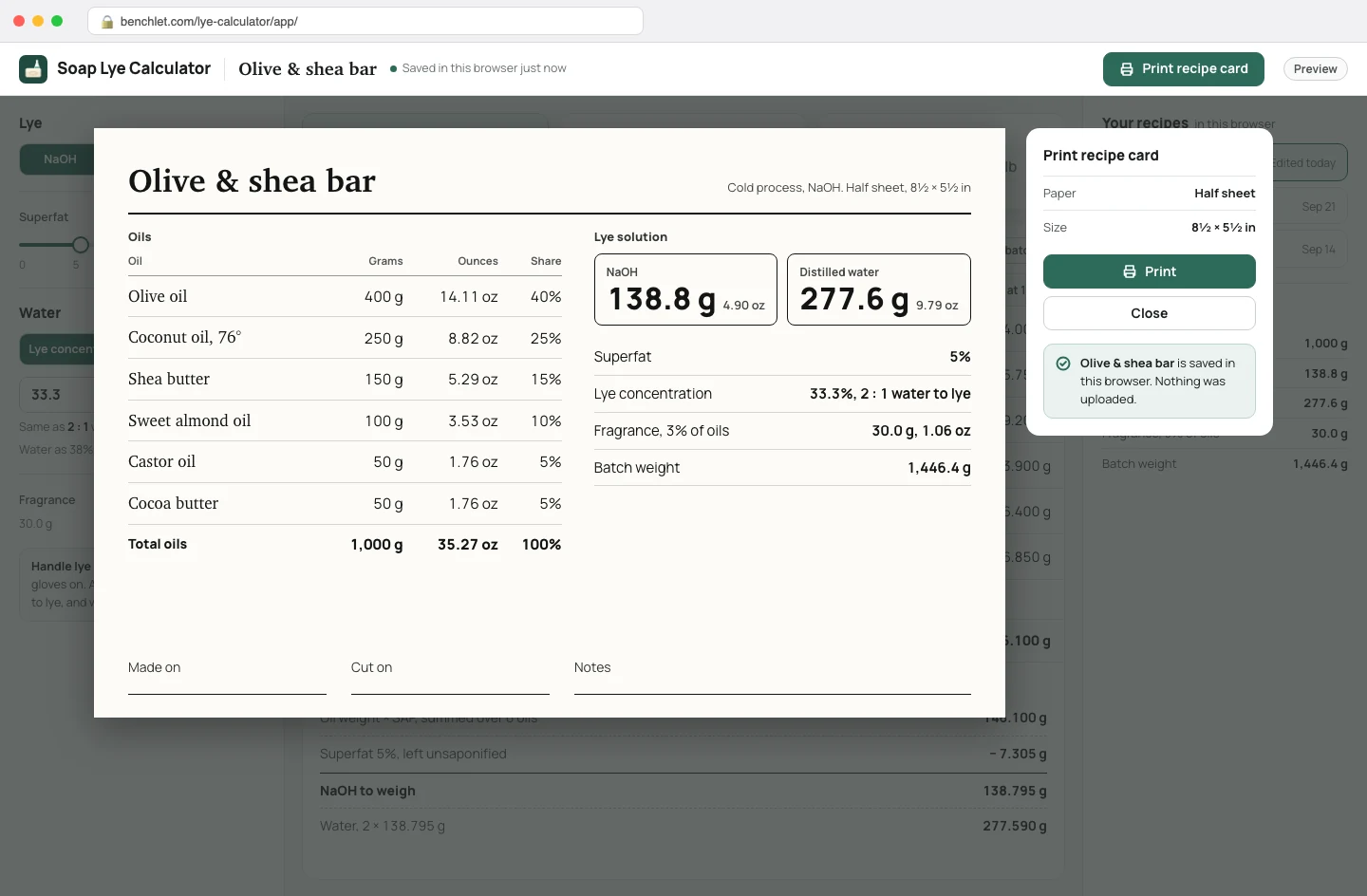
- Read it, print it, keep it. Lye and water amounts appear as you type, along with estimated batch yield. One click prints the recipe card; the recipe also saves in your browser, so nothing is uploaded and no account exists to lose.
The numbers underneath
The core formula is old and public: for each oil, lye needed equals oil weight times that oil's saponification value, summed across the recipe, then reduced by the superfat percentage. Coconut oil sits near the top of the SAP table (around 0.183 for NaOH) and luxury oils like jojoba near the bottom (around 0.069), which is why swapping oils without recalculating is how batches get ruined. Water is then derived from your chosen concentration — at 33 percent, water is twice the lye weight. The calculator shows its arithmetic per oil, so a suspicious number can be traced instead of trusted.
Frequently asked questions
How does dual-lye (NaOH + KOH) calculation work?
You set a ratio — shave-soap makers commonly run somewhere around 60/40 to 40/60 KOH to NaOH — and the calculator computes each hydroxide's share against each oil's own saponification value. KOH has a higher molecular weight than NaOH, so the same oil needs roughly 1.4 times as much of it; the calculator handles that conversion per oil, and also lets you set a purity for KOH, since commercial flake KOH is typically around 90 percent pure rather than the near-100 percent of NaOH.
What superfat should I use, and what does the number mean?
Superfat is the percentage of your oils deliberately left unsaponified — a safety margin against excess lye and a source of skin conditioning. Most bar soap makers work between 3 and 8 percent, with 5 percent the common default; 100 percent coconut oil bars often run 15 to 20 percent because coconut soap is so cleansing. Liquid soap is usually superfatted low, 0 to 3 percent, because free oils cloud the finished soap. You set any value from 0 to 20 and the lye amount adjusts.
How is the water amount decided?
Two interchangeable controls: lye concentration (grams of lye as a percentage of the lye-plus-water solution) or water-to-lye ratio. A 33 percent lye concentration is the same thing as a 2:1 water-to-lye ratio, and the calculator shows both numbers at once so recipes written either way translate. Old-style 'water as 38 percent of oils' is also displayed for comparison, since a lot of published recipes still use it.
What is on the printable recipe card?
Everything you need at the soap bench with gloves on: each oil with weight and percentage, the exact lye and water in grams and ounces, superfat, lye concentration, fragrance load if you set one, and blank lines for the dates you made and cut the batch. It prints on a half sheet so it fits a binder or tapes to the mold.
Is working with lye dangerous?
Sodium and potassium hydroxide are caustic and can burn skin and eyes; mixing them into water also releases heat fast. Wear goggles and gloves, always add lye to water (never water to lye), work with ventilation, and keep vinegar nearby for surfaces. This calculator gives you correct amounts, but safe handling is on you — if you are new, read a full cold-process safety guide before your first batch.
Sodium hydroxide and potassium hydroxide are corrosive. This page and the calculator provide measurement math, not safety training — use protective equipment, add lye to water, and follow a complete soap-making safety guide. Saponification values are averages; natural oils vary slightly by source, which is one reason superfat margins exist.