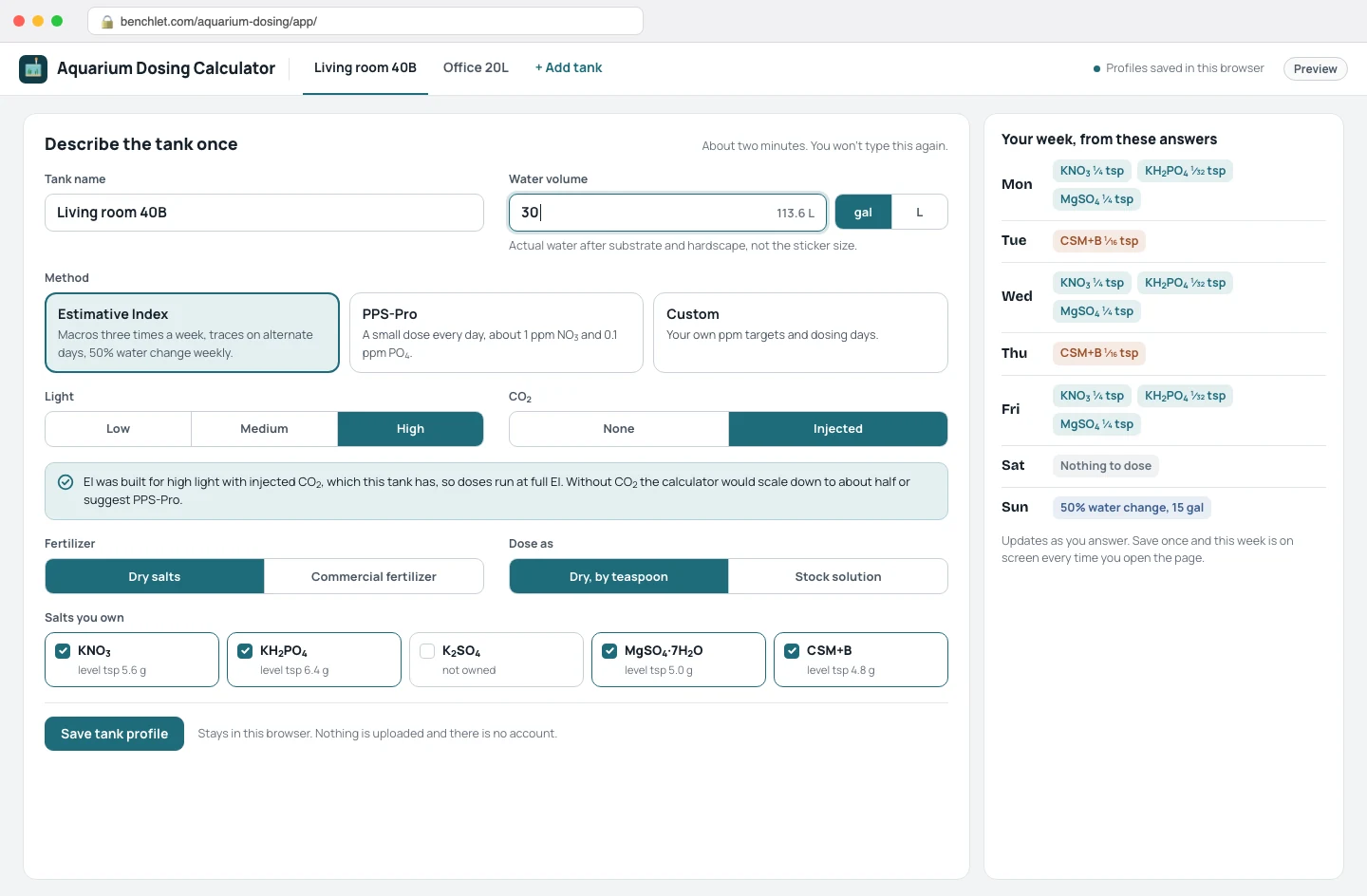
Describe the tank once
Water volume, method (EI, PPS-Pro, or custom), your salts or commercial fertilizer, dry or solution dosing, light and CO2 level. Takes about two minutes.
Planted tanks · for planted aquarium keepers

Aquarium Fertilizer Dosing Calculator converts EI or PPS-Pro nutrient targets into real doses — teaspoons of dry salts or milliliters of your stock solution — for your exact water volume. Your tank profile saves in the browser, so every visit after the first shows this week's schedule immediately. Free, no account, built for the phone next to the tank.
Water volume, method (EI, PPS-Pro, or custom), your salts or commercial fertilizer, dry or solution dosing, light and CO2 level. Takes about two minutes.
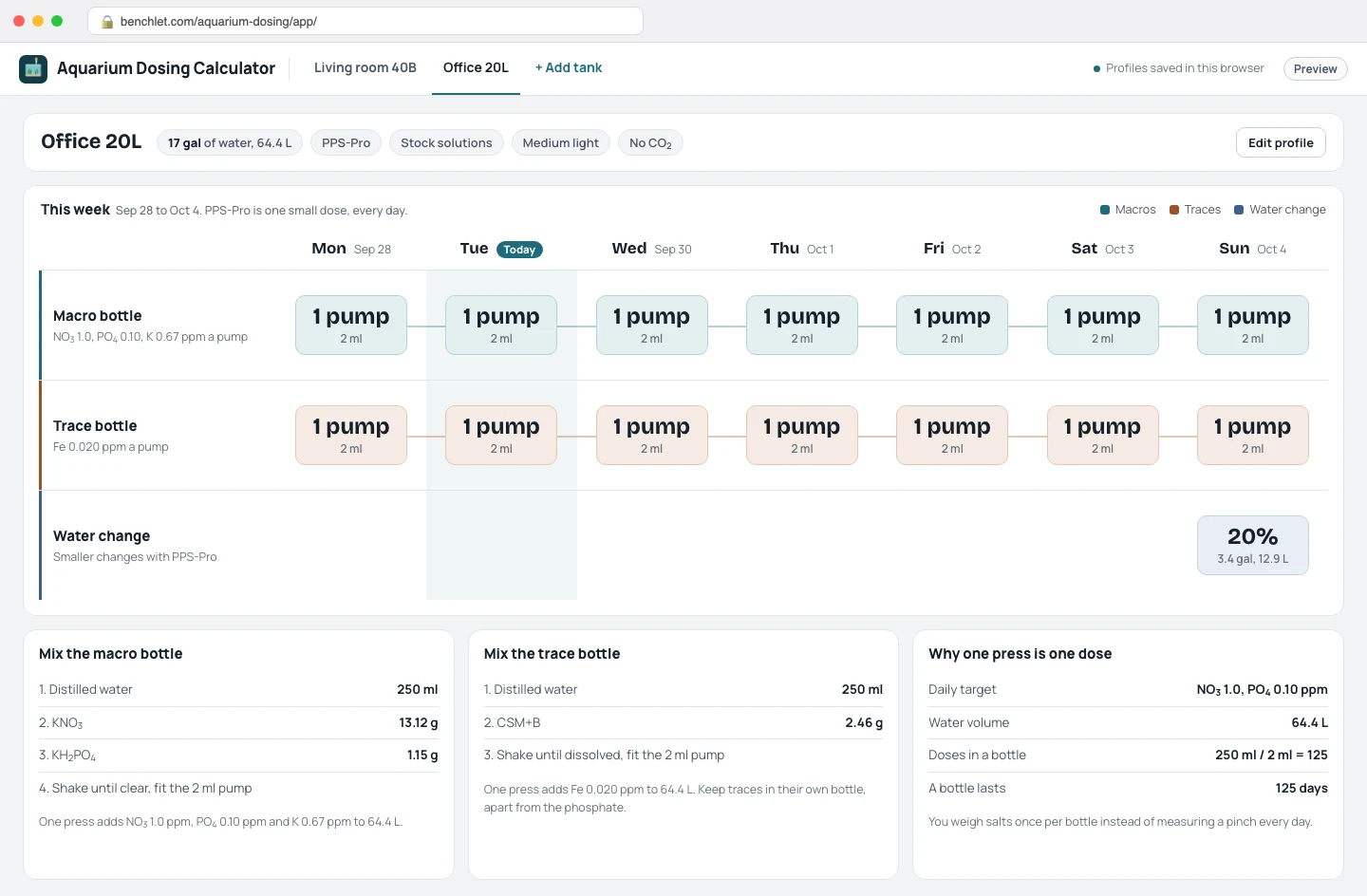
The calculator lays the doses on a day grid: macros Monday, Wednesday, Friday and traces Tuesday, Thursday under EI, or a single daily line under PPS-Pro. Each one is a concrete measurement for your tank.
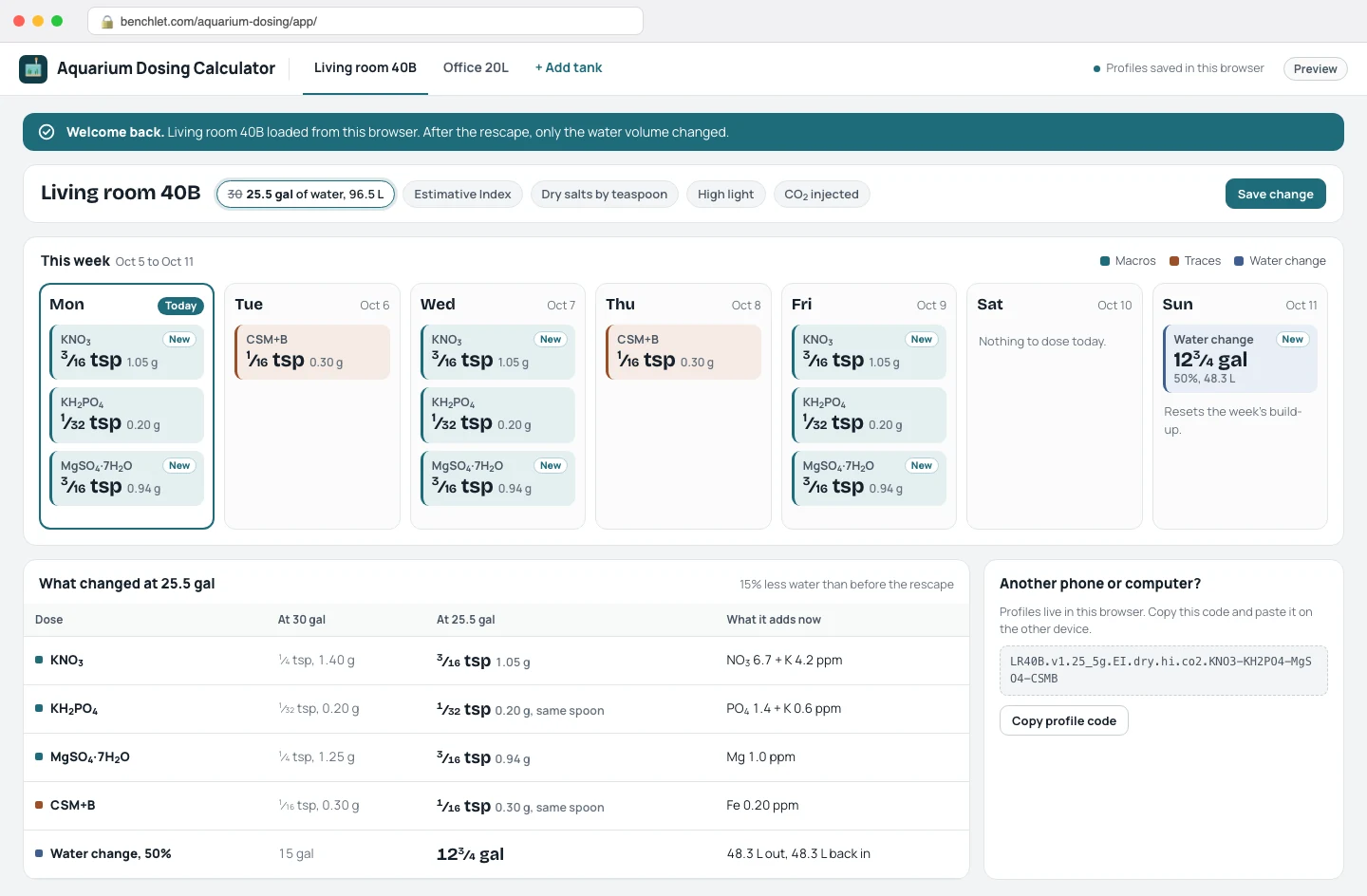
The profile is already loaded on the next visit. Change something real, like a rescape that ate 15 percent of your volume or a switch from dry salts to a DIY solution, and edit only that field.
Planted-tank fertilization is a solved science with unsolved tooling. The community's reference calculator has carried the hobby for years and its math is trusted — but it has sat in "beta" seemingly forever, renders poorly on the phone you actually hold over the tank, and forgets everything between visits. So the Sunday routine goes: reopen the site, re-enter tank volume, reselect the salt, reselect "EI low light", recompute the same 1/2 teaspoon you computed last Sunday. Hobbyists on the planted-tank forums describe keeping the results in Notes apps and taped-up index cards precisely because the calculator will not remember. A calculator whose inputs never change should not ask for them twice.
Estimative Index, popularized by Tom Barr, floods the tank with more nutrients than plants can use — typical macro dosing lands around 7 to 8 ppm of NO3 per dose, three times a week — and resets the water column with a 50 percent weekly water change. PPS-Pro takes the opposite bet: about 1 ppm NO3 and 0.1 ppm PO4 per day, every day, with smaller water changes. Both reduce to the same mechanics: a target in ppm, a tank volume, and a salt with a known nutrient fraction. That conversion — ppm target to grams to level-teaspoon fractions or pump squirts — is the entire job of this tool, done for your volume rather than the 10-gallon example in a forum sticky.
No calculator grows plants. EI in particular is an estimate by design — its author's point was that precision is unnecessary when excess is cheap and water changes cap the accumulation. So this tool refuses false precision: doses round to measurable fractions, the schedule tells you when the water change does the real work, and the low-tech warning is loud, because the fastest way to an algae farm is EI-level dosing over a tank with no CO2 and modest light. What it does promise is that the arithmetic between a published target and your teaspoon is correct, every week, with zero re-entry.
Estimative Index (EI) — macros three times a week, traces on alternate days, 50 percent weekly water change — and PPS-Pro, the leaner daily method targeting roughly 1 ppm NO3 and 0.1 ppm PO4 per day. You can also define a custom method with your own targets. The calculator converts targets into actual doses of the salts you own: KNO3, KH2PO4, K2SO4, MgSO4, and trace mixes like CSM+B, in teaspoons for dry dosing or milliliters for stock solutions.
Volume (actual water volume after substrate and hardscape, not the sticker gallons), the method you dose, which salts or commercial ferts you use, whether you dose dry or from solution, and your light and CO2 level. That is everything the math needs, which is why after the first setup you never enter it again — you open the page and this week's schedule is just there. Multiple tanks each get their own profile.
In your own browser's local storage, on your device. Nothing is uploaded and there is no account. The tradeoff is honest: clear your browser data or switch devices and the profile is gone, so the profile can also be exported as a small text code you can paste on another device.
Yes. Tell it your bottle size and pump or cap volume, and it computes how many grams of each salt to dissolve so that one squirt equals one dose for your tank. This is how most people escape weighing 1/16 teaspoon three times a week — you weigh once per bottle instead.
EI was designed around high light with CO2 injection, where plants consume nutrients fast; running full EI on a low-tech tank mostly feeds algae. The calculator asks about your light and CO2 and scales accordingly — low-tech tanks typically get a reduced EI (often around half doses at lower frequency) or PPS-Pro. It suggests a starting point, and the forums' universal advice still applies: watch the plants and adjust.
Pick the channel you use.